
TL;DR — Virtual CFO KPIs in one minute
• A KPI is a number that tells you if the business is healthy. A Virtual CFO watches a small, focused set — not fifty vanity metrics.
• Group them into five families: growth, cash, profitability, unit economics and risk. Each answers a different founder question.
• The three every founder should know cold: burn rate, runway and gross margin. They decide how long you survive and how well you scale.
• For SaaS and D2C, add CAC, LTV, LTV:CAC and the Rule of 40 to test whether growth is actually profitable.
• KPIs only earn their keep when someone acts on them. That is the real job of a Virtual CFO.
A Key Performance Indicator (KPI) is a single number that tells you whether the business is moving the right way. Revenue growth, cash burn, gross margin — each is a KPI. Together they turn a messy set of accounts into a clear scoreboard.
Hiring a full-time CFO in India can cost ₹50 lakh to ₹1 crore+ a year. A Virtual CFO gives you the same financial brain on a monthly retainer. But the value is not the person — it is the decisions their KPIs drive.
The point of a KPI is action. If a number goes red and nobody changes anything, it was never a KPI. It was just data.
 Founder tip: Do not track everything. Pick five to eight KPIs that map to your current goal — survival, growth or profitability — and review them on a fixed date every month.
Your profit-and-loss statement tells you what already happened. KPIs tell you what is about to happen and whether your strategy is working. That forward view is what founders and boards actually pay for.
A good KPI set does four things at once:
Gives visibility — you see performance without wading through ledgers.
Forces data-driven calls — you decide on real numbers, not gut feel.
Flags risk early — a dipping runway or margin shows up months before a crisis.
Tracks progress — every review measures the gap between plan and reality.
Founders often drown in metrics. A Virtual CFO groups them into five families, so every number has a clear job. This is the backbone of most MIS reports we build.
KPI family | Key metrics inside | The founder question it answers |
Growth | Revenue growth rate, MRR, YoY growth | Are we getting bigger, and how fast? |
Cash | Burn rate, runway, operating cash flow, working capital | How long can we survive? |
Profitability | Gross margin, EBITDA, net margin | Do we make money as we grow? |
Unit economics | CAC, LTV, LTV:CAC, payback period | Is each customer worth winning? |
Risk | Liquidity ratio, debt-to-equity, compliance metrics | What could break the business? |
Growth KPIs measure how fast your top line is expanding. They are the first thing an investor reads.
Revenue growth rate — the percentage rise in revenue over a period. Grow from ₹40 lakh to ₹50 lakh in a quarter and that is 25% quarterly growth.
Monthly Recurring Revenue (MRR) — predictable subscription revenue each month. The backbone metric for any SaaS business.
Year-over-year (YoY) growth — this year versus last, which strips out seasonal noise.
Growth alone is not enough, though. In 2026 the market rewards efficient growth, not growth at any cost. Median startup revenue growth has cooled to roughly 26% a year, down from the frothier days of 2021 and 2022, so profitability KPIs now sit right beside growth ones.
Cash flow is the lifeblood of a business. Profitable companies still die when the bank balance hits zero. These are the KPIs a Virtual CFO checks first.
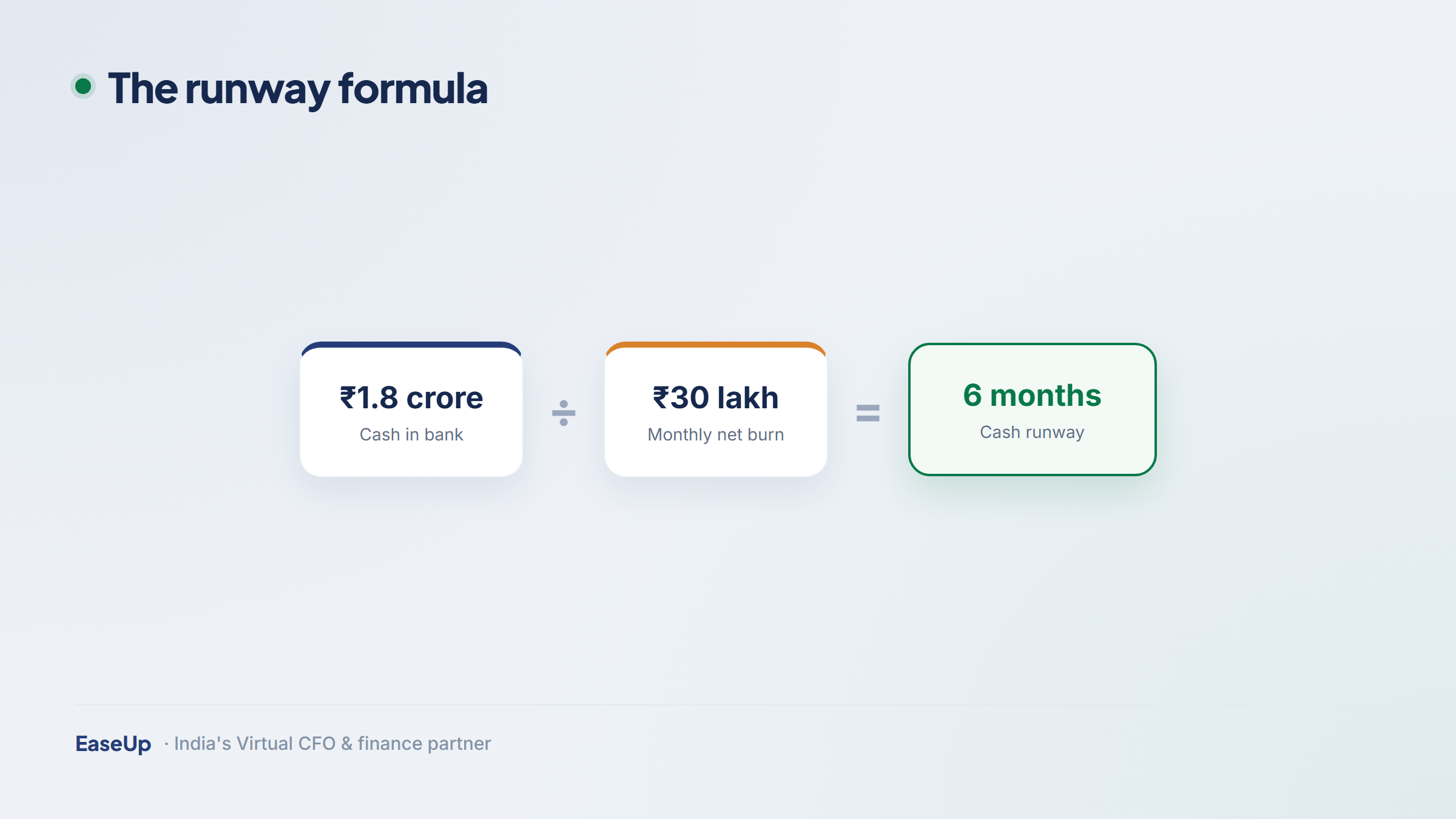
Say a startup holds ₹1.8 crore in the bank and spends ₹30 lakh more than it earns each month. Its net burn is ₹30 lakh, so its runway is (₹1.8 crore ÷ ₹30 lakh) = 6 months. Here is how the core cash KPIs work:
Cash KPI | What it measures | Simple example |
Operating cash flow | Cash generated by core operations | Positive means the business funds itself |
Cash burn rate | Net cash spent each month | ₹30 lakh net outflow per month |
Cash runway | Months of survival at current burn | ₹1.8 cr ÷ ₹30 lakh = 6 months |
Working capital | Current assets minus current liabilities | Short-term cushion to run day to day |
 Watch out: Runway targets have tightened. After the 2023-24 funding slowdown, seed-stage founders now aim for 9+ months of runway before a raise, up from six. Start fundraising when runway hits that mark, not when cash is nearly gone.
Growth without margin is a leaking bucket. Profitability KPIs show whether each rupee of revenue actually leaves money on the table.
Gross profit margin — revenue minus the direct cost of delivery, as a percentage. For SaaS, a healthy gross margin sits around 70-85%.
EBITDA — earnings before interest, tax, depreciation and amortisation. A clean read on core operating performance.
Net profit margin — what is left after every cost, including tax and interest. The final word on profitability.
Margins also decide your tax position and how your books read to lenders. Getting the classification of costs right is part of solid accounting and compliance. India follows the Ind AS framework notified by the Ministry of Corporate Affairs for how these figures are reported.
Unit economics answer one question: is a single customer worth more than it costs to win them? For any startup spending on marketing, this is the make-or-break KPI set.
CAC (Customer Acquisition Cost) — total sales and marketing spend divided by new customers won.
LTV (Lifetime Value) — the total profit you expect from a customer over the whole relationship.
LTV:CAC ratio — how many rupees of value each rupee of acquisition buys.
CAC payback period — the months it takes to earn back what you spent to win a customer.
Benchmarks give you a quick health read. Treat them as guides, not gospel — every stage and sector differs.
KPI | Healthy benchmark | Red flag |
Gross margin (SaaS) | 70-85% | Below 60% and falling |
LTV:CAC ratio | 3:1 to 5:1 | Below 1:1 — you lose money per customer |
CAC payback | Under 12-18 months | Over 24 months |
Net revenue retention | 100% or higher | Below 90% |
Capital structure is how you fund the business — the mix of debt and equity. A Virtual CFO tracks it so financing stays cheap and low-risk.
Debt-to-equity ratio — total debt divided by shareholder equity. It shows how leveraged you are.
Cost of capital — the blended rate you pay to fund operations. It rises and falls with lending rates.
Equity dilution — how much ownership founders give up with each round.
Debt is not free money, and rates move with the RBI policy cycle. You can track the current repo rate and lending environment on the Reserve Bank of India website before you take on a working-capital loan.
Some KPIs exist to warn you before something breaks. A Virtual CFO uses them to keep the business out of trouble.
Liquidity ratio — can you cover short-term dues? A current ratio near 1.5-2 is usually comfortable.
Financial leverage — how much debt sits against equity, and whether it is safe.
Compliance metrics — are GST returns, TDS and ROC filings on time? Missed deadlines mean penalties.
:info: Compliance is a KPI too: Late statutory filings quietly drain cash through interest and penalties. Many founders forget that an on-time filing record is a real financial KPI. India-recognised startups can also check benefits on the Startup India portal.
Beyond day-to-day numbers, a Virtual CFO tests the big decisions. Strategic KPIs measure whether your plans are working.
ROI (Return on Investment) — the profit a project or campaign returns for every rupee put in.
Budget variance — the gap between what you planned to spend and what you actually spent.
Forecast accuracy — how close your projections land to reality. Poor accuracy erodes board trust fast.
These KPIs keep spending honest. A widening budget variance is often the first sign that a growth plan has drifted off course.
Single KPIs can mislead. Blended scores combine two into one health signal. The most famous is the Rule of 40.
It says a healthy software business should have its revenue growth rate plus profit margin add up to 40% or more. Grow 30% while running at a 15% margin and you score 45 — a strong, balanced business. Grow fast but burn heavily and the score exposes it.
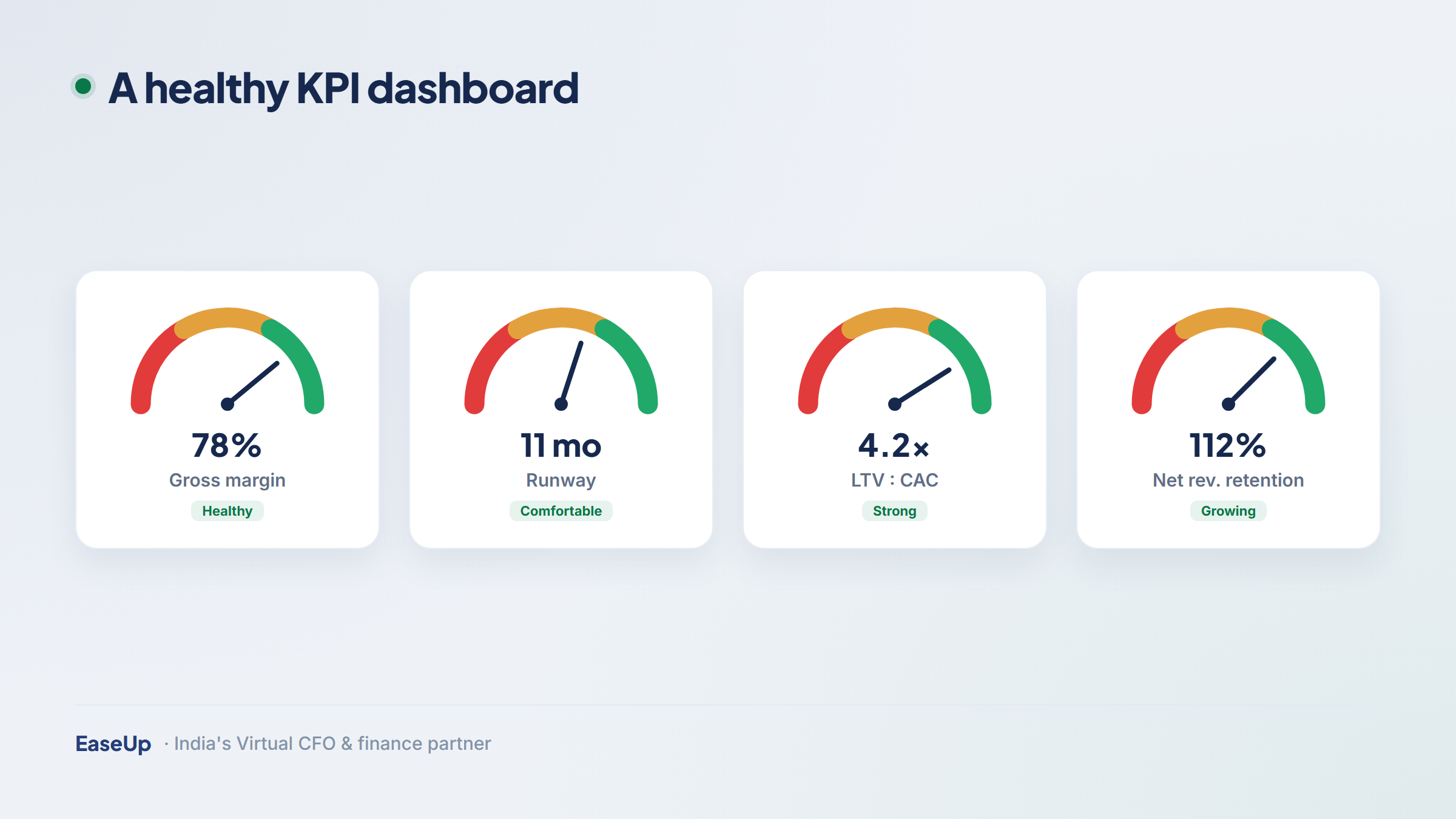
A Virtual CFO reads several KPIs together like this dashboard. One green dial does not mean a healthy business — but four usually do.
More KPIs are not better. A founder who tracks forty numbers acts on none of them. The right count depends on your stage.
Stage | Focus KPIs | Why |
Early / pre-revenue | Burn, runway, cash flow | Survival is the only goal |
Growth | MRR, CAC, LTV:CAC, gross margin | Prove the model scales profitably |
Scale / pre-IPO | Rule of 40, EBITDA, net margin, NRR | Board and investor readiness |
Founder tip: Put your top KPIs on one page and review them on the same date each month. A dashboard nobody opens is worse than no dashboard at all.
Chasing vanity metrics — app downloads or signups that never turn into revenue.
Tracking too many numbers — so no single KPI ever drives a decision.
Ignoring cash for growth — celebrating revenue while runway quietly shrinks.
No benchmarks — a KPI with no target or peer comparison is just trivia.
Reviewing late — reading last quarter’s numbers cannot fix this quarter’s problem.
Anyone can pull a number. The value of a Virtual CFO is reading KPIs together and knowing what to do next. A dipping margin plus a rising CAC is not two problems — it is one story about pricing.
At EaseUp, we build the dashboard, set the benchmarks, and sit in the monthly review so every red number gets a plan. That is the difference between tracking KPIs and actually running on them.
The three every founder should know are burn rate, runway and gross margin, because they decide how long the business survives and how well it scales. Beyond those, the key KPIs depend on your stage: cash flow for early startups, and CAC, LTV and the Rule of 40 as you grow.
After the 2023-24 funding slowdown, seed-stage Indian startups typically aim for at least 9 months of runway before starting a fundraise, up from the earlier six-month norm. Growth-stage companies often keep around six months. Runway is your cash in bank divided by your monthly net burn.
A healthy LTV:CAC ratio sits between 3:1 and 5:1, meaning each rupee spent on acquiring a customer returns three to five rupees of lifetime value. Below 1:1 you lose money on every customer. Much above 5:1 can signal you are underspending on growth.
The Rule of 40 says a healthy software business should have its revenue growth rate plus its profit margin add up to 40% or more. For example, 30% growth with a 15% margin gives a score of 45. It is a quick way to balance growth against profitability in a single number.
Most small businesses do best with five to eight focused KPIs, not forty. Early-stage companies should watch burn, runway and cash flow. Growth-stage companies add MRR, CAC, LTV:CAC and gross margin. The goal is a set small enough that every number actually drives a decision.
This guide is for general information only and does not constitute financial, tax or investment advice. KPI benchmarks vary by stage, sector and business model — confirm the right targets for your company with a qualified professional before you act.


Your trusted partner for all your Financial needs.


Finance Management
Strategic Services