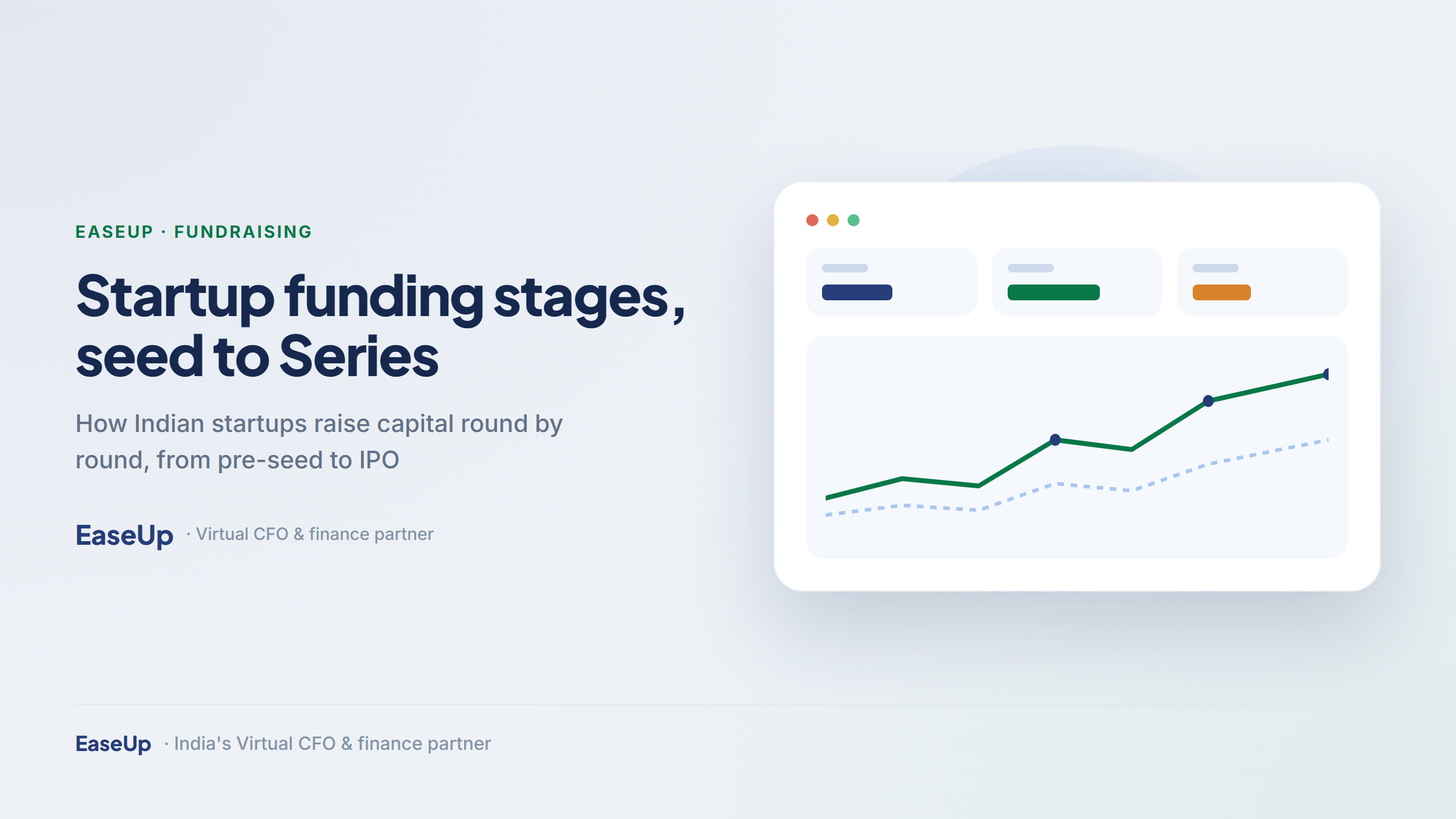
TL;DR — startup funding rounds in one minute
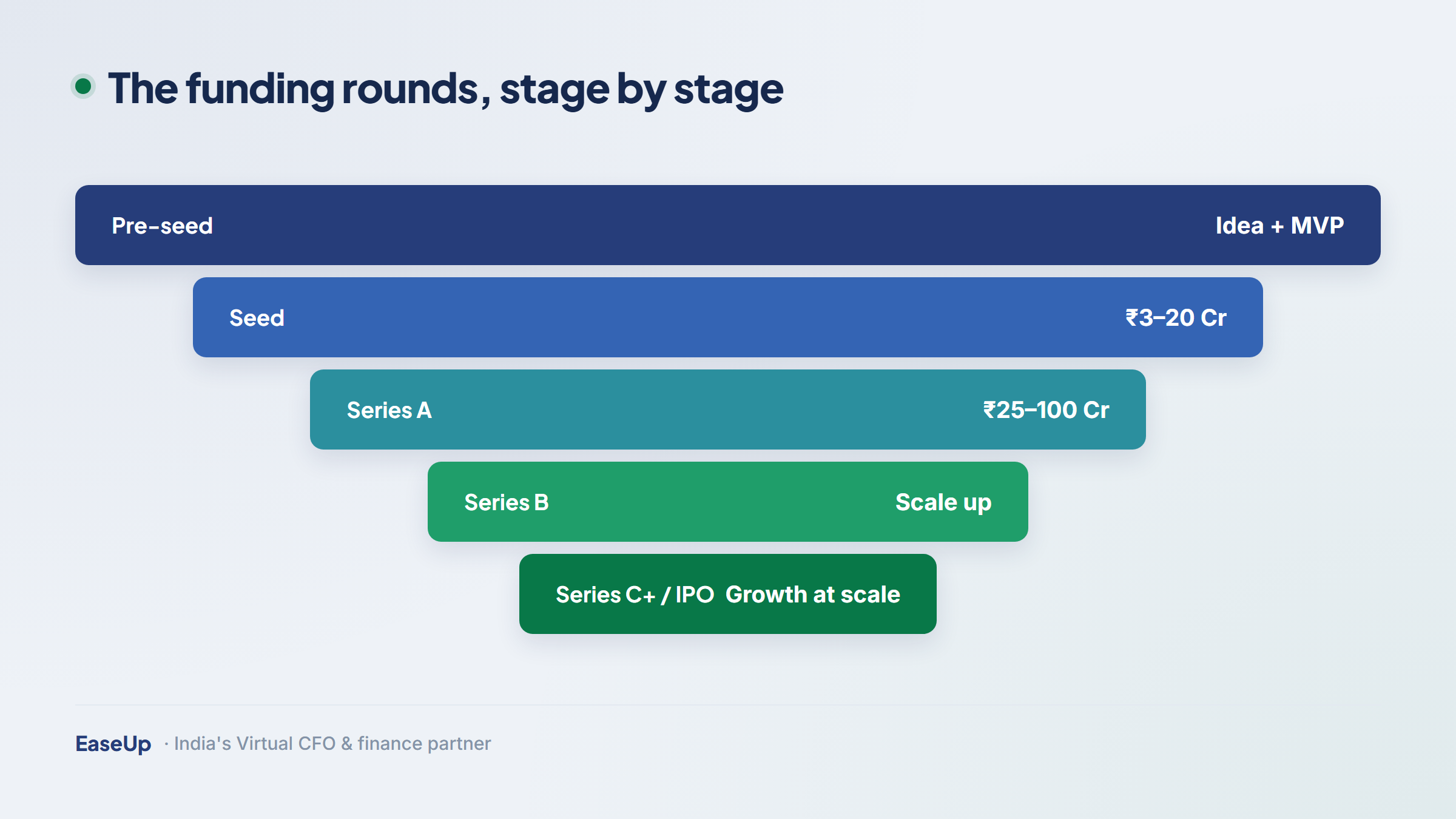
• Startups raise in stages — pre-seed, seed, Series A, B, C and beyond — so capital matches the risk and milestones at each point.
• An Indian seed round in 2026 is typically ₹3–20 crore for 15–25% equity; Series A is often ₹25–100 crore+ at 18–25% dilution.
• Each round has a job: seed proves execution, Series A proves repeatable growth, Series B/C scale it. Raise for the next milestone, not for the biggest headline.
• DPIIT-recognised startups can tap the Startup India Seed Fund Scheme (SISFS) — up to ₹20 lakh grant plus up to ₹50 lakh for market entry, and it is non-dilutive.
• Deals close on clean books and diligence-ready compliance. Messy accounting or a missing PAS-3 or FC-GPR filing is where rounds stall.
Raising capital is not a one-time event. For most venture-backed startups it is a sequence of rounds, and each round is designed for a different level of growth. Early on, you are proving the problem is real. Later, you need cash to hire, scale distribution, enter new markets and prepare for a bigger exit.
Staged funding matters because it protects you. You raise only what you need to hit the next milestone, then raise again at a higher valuation once the risk has dropped. Raise everything upfront and you dilute far more than you need to. Match the money to the moment instead.
 Founder tip: Before you raise, write down the one milestone this round must buy — product-market fit, ₹1 crore ARR, a second city. That milestone sets how much you raise and what you promise investors.
Rounds are not defined only by name. They differ in company stage, the job of the capital, and what investors expect before they write a cheque.
Stage | Typical company | What the capital is for | What investors expect |
Pre-seed | Idea or early prototype | Build an MVP, validate the market | Founder quality, a real problem, early signals |
Seed | Early product, first traction | Launch, hire a core team, refine go-to-market | Early users or revenue, a credible market |
Series A | Product-market fit emerging | Scale product, sales and operations | Repeatable growth, retention, clearer economics |
Series B | Established early growth | Expand team, channels and markets | Proven traction, a scalable model |
Series C+ | Growth at scale | New markets, acquisitions, IPO prep | Operational maturity, strong market position |
Pre-seed is the earliest capital, often raised before the product is finished. You are validating the problem, building an MVP and gathering the first customer feedback. Revenue is usually zero and uncertainty is high.
Money here comes from founder savings, friends and family, angels and early accelerators. Investors are betting on you and the opportunity, not on historical numbers. Show why this team is right for this problem and how fast you can learn.
Seed is typically the first formal round of outside capital. By now you usually have a concrete product, a small team and some early traction. In India in 2026, a seed round commonly ranges from ₹3 crore to ₹20 crore, in exchange for 15–25% of your company, at a pre-money valuation often in the ₹18–35 crore band.
Seed capital is spent on the product, the first core hires, initial customer-acquisition channels and testing pricing. Investors are no longer betting on a slide deck — they expect a working MVP, early waitlists or paying pilot customers. Seed is not free money; every rupee costs ownership, so raise what reaches your next milestone and no more. Over-raising here quietly dilutes founders before the company even scales.
 Watch out: Diligence kills more seed deals than valuation does. Investors audit your GST records, financial history and founder agreements. Messy bookkeeping or a gap in filings can sink a term sheet you have already signed. Get diligence-ready before you pitch.
The founders who close in six weeks instead of six months are simply better prepared. Before you knock on doors, get five things in order:
Validate the problem — talk to 50+ potential customers and describe the pain in their words, with data and objections you have already heard.
Show traction — even ₹5–15 lakh in monthly revenue, active users with retention, or signed pilots. Investors want momentum, not perfection.
Size the market — build a bottom-up TAM (customers × annual value) so your numbers survive hard questions.
Build the deck — a tight 10–12 slide story: problem, solution, traction, market, team, ask and use of funds.
Clean the numbers — a realistic financial model and monthly accounting so diligence is a formality, not a fire drill.
If your operating data is still fragmented, tightening your reporting is part of fundraising, not a back-office afterthought. Early fundraise preparation is what turns a promising idea into an investable one.
The Startup India Seed Fund Scheme (SISFS) is the most founder-friendly capital available because it does not cost you equity. If you are a DPIIT-recognised startup incorporated less than two years ago, with at least 51% Indian shareholding and under ₹10 lakh of prior government support, you may be eligible.
SISFS component | Amount | Purpose |
Grant | Up to ₹20 lakh | Proof of concept, prototype and product trials |
Debt / convertible | Up to ₹50 lakh | Market entry, commercialisation and scale-up |
You do not apply to the government directly — funds go through DPIIT-approved incubators, and you can apply to up to three in preference order. The process runs several weeks and demands 100% accurate accounting and compliance. A single delay in GST or ROC filings can trigger rejection. Check eligibility and apply on the Startup India Seed Fund portal.
Series A is where investors expect more than promise. You are past pure experimentation, with product-market fit emerging and early revenue. In India, Series A rounds often run ₹25 crore to ₹100 crore or more, for 18–25% dilution, at pre-money valuations frequently in the ₹80–300 crore range.
The capital scales what already works: product, sales, marketing and operations. Investors underwrite retention, unit economics and a believable path to scale. If your raise leans heavily on valuation, understand how investors will pressure-test your assumptions — a defensible business valuation helps you hold your number.
By Series B the model is proven and the question shifts from "does this work?" to "how big can it get?" Capital expands the team, adds channels and pushes into new markets and segments. Investors expect a scalable model, a stronger revenue base and the operational controls to deploy larger cheques well.
In 2026, growth-stage capital has rotated toward the middle of the funnel — money that once chased late-stage mega-rounds is landing in Series B and C companies that have a proven model but a reasonable valuation. That is good news if your fundamentals are clean.
Series C and beyond fund growth at scale: new geographies, acquisitions, product expansion and bridges to an IPO. Investors here want operational maturity, a strong market position and public-market-grade governance and reporting.
An IPO or major exit is the far end of the journey — public capital, liquidity for early backers, and a much higher bar on disclosure and controls. Not every startup should or will reach it, and that is fine. The discipline you build round by round is what makes any exit possible.
Every raise gives away a slice of the pie. In a standard Indian seed round, median dilution sits around 19–20%. But founders often forget the ESOP pool — shares set aside for employees, usually carved out before the investor puts money in, so the founders absorb it.
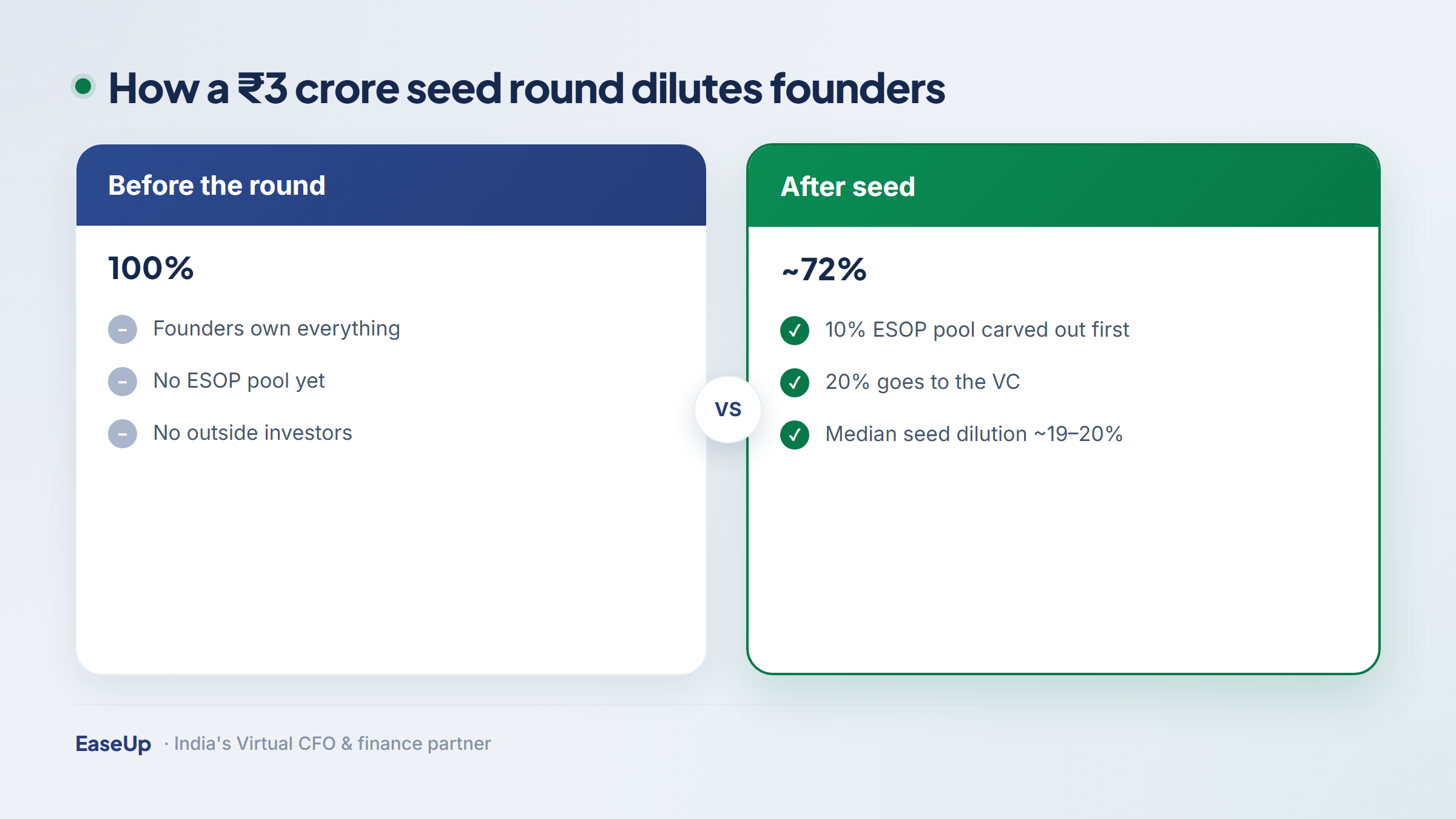
Worked example on a ₹3 crore raise: founders start at 100%. Carve out a 10% ESOP pool and they hold 90%. A VC then takes 20% of the whole company, so their 90% is reduced by that dilution to roughly 72%. Model this before you sign — a virtual CFO can run the scenarios so you do not give away control too early.
A term sheet is about control as much as valuation. These five clauses matter most:
Pre-money vs post-money: pre-money is your worth before the cash; post-money adds it. Always confirm which, or you dilute by accident.
Liquidation preference: "1x non-participating" is the founder-friendly standard — investors get their money back first but do not double-dip.
Founder vesting: investors expect founders to earn shares over about four years. Leave early and you forfeit part of your equity.
Anti-dilution: protects investors if you raise a lower round next. Push for "broad-based weighted average", the mildest version.
Board control: do not give up majority board control at seed. A 3-person board with 2 founders and 1 investor is typical.
Founder tip: Read the term sheet with a lawyer, but negotiate the economics and control clauses yourself. Understanding liquidation preference and board seats is not optional — these terms follow you into every future round.
Closing a round in India is a marathon, usually four to six months from first meeting to money in the bank. The typical flow:
Pitch and term sheet — you present, the investor issues a non-binding term sheet pricing your shares.
Due diligence — their team audits your financials, GST records and founder agreements. Most deals wobble here.
Definitive agreements — lawyers draft the SHA (Shareholders Agreement) and SSA (Share Subscription Agreement).
Closing and filings — pass a board resolution, allot shares and file Form PAS-3 with the ROC on time.
FEMA compliance — for foreign investment, file Form FC-GPR with the RBI within 30 days to avoid heavy penalties.
The work does not end when the balance jumps. Indian rules are strict about new capital, and slipping up can cost you dearly:
Valuation report: A Registered Valuer report supports your share price for a preferential allotment under Section 62(1)(c) of the Companies Act, and — if you have any foreign investors — a fair-value certificate is required under FEMA pricing rules.
Statutory registers: update your Register of Members and Register of Directors at your registered office right away.
ROC filings: file Form PAS-3 (Return of Allotment) on time; a missed deadline invites penalties and diligence red flags.
FEMA reporting: foreign money means an FC-GPR filing with the RBI within the statutory window.
You can access allotment forms on the Ministry of Corporate Affairs portal, check FEMA reporting rules on the Reserve Bank of India site, and confirm valuation rules on the Income Tax Department portal.
Fundraising touches strategy, finance, tax and law at once. If you are modelling dilution, prepping diligence, or negotiating a term sheet, expert help avoids expensive mistakes. Beyond equity, if you are weighing a debt line alongside the round, preparing for a business loan early keeps your options open. A finance partner brings cap-table discipline, valuation inputs and board-reporting rigour so you raise on your terms.
The common stages are pre-seed, seed, Series A, Series B, Series C and beyond, and finally an IPO or major exit. Pre-seed builds an MVP, seed proves early execution, Series A proves repeatable growth, and Series B and C scale the business. Each round raises capital that matches the company's risk and milestones at that point.
An Indian seed round in 2026 commonly ranges from about ₹3 crore to ₹20 crore, raised in exchange for roughly 15% to 25% of the company, at a pre-money valuation often between ₹18 crore and ₹35 crore. The exact numbers depend heavily on your sector, traction and how competitive the round is.
Seed funding launches the product and hires the first core team, and investors accept early traction and a credible market. Series A is larger, often ₹25 crore to ₹100 crore or more, and investors expect proof of repeatable growth, strong retention and clearer unit economics. Seed proves the idea can execute; Series A proves it can scale.
Yes. The Startup India Seed Fund Scheme (SISFS) offers up to ₹20 lakh as a grant for proof of concept and up to ₹50 lakh as debt or convertible support for market entry. You must be a DPIIT-recognised startup incorporated within the last two years, and you apply through DPIIT-approved incubators rather than to the government directly.
Median dilution in an Indian seed round is around 19% to 20%, but the ESOP pool adds to it. If you carve out a 10% employee pool and then a VC takes 20% of the company, founders can drop from 100% to roughly 72%. Modelling the cap table before you sign helps you avoid giving away too much control too early.
This guide is for general information only and does not constitute financial, tax or legal advice. Funding norms, valuations and statutory rules change — confirm the current position with a qualified professional before you raise or file.

Your trusted partner for all your Financial needs.


Finance Management
Strategic Services