TL;DR — SFT filing in one minute
• An SFT (Statement of Financial Transactions) is how specified entities report prescribed high-value transactions to the Income Tax Department under Section 285BA.
• It is filed in Form 61A (most reporting persons) or Form 61B (reportable accounts under FATCA/CRS), electronically with a digital signature.
• The deadline is 31 May of the financial year following the year of the transaction.
• Miss it and Section 271FA charges ₹500 per day, rising to ₹1,000 per day after a notice. Inaccurate data can attract ₹50,000 under Section 271FAA.
• Clean books and reconciled data make SFT a routine filing rather than a year-end scramble.
An SFT — Statement of Financial Transactions — is a report that certain specified entities must send to the Income Tax Department. It lists high-value financial transactions they registered, recorded or maintained during the year.
The idea is simple. The tax department wants a clear picture of big-ticket money movement — large cash deposits, property deals, bond purchases and the like. So it asks the banks, registrars and businesses that handle those transactions to report them directly.
If your organisation records reportable activity, you must file the statement in the prescribed form, by the deadline, in the correct electronic format. The legal hook is Section 285BA of the Income Tax Act, 1961, with the detailed rules in Rule 114E. You can read the department’s own overview on the Income Tax SFT page.
 Founder tip: SFT is a reporting obligation, not a tax payment. You are not paying anything extra — you are just telling the department what already happened. Treat it as a data-quality exercise and it stops feeling scary.
SFT is more than a box-ticking chore. For the system, it improves transparency and helps the department match what you report against what shows up elsewhere. For your business, it signals strong internal controls.
Transparency: authorities get a reliable view of high-value transactions across the economy.
Fewer surprises: accurate reporting reduces the chance of a mismatch notice landing later.
Better governance: timely, reconciled filing reflects tidy books and disciplined processes.
Lower risk: non-reporting or under-reporting is exactly what triggers scrutiny and penalties.
SFT applies to specified reporting persons listed under Rule 114E — not to every business. The obligation attaches to the type of entity and the kind of transaction it handles. Common reporting persons include:
Reporting person | Typical transactions reported |
Banks & co-op banks | Large cash deposits, withdrawals, demand drafts and term deposits |
Companies issuing shares/bonds | Receipts for shares, debentures, bonds and buy-backs |
Registrar / Sub-Registrar | Purchase or sale of immovable property |
Persons liable to tax audit (Sec 44AB) | Cash receipts above the prescribed limit for sale of goods or services |
Credit card issuers | High-value credit card bill payments |
Post offices, NBFCs, mutual funds | Deposits, bonds and unit purchases above thresholds |
If your business is under a tax audit, it is worth checking whether your cash receipts cross the reporting line for the year.
Rule 114E sets a monetary threshold for each category. Below the line, no reporting. On or above it, the transaction goes into the SFT. The department also aggregates transactions of the same nature for a person across the year, so several smaller deposits can add up past the limit.
Transaction | Reporting threshold (aggregate/year) |
Cash deposits in savings accounts | ₹10 lakh or more |
Cash deposits/withdrawals in current accounts | ₹50 lakh or more |
Fixed / term deposits (other than renewals) | ₹10 lakh or more |
Credit card bill paid in cash | ₹1 lakh or more |
Credit card bill paid by any mode | ₹10 lakh or more |
Purchase of shares, bonds or debentures | ₹10 lakh or more |
Purchase or sale of immovable property | ₹30 lakh or more |
 Watch out: The thresholds are aggregated per person, per category. Two savings accounts in the same bank with ₹6 lakh and ₹5 lakh become ₹11 lakh combined — over the ₹10 lakh limit and reportable. Do not assume a single small transaction keeps you out of scope.
At the statute level, Section 285BA describes broad classes of reportable activity. Rule 114E then pins down the exact amounts. The broad legal categories are:
Property & rights: purchase, sale or exchange of goods, property, or any right or interest in property.
Services: transactions for rendering services above prescribed limits.
Works contracts: specified transactions under a works contract.
Investment & expenditure: transactions involving investment made or expenditure incurred.
Loans & deposits: accepting deposits or taking/repaying loans above the limit.
Because the statute is deliberately broad, the practical test is always the Rule 114E threshold that fits your entity and transaction type.
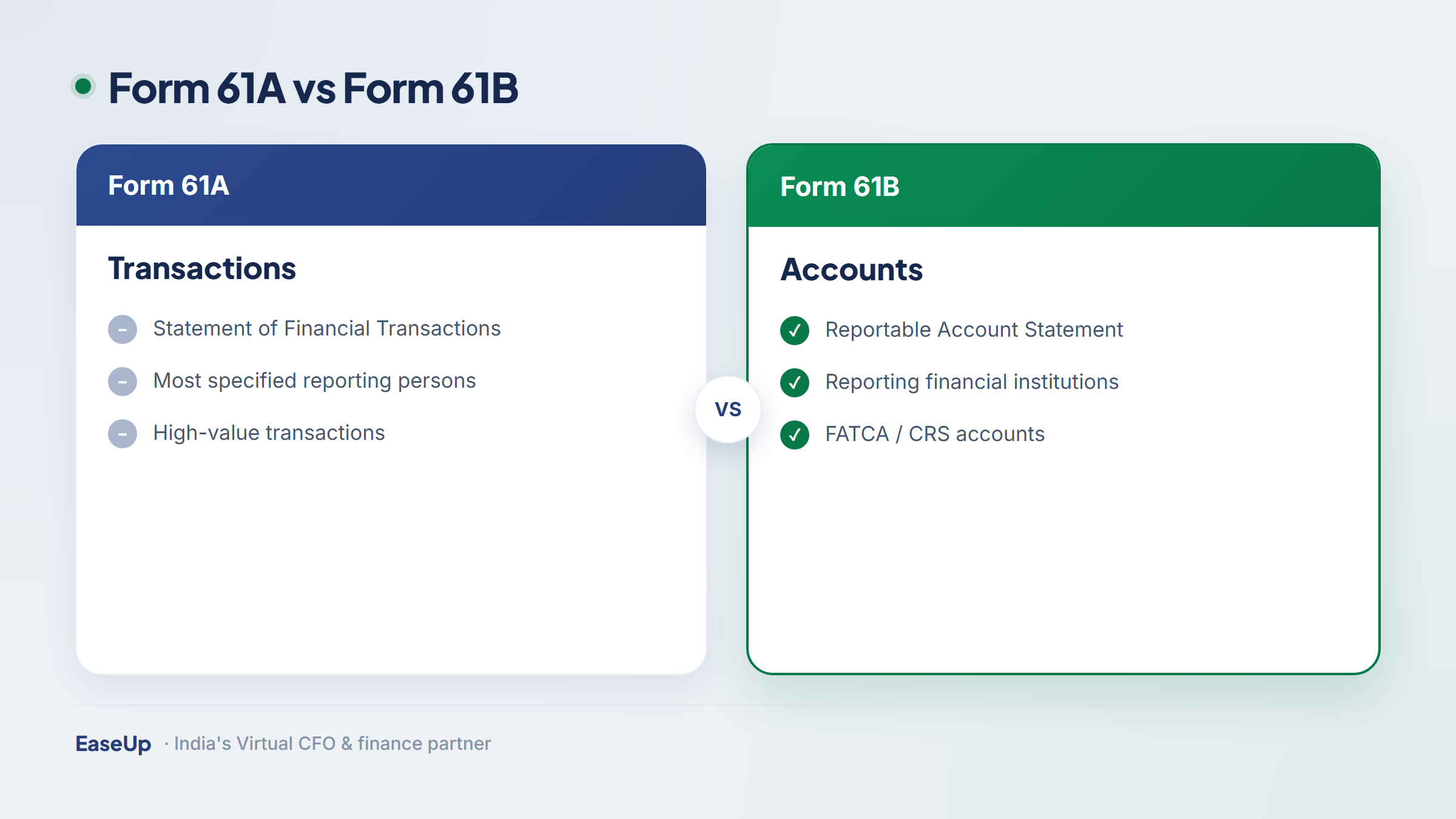
Two forms handle two different jobs. Picking the wrong one is a common — and avoidable — filing defect.
Form | Used by | Reporting focus |
Form 61A | Most specified reporting persons | Statement of high-value financial transactions |
Form 61B | Prescribed reporting financial institutions | Reportable accounts under FATCA / CRS |
In short: Form 61A reports transactions; Form 61B reports accounts. Businesses most often deal with Form 61A. Identifying the right form early keeps your accounting and compliance calendar clean.
SFT is furnished electronically, usually with a digital signature, through the reporting portal of the Income Tax Department. Before you hit submit, run through this checklist:
Register the reporting entity — obtain the ITDREIN (Income Tax Department Reporting Entity Identification Number) and register the principal officer.
Confirm the correct form — Form 61A or 61B, based on what you report.
Reconcile the data — match reportable transactions against your books and remove duplicates.
Validate the file — use the department’s utility to check the format before upload.
Sign and submit — upload with a valid digital signature and save the acknowledgement.
Register and file through the official Income Tax e-filing portal. If your books are already reconciled monthly, this step takes hours, not weeks.
Founder tip: Even if you have nothing reportable in a year, some entities file a preliminary response (a nil / no-transaction statement) to close the loop. When in doubt, confirm your status rather than staying silent.
The core deadline is easy to remember: 31 May. The reporting period just differs slightly between the two forms.
Form | Reporting period | Due date |
Form 61A | Financial year (1 Apr – 31 Mar) | 31 May of the following financial year |
Form 61B | Calendar year (1 Jan – 31 Dec) | 31 May of the following year |
So transactions in FY 2025-26 are reported in Form 61A by 31 May 2026. Because the base period differs, a pre-filing review well before May keeps you off the penalty clock.
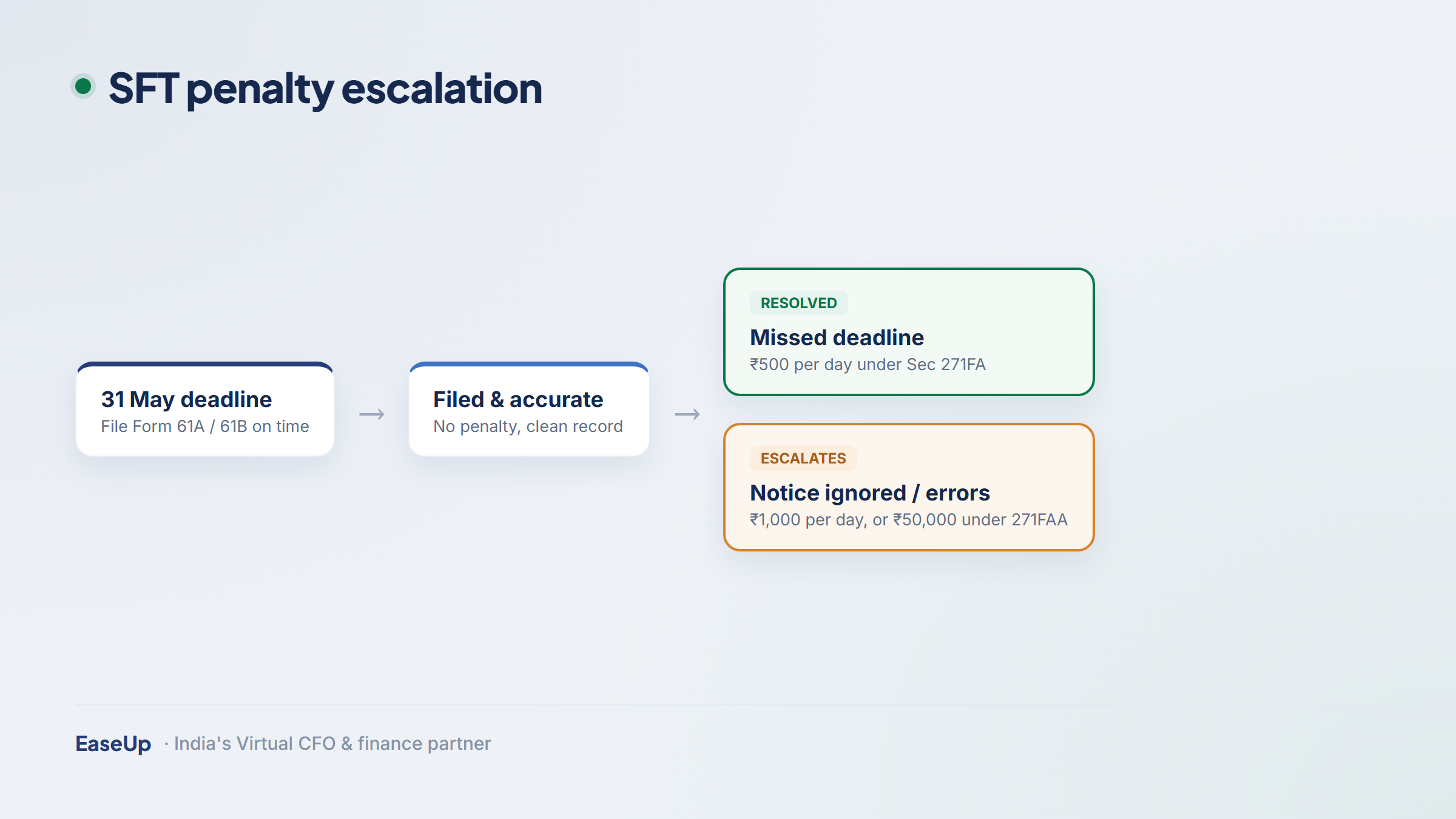
The penalties are daily and they add up fast. This is why timely filing beats last-minute panic.
Situation | Section | Penalty |
Late or non-filing before any notice | Sec 271FA | ₹500 per day of default |
Still not filed after the notice period | Sec 271FA | ₹1,000 per day from the day after the notice deadline |
Inaccurate information furnished | Sec 271FAA | ₹50,000 (flat) |
The ₹1,000-a-day rate kicks in from the day after the time specified in the department’s notice expires. A single missed deadline that drags on for months can become a serious number. You can review the statutory provisions on the Income Tax Department’s Acts page.
Assuming SFT does not apply without checking the Rule 114E thresholds against actual transactions.
Ignoring aggregation, so several smaller deposits quietly cross the limit unnoticed.
Using the wrong form — filing 61A when 61B applies, or vice versa.
Poor reconciliation, leading to inaccurate data and a Section 271FAA penalty.
Waiting until late May, when data cleanup and DSC issues create needless stress.
SFT is far easier when the work is spread out. A few habits make the 31 May filing a non-event:
Tag reportable transactions as they happen, instead of hunting for them in May.
Reconcile monthly so your reported data always matches your books.
Keep the ITDREIN and DSC current to avoid last-minute registration snags.
Do a pre-filing review in April to catch gaps with time to fix them.
Businesses with strong monthly accounting rarely feel SFT pressure. This is exactly where a virtual CFO and organised bookkeeping pay off — the data is ready before the deadline arrives.
SFT sits at the intersection of data quality, tax rules and deadlines. If you are unsure whether you are a reporting person, which form applies, or how to reconcile a messy year of transactions, expert help removes the guesswork. A virtual CFO brings the reconciliation discipline and filing rigour to get it right the first time — and keeps your wider accounting and compliance running smoothly.
SFT (Statement of Financial Transactions) is a report that specified entities such as banks, companies and registrars send to the Income Tax Department under Section 285BA. It lists high-value transactions like large cash deposits, property deals and bond purchases that they recorded during the year, so the department can monitor big-ticket money movement.
The due date is 31 May. For Form 61A, transactions of a financial year (1 April to 31 March) are reported by 31 May of the following financial year. For Form 61B, the reporting period is the calendar year, and the statement is due by 31 May of the following year. So FY 2025-26 transactions are reported by 31 May 2026.
Under Section 271FA, a penalty of ₹500 per day applies for failure to file by the due date. If the department issues a notice and you still do not comply, the penalty rises to ₹1,000 per day from the day after the notice period expires. Separately, furnishing inaccurate information can attract a flat ₹50,000 penalty under Section 271FAA.
Form 61A is the Statement of Financial Transactions, used by most specified reporting persons to report high-value transactions. Form 61B is the Reportable Account Statement, used by prescribed reporting financial institutions to report accounts under FATCA and CRS. In short, 61A reports transactions and 61B reports accounts.
If none of your transactions cross the Rule 114E thresholds, you generally have nothing to report. However, some registered reporting entities choose to file a preliminary or nil response to confirm they had no reportable transactions for the year. If you are unsure of your status, it is safer to confirm than to stay silent.
This guide is for general information only and does not constitute tax, legal or financial advice. SFT rules, thresholds and forms change — confirm the current position with a qualified professional before you file.


Your trusted partner for all your Financial needs.


Finance Management
Strategic Services