TL;DR — Outsourcing your finance function
• Outsourced finance means an external team runs your bookkeeping, GST, TDS, payroll and reporting — backed by senior review, not a single overworked accountant.
• Indian SMEs typically save 40–60% versus an in-house team while getting broader skills and fewer compliance surprises.
• Outsource when month-end drags past 5 days, notices keep arriving, or founders spend near a full day a week on admin.
• A clean transition takes about 4 weeks: workflow mapping, data migration, compliance sync, then MIS and handover.
• The real return is not just lower salary — it is fewer penalties, faster decisions and reclaimed founder time.
Outsourced finance is a service model where an external team runs your financial function — bookkeeping, GST filing, TDS, payroll and monthly reporting — remotely, on a modern cloud system. It is not a part-time data-entry clerk. It is a structured setup with junior accountants on daily entries, a tax specialist on filings, and a senior reviewer on your numbers.
The point is simple. You get the skills of a full finance department without carrying its salary, hiring and software cost. Every transaction is recorded to Indian Accounting Standards, so you stay audit-ready for the Ministry of Corporate Affairs and for any future investor.
If you are still deciding what to hand over first, day-to-day bookkeeping is usually the cleanest place to start.
 Founder tip: Do not outsource chaos. Spend a week listing what your finance process actually does today — who approves invoices, where records live, which filings are due. A clear "before" picture makes the handover far faster and cheaper.
For most small businesses, hiring one "all-rounder" accountant feels efficient — until it is not. One person cannot master every GST change, every TDS rule and every ROC deadline at the same time. That single point of failure is where compliance leaks and messy books begin.
Filings are now more connected and time-sensitive than before. Enquiries from SMEs seeking professional compliance help have risen sharply year on year, and many owners now spend roughly a full working day each week on manual finance admin that earns nothing. Outsourcing replaces the solo hire with a layered team so no single deadline can slip through.
Answer honestly. If you say "no" to two or more of these, your finance process is likely creating risk and delaying decisions.
Health check | What a healthy answer looks like |
Can you close the month and get an accurate Balance Sheet and P&L within 5 days? | Yes — clean books close fast |
Do your GST purchase records match your filings without regular errors? | Yes — reconciled every month |
Can your MIS show profit by product, service or business line? | Yes — not just a single bottom line |
Are TDS deductions and deposits correct for contractor and professional payments? | Yes — right section, right rate, on time |
Are your ROC filings up to date with no pending penalties? | Yes — no surprises at year-end |
 Watch out: Scattered spreadsheets and a single local Tally file are the classic warning sign. If your books live on one laptop, a crash, a resignation or a lost password can wipe out your audit trail overnight.
The return on outsourcing is more than a lower salary line. It also cuts filing delays, lowers the risk of avoidable penalties, and frees founder hours for higher-value work. Here is a realistic example for a manufacturing SME with ₹40 crore turnover.
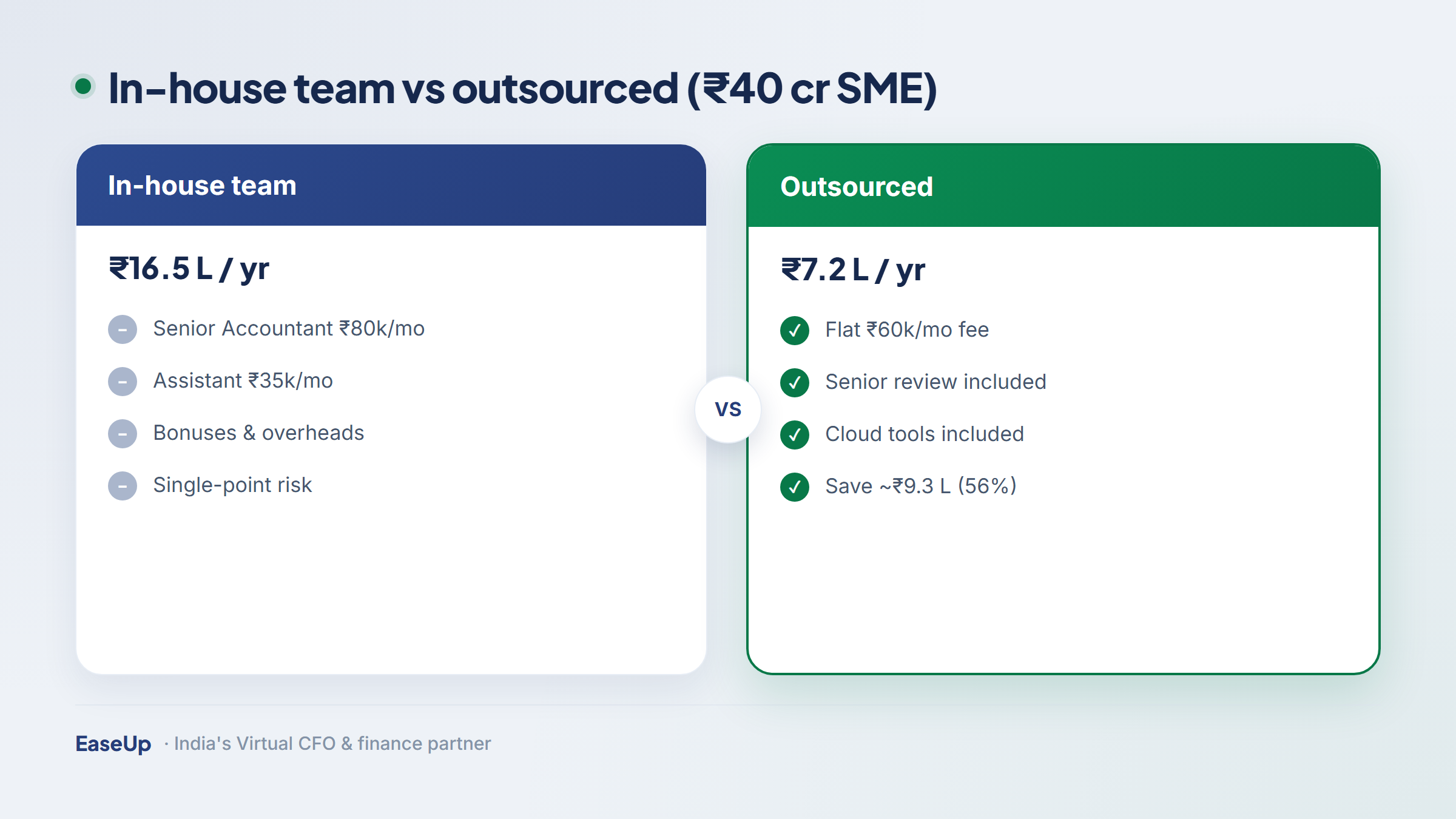
The in-house route means a Senior Accountant at ₹80,000 a month and an Assistant at ₹35,000 a month. With bonuses, workspace and overheads, that is about ₹16.5 lakh a year. A flat outsourced fee of ₹60,000 a month works out to ₹7.2 lakh a year — a saving of roughly ₹9.3 lakh (56%), with senior review included.
ROI driver | Typical impact | Why it matters |
Direct cost | Lower annual finance spend | You cut payroll, hiring and software overhead |
Fewer notices | Less rework and fewer late fees | Regular GST, TDS and ROC tracking prevents avoidable errors |
Founder time | More hours for sales and growth | Less chasing documents and routine approvals |
Visibility | Faster, more confident decisions | Clear reporting flags margin and cash-flow issues early |
Senior guidance | CFO-level review when you need it | Planning and margin help without a full-time CFO salary |
Growth creates financial complexity long before most teams are ready for it. Basic bookkeeping records the past; financial management plans the future. As you scale, decisions made on three-month-old data, unclear business worth during investor talks, and founders spending 40% of their time on admin all become real bottlenecks.
A good outsourced partner bridges the gap between a "basic accountant" and a full-time CFO. That means predictive budgeting, cash-flow optimisation and KPI tracking sitting on top of clean accounting and compliance — sophisticated financial intelligence at a fraction of the in-house cost.
This is the "Goldilocks" fit — too big for a solo bookkeeper, too lean for a ₹1.5 crore-a-year CFO. It suits:
Venture-backed startups: preparing for Seed or Series A/B rounds and investor due diligence.
Scaling tech companies: juggling R&D spend, multiple revenue lines and international growth.
Founder-led SMEs: professionalising operations ahead of a future exit or sale.
Agencies and service firms: needing sharp, project-level profitability tracking.
Feature | In-house finance team | Outsourced solution |
Operating cost | High — salary, benefits, overheads | Predictable, scalable service fee |
Breadth of skill | Limited to the hire's experience | A cross-functional expert team |
Software | You buy and maintain the stack | Modern cloud tools included |
Scalability | Slow — months to hire and train | Fast — adjust the service tier |
Risk | Single-point dependency | Redundant, reviewed oversight |
A clean transition is a 4-week process. Done well, you lose no history and gain real-time visibility into cash flow. Here is the flow.
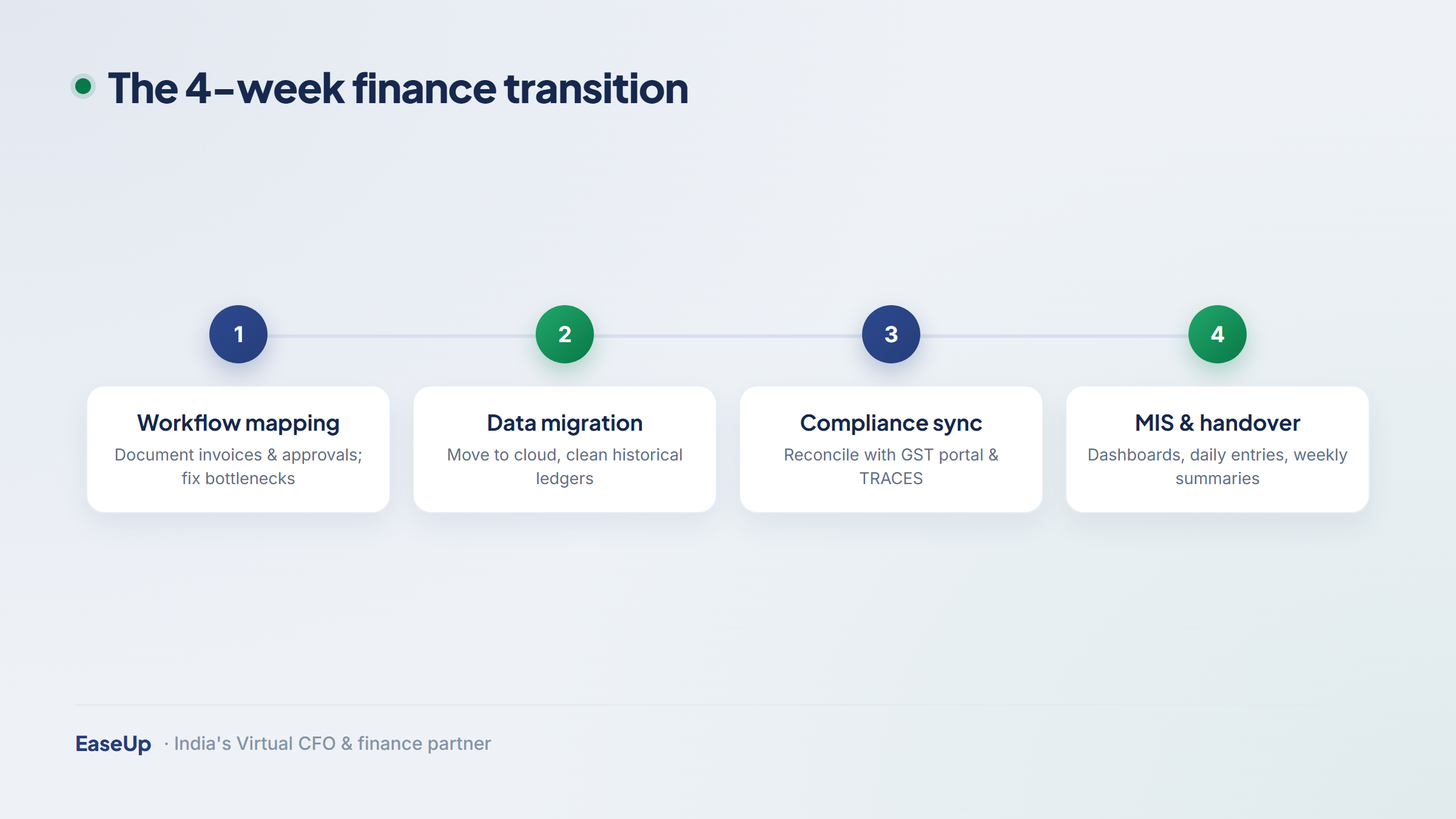
Week 1 — Workflow mapping: document how invoices arrive and how payments are approved, then replace bottlenecks with a digital approval cycle.
Week 2 — Data migration & cleanup: move books to a cloud system like Zoho Books or TallyPrime on Cloud and clean historical ledgers so opening balances match past filings.
Week 3 — Compliance sync: reconcile books with the GST portal and TRACES for TDS, so no past liability follows you into the new system.
Week 4 — MIS & handover: build your reporting dashboard, take over daily entries, and start weekly summaries of financial health.
Departmental scrutiny usually starts with three things: late GST filings, wrong TDS deduction, and mismatches between books and returns. A layered outsourced team catches these before a notice does, because reconciliation is a routine step, not a year-end scramble.
Getting TDS sections and rates right is a common weak spot for SMEs. The government’s own reference on rates and provisions sits on the Income Tax Department portal, and a good partner maps every vendor payment to the correct section before it is deposited.
:info: On data security: Worried about handing over your books? Reputable providers use encrypted cloud platforms and signed NDAs — often safer than an unmonitored office desktop that anyone in the room can open.
Layered team, not a solo hire: junior, specialist and senior review on every account.
Indian-standards fluency: real command of GST, TDS, ROC and Accounting Standards, not just data entry.
Cloud-first tooling: modern software included, with dashboards you can see anytime.
CFO-level access: strategic review available when you fundraise, plan or face an audit.
Clear ownership: a named point of contact and a fixed reporting rhythm.
Many businesses begin with a simple monthly accounting plan and add advisory as they grow.
Timing matters. Move sooner rather than later if any of these ring true:
Month-end drags: you do not see a P&L or Balance Sheet within 5–10 days of close.
Deadlines feel like emergencies: GST and TDS dates arrive as a recurring panic.
You are unsure of burn or runway: the two numbers that decide your next 12 months.
A round or exit is near: investors will want a clean, audit-ready data room.
Founder tip: Recognition helps too. If you are a DPIIT-registered startup, keep your paperwork current on the Startup India portal — clean, recognised books make diligence and tax benefits far smoother.
Outsourced financial management is no longer just a way to save money. By professionalising your finance function today, you reduce risk, improve valuation and reclaim your time. Clean books are the foundation of any fundraise or exit, and clear reporting turns numbers into decisions instead of guesswork.
If you want to move from "fighting fires in the ledger" to steady, confident growth, expert help is the shortcut.
Bookkeeping records history — it captures every transaction accurately. Financial management plans the future. It layers valuation, tax strategy, cash-flow planning and CFO-level advisory on top of clean books, so the numbers actively guide your decisions rather than just describing the past.
Most Indian SMEs save around 40–60% compared with building the same capability in-house. In a typical example, a ₹40 crore-turnover business replaces about ₹16.5 lakh a year of in-house salary and overhead with a roughly ₹7.2 lakh outsourced fee, saving close to ₹9.3 lakh while gaining broader skills and senior review.
With a reputable provider, usually safer than in-house. Top firms use encrypted cloud platforms, role-based access and signed non-disclosure agreements. That is often more secure than an unmonitored office computer that several people can access, and it keeps a clear, backed-up audit trail.
A clean transition typically takes about four weeks: workflow mapping in week one, data migration and ledger cleanup in week two, compliance synchronisation with GST and TDS records in week three, and MIS setup with full handover in week four. You keep your history and gain real-time visibility.
Yes. A strong partner specialises in audit readiness and data-room organisation, so investors and lenders see a clean, professional financial history. They can also provide business valuation inputs and CFO-level review to help you prepare for Seed, Series A or later due diligence.
This guide is for general information only and does not constitute tax, legal or financial advice. Rules, rates and filing requirements change — confirm the current position with a qualified professional before acting.


Your trusted partner for all your Financial needs.


Finance Management
Strategic Services