TL;DR — Outsourced payroll in one minute
• Outsourced payroll hands the full salary lifecycle — calculation, statutory filings and disbursement — to an external specialist, so your team stops chasing spreadsheets.
• The real draw is compliance. PF, ESI, TDS and professional tax each have their own rates, thresholds and deadlines, and a single late filing can cost more than a year of fees.
• Pricing in India runs roughly ₹50–₹1,000 per employee per month, or a flat fee from about ₹5,000 for small teams — usually 30–40% cheaper than an in-house desk.
• Most founders switch when headcount rises fast, filings start slipping, or they expand into a new state with different labour rules.
• The best partners fold payroll into your wider accounting and reporting, so labour cost becomes a number you can actually plan around.
Outsourced payroll means handing the entire lifecycle of employee pay to an external specialist instead of running it in-house. Rather than loading your HR or finance team with repetitive data entry, you partner with a provider who runs the process on secure, automated systems.
A good provider typically owns four things:
End-to-end processing — gross salary, bonuses, overtime, deductions and net pay for every cycle.
Statutory compliance — managing TDS, Provident Fund (PF), Employee State Insurance (ESI) and professional tax filings.
Disbursement — direct salary transfers and digital payslips to each employee.
Reporting — aligning payroll data with your monthly accounting and compliance so the books stay clean.
 Founder tip: You stay the legal employer — the PF and ESI registrations remain in your company name. The provider runs the process and files the returns; they do not take over your statutory identity. Keep that distinction clear in the contract.
Aspect | What it means | Why it matters |
What you hand over | Salary calculation, filings and disbursement | Frees your team from repetitive monthly admin |
Best fit | Startups and SMEs scaling headcount fast | Payroll load grows without new internal hires |
Main gain | Accurate, on-time statutory compliance | Avoids penalties on PF, ESI, TDS and PT |
Typical cost | ₹50–₹1,000 per employee per month | Predictable, scalable service fee |
Key risk | A vague contract with unclear ownership | Fixable by naming who owns each deadline |
On paper, in-house payroll looks free — someone in finance already does it. In practice you are paying for salaries, software licences, training and the cost of fixing errors. Here is the honest comparison.
Feature | In-house payroll | Outsourced payroll |
Who runs it | Internal HR or finance, often part-time | Dedicated payroll specialists |
Cost shape | Salaries plus software plus training | Predictable, scalable service fee |
Compliance | Rests on your internal knowledge | Owned by dedicated compliance experts |
Accuracy | Higher risk of manual errors | Automated, checked and verified |
Scalability | Hard to flex during hiring spikes | Scales up or down with headcount |
For most companies with 10 or more employees, outsourcing works out cheaper once you add up the true internal cost — commonly a 30–40% saving versus an in-house desk.
Payroll in India is not just arithmetic. It is a web of statutory obligations, each with its own rate, threshold and deadline. Getting any one wrong invites penalties and labour-law disputes. Your provider must handle all of these:
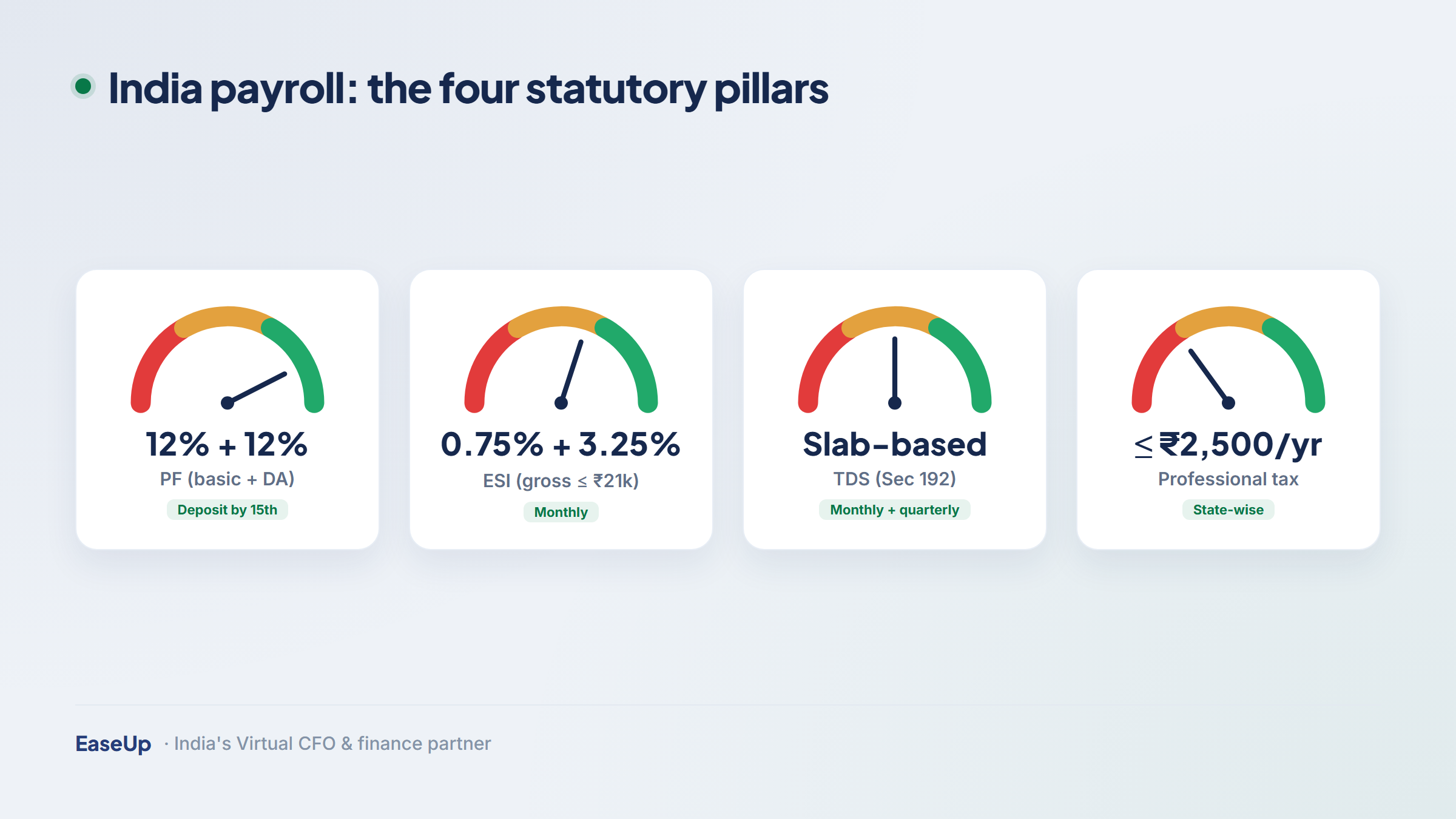
Income Tax (TDS): deducting tax at source on salaries under Section 192, with accurate monthly deposits and quarterly returns.
Provident Fund (PF): 12% employee and 12% employer contributions on basic pay plus dearness allowance, deposited by the 15th of the next month.
Employee State Insurance (ESI): cover for employees earning up to ₹21,000 gross, split as 0.75% employee and 3.25% employer.
Professional Tax (PT): a state levy capped at ₹2,500 per employee a year, with slabs and filing rules that differ by state.
You can confirm the current PF rules on the EPFO official portal and ESI thresholds on the ESIC portal.
 Watch out: India's new Labour Codes came into force in late 2025 and redefine "wages" as at least 50% of total CTC. That re-bases PF and gratuity for many salary structures that historically kept basic pay low — a change a specialist tracks for you, and an in-house desk often misses.
These are the core numbers behind every Indian payslip. A provider bakes them into the system so they are applied consistently, cycle after cycle.
Component | Rate / limit | Key deadline |
PF | 12% employee + 12% employer on basic + DA | Deposit by the 15th of the next month |
ESI | 0.75% employee + 3.25% employer, gross up to ₹21,000 | Contribution by the 15th of the next month |
TDS | Per employee slab under Section 192 | Deposit monthly; return each quarter |
Professional tax | State slabs, capped at ₹2,500 a year | Varies by state — monthly or annual |
Pricing is usually per employee per month (PEPM) or a flat fee for small teams. What you pay scales with headcount, the number of states you run payroll in, and how much compliance and advisory you want bundled in.
Basic processing (salary runs and payslips): roughly ₹150–₹400 per employee a month.
Processing plus compliance (PF, ESI, PT and TDS filings): about ₹300–₹800 per employee a month.
Fully managed (compliance plus HR and advisory support): ₹800–₹2,500+ per employee a month.
Small teams are often quoted a flat retainer, commonly starting near ₹5,000 a month.
Running payroll across multiple states usually adds 15–30%, because labour rules and PT slabs differ by state — a good reason to keep vendor management tight as you grow.
Cost and time savings — you access enterprise-grade payroll technology without full-time hires or software licences.
Bulletproof compliance — specialists track every regulatory change so filings stay accurate and on time.
Stronger data security — encrypted platforms and strict access controls protect bank details and salary data.
Better insight — modern platforms surface labour-cost and workforce-budget reports you can actually plan with.
Focus on growth — every hour not spent on a payroll spreadsheet goes back to hiring and building.
That fourth point compounds when payroll feeds a payroll management setup wired into your wider financials — labour cost stops being a mystery line item.
Payroll mistakes are rarely small. A late PF deposit attracts 12% annual interest plus damages under the EPF Act, and those charges can quietly exceed a full year of outsourcing fees. TDS errors invite notices; PT lapses invite state penalties.
:info: The false economy: The cheapest provider is not the one who takes no responsibility for deadlines. If a missed filing is "your problem," you have not really outsourced the risk. Pay a little more for a partner who owns the calendar.
You can read the official TDS provisions on the Income Tax Department portal before you sign off on any provider’s scope.
You do not need to outsource payroll on day one. But a few clear signals mean it is time:
Headcount is climbing fast and each cycle takes longer than the last.
Internal teams are drowning in administrative work instead of core tasks.
You have hit filing errors — wrong TDS, late PF, or salary miscalculations.
You are expanding across states with different labour laws and PT slabs.
A good transition is structured, not chaotic. Most providers follow a clear path so nothing slips between the last in-house run and the first outsourced one.
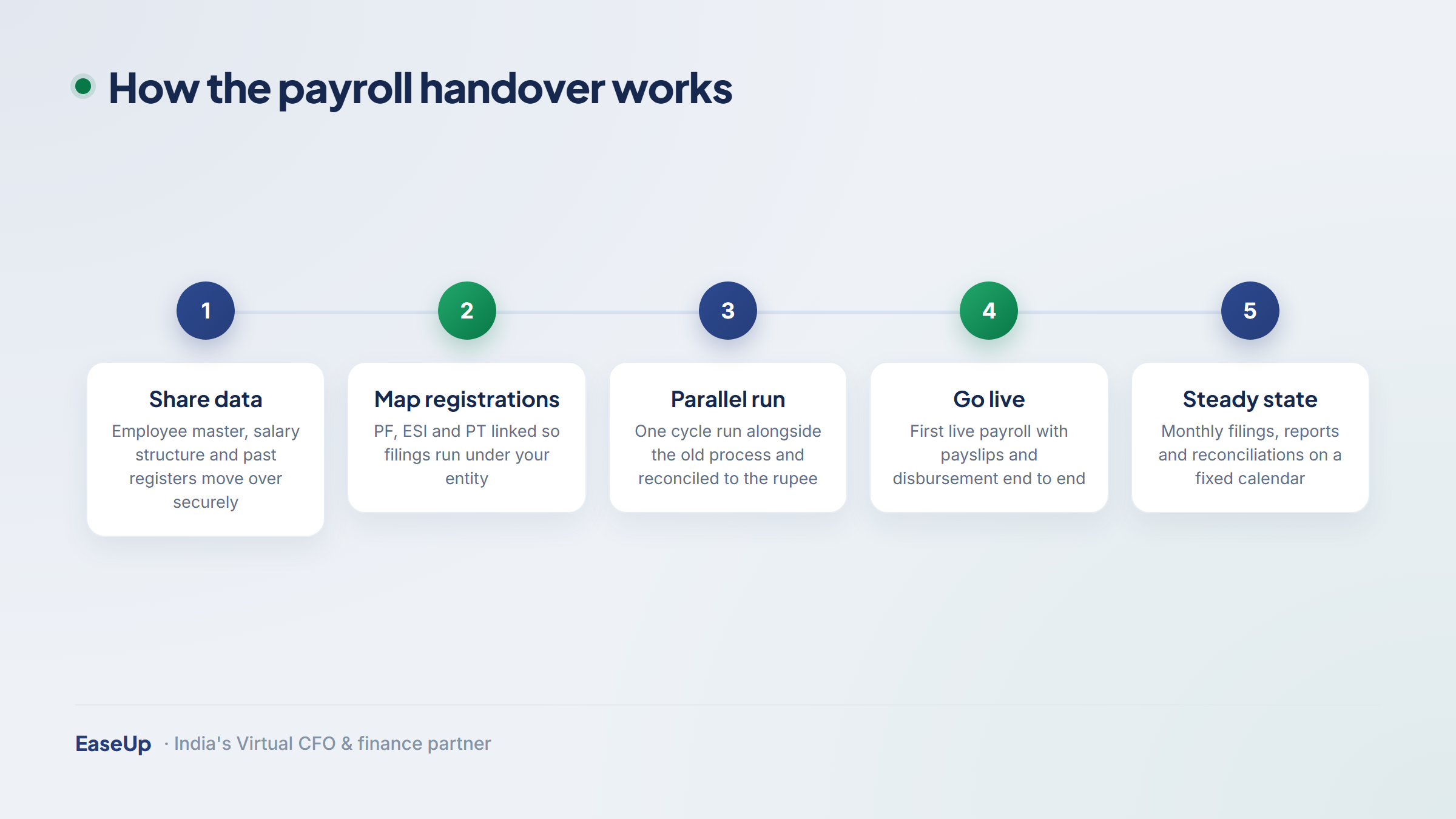
Share data — employee master, salary structure and past registers move over securely.
Map registrations — PF, ESI and PT registrations are linked so filings run under your entity.
Parallel run — one cycle is run alongside your old process and reconciled to the rupee.
Go live — the first live payroll runs, with payslips and disbursement handled end to end.
Steady state — monthly filings, reports and reconciliations continue on a fixed calendar.
Payroll data is among the most sensitive you hold — bank details, salaries and identity documents. Reputable providers run on encrypted cloud systems with strict, role-based access controls, so only authorised people see the numbers. Ask any prospective partner how they encrypt data, who can access it, and how breaches are handled before you share a single record.
At EaseUp, payroll is not an isolated task. We fold it into a single financial system alongside GST compliance, bookkeeping and reporting — so your payroll management and your books tell one consistent story.
That means unified dashboards for real-time visibility, experience supporting fast-growing SMEs and startups, and bank-grade security for sensitive employee data. When payroll, compliance and reporting sit together, you stop reconciling and start planning.
Yes, with a reputable provider. Top providers run on encrypted cloud platforms with strict, role-based access controls, so employee bank details and salary information stay protected. Before you sign, ask how data is encrypted, who can access it, and how any breach would be handled — a serious partner answers all three clearly.
Pricing is usually per employee per month and scales with headcount and scope. Basic processing runs about ₹150–₹400 per employee, processing plus statutory filings around ₹300–₹800, and fully managed service ₹800–₹2,500 or more. Small teams are often quoted a flat retainer starting near ₹5,000 a month.
No. You remain the legal employer, and your PF and ESI registrations stay in your company name. The outsourcing provider processes payroll, calculates deductions and files returns on your behalf, but your business keeps its statutory identity and ultimate responsibility.
Yes. Professional providers manage the full pay lifecycle, including variable pay such as bonuses, overtime and incentives, as well as employee reimbursements and claims. These are calculated, taxed correctly and reflected in each payslip alongside regular salary.
Consider switching when headcount is rising quickly, internal teams are overwhelmed by admin, you have hit errors in TDS or PF filings, or you are expanding into new states with different labour laws and professional tax slabs. Any one of these signals that in-house payroll is becoming a risk.
This guide is for general information only and does not constitute tax, legal or financial advice. Payroll rates, thresholds and labour rules change — confirm the current position with a qualified professional before you act.


Your trusted partner for all your Financial needs.


Finance Management
Strategic Services