TL;DR — the 30-second version
• MSME accounting means keeping clean, daily records of every rupee in and out, so your GST, TDS, and income tax filings are always ready.
• First moves: open a separate business bank account, pick cloud software like Zoho Books or Tally, and record entries weekly, not yearly.
• Budget 2025 raised MSME limits. A micro unit can now have up to Rs 2.5 crore investment and Rs 10 crore turnover.
• The 45-day rule (Section 43B(h)) means buyers must pay registered micro and small suppliers within 45 days or lose the tax deduction.
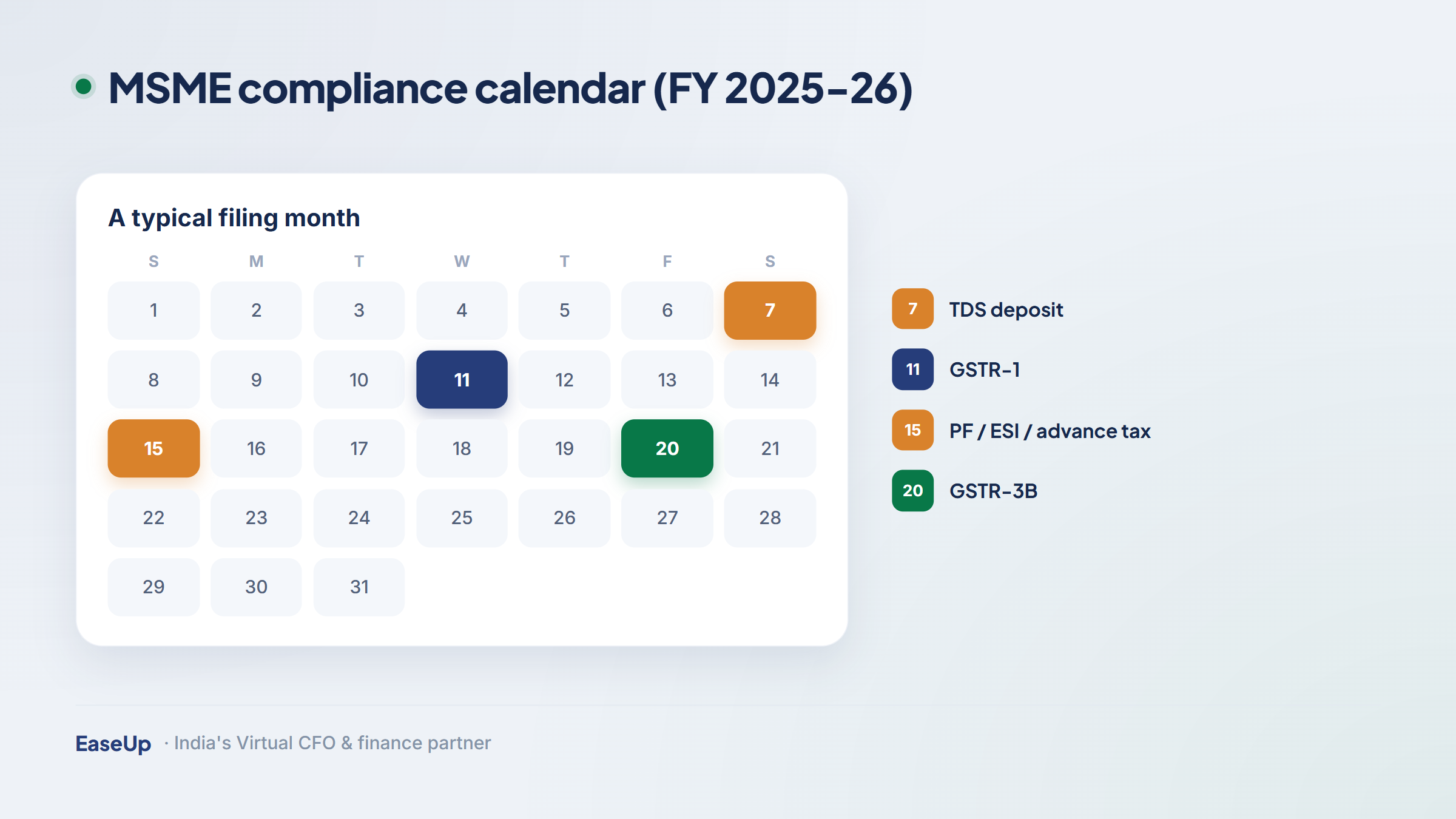
• Match your books to the FY 2025-26 calendar: GSTR-1 by the 11th, GSTR-3B by the 20th, ITR by 31 July or 31 October if audited.
MSME accounting is the day-to-day work of recording every sale, purchase, and expense in your micro, small, or medium business. It turns a pile of invoices and bank entries into clear numbers you can trust. Good bookkeeping is the base. Accounting sits on top and tells you what those numbers mean.
For an Indian founder or shop owner, clean accounts are not just paperwork. They decide your tax bill, your loan eligibility, and whether an investor takes you seriously. Messy books cost real money in late fees and missed input credit. Clean books save it.
Budget 2025 raised the size limits for MSMEs. More businesses now qualify, which means easier compliance and access to MSME benefits. To stay in a category you must meet both the investment and turnover limits at the same time. The official rules sit with the Ministry of MSME and registration is free on the Udyam portal.
Category | Investment limit | Turnover limit |
Micro | Up to Rs 2.5 crore | Up to Rs 10 crore |
Small | Up to Rs 25 crore | Up to Rs 100 crore |
Medium | Up to Rs 125 crore | Up to Rs 500 crore |
 Note: These limits apply for FY 2025-26. You must satisfy both the investment and the turnover cap to stay in a category. Cross either one and you move up a tier.
You do not need a finance degree. You need a clear set of records that any CA, banker, or auditor can read. Keep these from day one:
Cash book. Every rupee of cash in and out, dated and described.
Bank book. All bank transactions, matched to your statements each month.
Sales and purchase registers. Every invoice raised and received, with GST split out.
Ledger. Account-wise totals for customers, vendors, expenses, and assets.
Fixed asset register. Laptops, machinery, and furniture, with their depreciation.
GST and TDS records. Input credit, output tax, and deductions, kept filing-ready.
Under the Income Tax Act, businesses crossing set income or turnover limits must keep books for at least six years. The current rules live on the Income Tax portal.
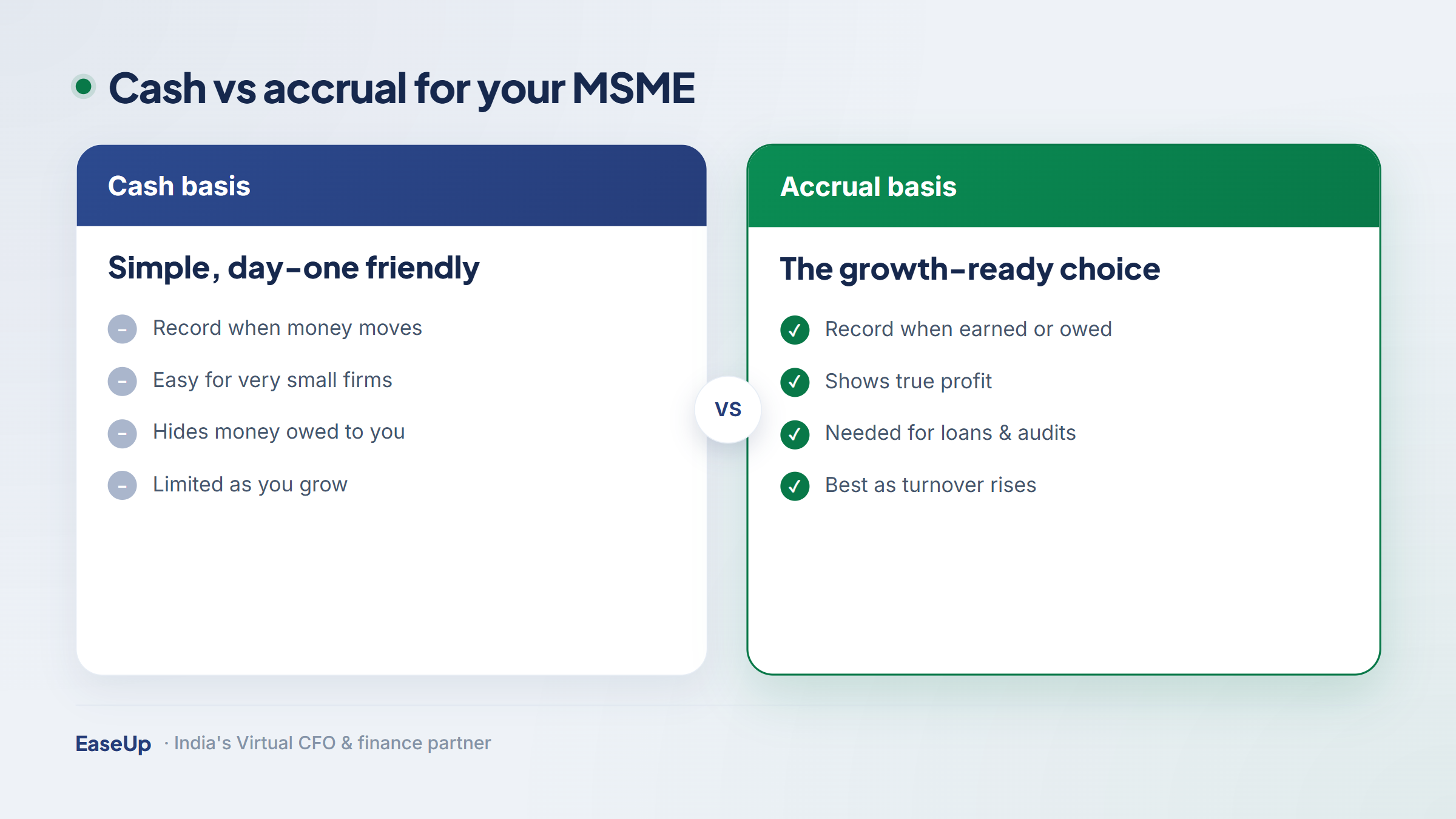
There are two ways to record money. Pick one and stay with it.
Point | Cash basis | Accrual basis |
When you record | When cash moves | When the sale or cost happens |
Best for | Tiny shops, freelancers | Growing firms, companies |
Example | Record Rs 50,000 when client pays | Record Rs 50,000 when you invoice |
GST and audit fit | Limited | Required for most companies |
Most early-stage businesses start on cash basis because it is simple. But once you raise invoices on credit or register a private limited company, accrual gives a truer picture. If you are unsure, our bookkeeping team can set the right method up for you.
:check_mark_button: Founder tip: Switching methods mid-year confuses your numbers and your auditor. Choose your basis before the financial year starts and lock it for all twelve months.
These habits separate a calm founder from a stressed one. Build them in early.
Open a separate business bank account. Never mix personal and business money. It is the single biggest fix.
Record entries weekly. Do not let a year of invoices pile up before March.
Reconcile your bank monthly. Match your books to your statement every month, no exceptions.
Use cloud accounting software. Zoho Books, Tally, or QuickBooks keep records safe and GST-ready.
Keep digital copies of every bill. A photo of each invoice protects your input credit.
Track receivables closely. Know who owes you and chase dues before they age.
Set money aside for tax. Park GST and TDS amounts so you are never caught short.
Review a monthly report. Read your profit and loss and cash position every month.
Follow the compliance calendar. Map every GST, TDS, and ITR date in advance.
Get a yearly expert review. A CA or virtual CFO catches what software cannot.
Want this run for you instead of by you? Our bookkeeping service and virtual CFO teams handle the whole cycle.
Two taxes drive most MSME paperwork in India: GST and TDS. Your accounting must feed both without a scramble.
GST returns. Most file GSTR-1 by the 11th and GSTR-3B by the 20th each month on the GST portal.
Input tax credit. You can only claim credit if your purchase invoices are recorded and matched.
TDS deductions. Deduct on rent, contractor, and professional payments, then pay by the 7th of the next month.
TDS returns. File quarterly and issue Form 16A so vendors get their credit.
 Watch out: If you fail to deduct or pay TDS, 30 percent of that expense can be disallowed in your income tax return. A missed TDS entry quietly raises your whole tax bill.
This rule changed the game for small suppliers. Under Section 43B(h) of the Income Tax Act, a buyer must pay a registered micro or small supplier within 45 days. If they do not, the buyer cannot claim that expense as a deduction until it is actually paid.
For you as a supplier, this is protection. For you as a buyer, it is a deadline. Either way, your accounting must flag MSME vendors and track their due dates. Delayed payments can also attract interest under the rules backed by the Reserve Bank of India.
:check_mark_button: Founder tip: Tag every vendor in your software as MSME or non-MSME on day one. Then a simple report shows which bills must clear inside 45 days to protect your deductions.
The right tool saves hours and cuts errors. For Indian MSMEs, three names lead the pack. Match the tool to your size and budget.
Software | Best for | Typical India cost |
Tally Prime | GST billing, traditional setups | Rs 18,000 / year (one-time options too) |
Zoho Books | Cloud access, startups | Rs 9,000 - Rs 24,000 / year |
QuickBooks / Vyapar | Simple invoicing, micro units | Rs 3,500 - Rs 12,000 / year |
Whatever you pick, make sure it generates GST-compliant invoices and exports clean reports. That alone removes most filing-day stress.
Clean books are only half the job. They must feed your filings on time. Pin these dates where your accounting team can see them:
GST monthly. GSTR-1 by the 11th, GSTR-3B by the 20th.
TDS payment. By the 7th of the next month, with quarterly returns after.
Income tax return. By 31 July if not audited, or 31 October if a tax audit applies, on the Income Tax e-filing site.
ROC filings. Private limited companies file annual returns with the Ministry of Corporate Affairs.
A tax audit kicks in once turnover crosses Rs 1 crore, or Rs 10 crore if most of your transactions are digital. Plan for it early if you are near the line.
Most penalties trace back to a short list of avoidable errors. Skip these:
Mixing personal and business money. It muddies every report and risks your tax position.
Saving books for year-end. A year of backlog guarantees missed input credit and errors.
Ignoring bank reconciliation. Unmatched entries hide fraud, double-counting, and missing income.
Forgetting TDS. One missed deduction can disallow the whole expense.
No system for invoices. Lost bills mean lost GST credit, straight off your bottom line.
Going it alone too long. A yearly expert review pays for itself in saved tax and clean filings.
You do not need everyone at once. Add help as you grow.
Bookkeeper. For daily entries, reconciliation, and clean records. Start here.
Chartered Accountant. For audits, ITR sign-off, and complex tax questions.
Virtual CFO. For cash-flow planning, fundraising prep, and board-level numbers.
Most founders begin with bookkeeping support, then add a virtual CFO once revenue crosses a few lakh a month or investors enter the picture.
Strong accounting is the quiet engine behind every healthy MSME. Get the basics right, follow the calendar, and your tax, loans, and fundraising all get easier. Start small: a separate bank account, weekly entries, and the right software.
Want a partner who knows Indian GST, TDS, and the MSME calendar inside out? Talk to the EaseUp bookkeeping team and get your books mapped out in one call.
Every MSME should keep a cash book, a bank book, sales and purchase registers, a general ledger, a fixed asset register, and clear GST and TDS records. Together these capture every rupee in and out and keep your filings ready. Under the Income Tax Act, businesses that cross set income or turnover limits must retain these books for at least six years. Cloud software like Zoho Books or Tally makes keeping and storing them far easier and ensures your invoices are GST-compliant.
After Budget 2025, a micro enterprise can have investment up to Rs 2.5 crore and turnover up to Rs 10 crore. A small enterprise can have up to Rs 25 crore investment and Rs 100 crore turnover. A medium enterprise can have up to Rs 125 crore investment and Rs 500 crore turnover. You must meet both the investment and the turnover limit at the same time to stay in a category. Cross either one and you move up a tier. Udyam registration is free and confirms your status.
Under Section 43B(h) of the Income Tax Act, a buyer must pay a registered micro or small supplier within 45 days of accepting goods or services. If the buyer does not pay in time, they cannot claim that expense as a tax deduction until it is actually paid. This protects small suppliers from long delays and can raise the buyer tax bill. In practice, your accounting should tag every vendor as MSME or non-MSME so a simple report shows which bills must clear inside 45 days.
For most Indian MSMEs, the three leading tools are Tally Prime, Zoho Books, and QuickBooks or Vyapar. Tally suits GST billing and traditional setups, Zoho Books suits cloud-first startups, and Vyapar or QuickBooks suit simple invoicing for micro units. Costs run roughly Rs 3,500 to Rs 24,000 a year depending on the tool and plan. Whichever you choose, make sure it produces GST-compliant invoices and exports clean profit-and-loss and balance-sheet reports, because that removes most of your filing-day stress.
Start with a bookkeeper for daily entries, bank reconciliation, and clean records. Bring in a Chartered Accountant when you face a statutory or tax audit, need your income tax return signed off, or hit a complex tax question. Add a virtual CFO once monthly revenue crosses a few lakh, you are raising funds, or you need cash-flow planning and board-level reporting. Many growing MSMEs use all three: a bookkeeper for the daily grind, a CA for compliance sign-off, and a virtual CFO for strategy.
This article is for general information only and is not tax, legal, or accounting advice. Rules, rates, limits, and deadlines change. Please confirm current requirements with a qualified professional or the relevant government portal before acting.

Your trusted partner for all your Financial needs.


Finance Management
Strategic Services