TL;DR — Income tax notices in one minute
• A notice is not an accusation. Most are routine checks — a mismatch, a defect, or a request for documents.
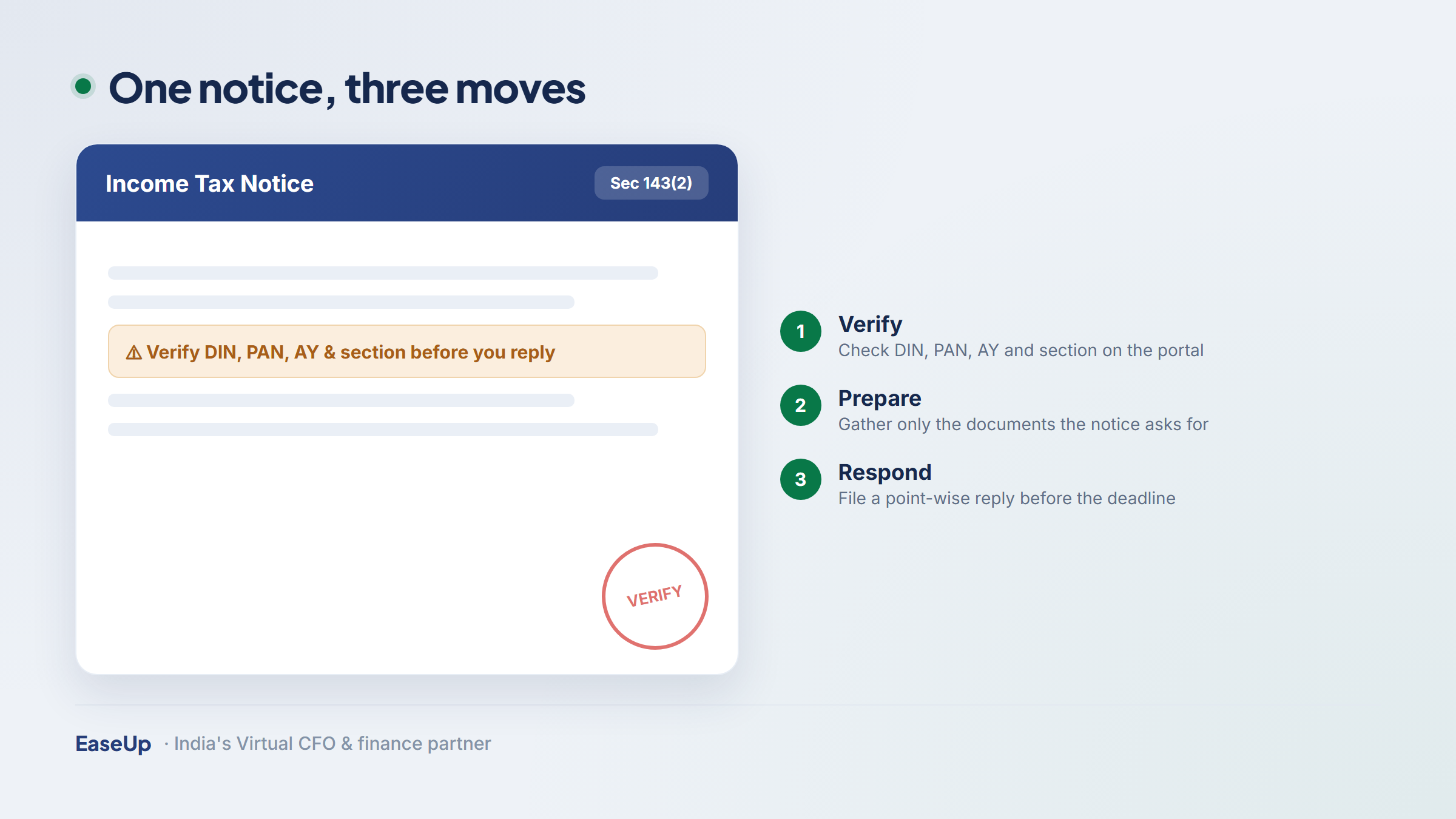
• Always verify the notice first. Check the DIN, PAN, section and assessment year on the income tax portal before you reply.
• Identify the section — 143(1), 139(9), 142(1), 143(2), 148 or 156 — because each one needs a different response.
• Reply within the deadline, point by point, with clean supporting documents. A silent or late reply is what turns a small issue into a big one.
• For scrutiny (143(2)) or reassessment (148/148A) notices, get professional help early. These carry the highest stakes.

An income tax notice is an official message from the Income Tax Department. It asks you to verify information, fix a return, submit documents, explain a mismatch, or respond to a tax demand.
Getting one does not mean you have done something wrong. Notices are usually triggered by return defects, mismatches with your AIS or Form 26AS, missing disclosures, high-value transactions, or a routine follow-up during processing. The right response is simple: stay calm, read it fully, and act on time.
If a notice touches your business books, it helps to align the reply with your accounting and compliance records so every number matches from the start.
 Founder tip: Do not reply from your phone based on the email subject line. Open the full notice on the portal, read every line, and note the exact section, deadline and documents asked for before you draft anything.
Speed matters more than perfection. Even a manageable issue can get expensive when a deadline slips. A delayed or missing response can lead to a best-judgement assessment, penalties, interest, refund adjustments, or avoidable litigation.
If you need more time, you can usually request an adjournment on the portal — but you must still respond before the clock runs out. Silence is never the right move.
Fake tax messages are common. Before you upload a single document, confirm the notice is real:
Log in to the Income Tax e-Filing portal.
Check whether the notice appears under Pending Actions or your notices section.
Verify the DIN (Document Identification Number). Every genuine notice carries one.
Match the PAN, assessment year, section and issue date with your records.
Download the full notice and save a copy.
You can independently confirm any document using the department’s Authenticate Notice/Order tool. If anything looks inconsistent, pause and review before replying.
Different notices need different responses. The fastest way to avoid errors is to identify the section first, then prepare only what is relevant.
Section | What it usually means | Typical timeline | What you should do |
139(9) | Defective return | Usually 15 days | Correct the defect and file the revised response. |
142(1) | Request for information or documents | As stated | Submit a complete, point-wise reply with evidence. |
143(1) | Processing intimation | Varies by issue | Review the adjustments; rectify only if there is an error. |
143(2) | Scrutiny notice | As stated | Prepare a detailed reply and keep records consistent. |
148 / 148A | Income escaping assessment / reassessment | Strict, case-specific | Review the grounds carefully — get expert help. |
156 | Demand notice | Usually 30 days | Verify the demand; pay if correct or challenge it. |
245 | Refund adjusted against old demand | As stated | Confirm the old demand is valid before it is adjusted. |
 Watch out: Do not treat every notice the same. A 143(1) intimation is often just an auto-calculated summary, while a 143(2) scrutiny or a 148 reassessment is serious. Replying to a scrutiny notice as if it were routine is a costly mistake.
A calm, structured response beats a rushed one every time. Follow this sequence:
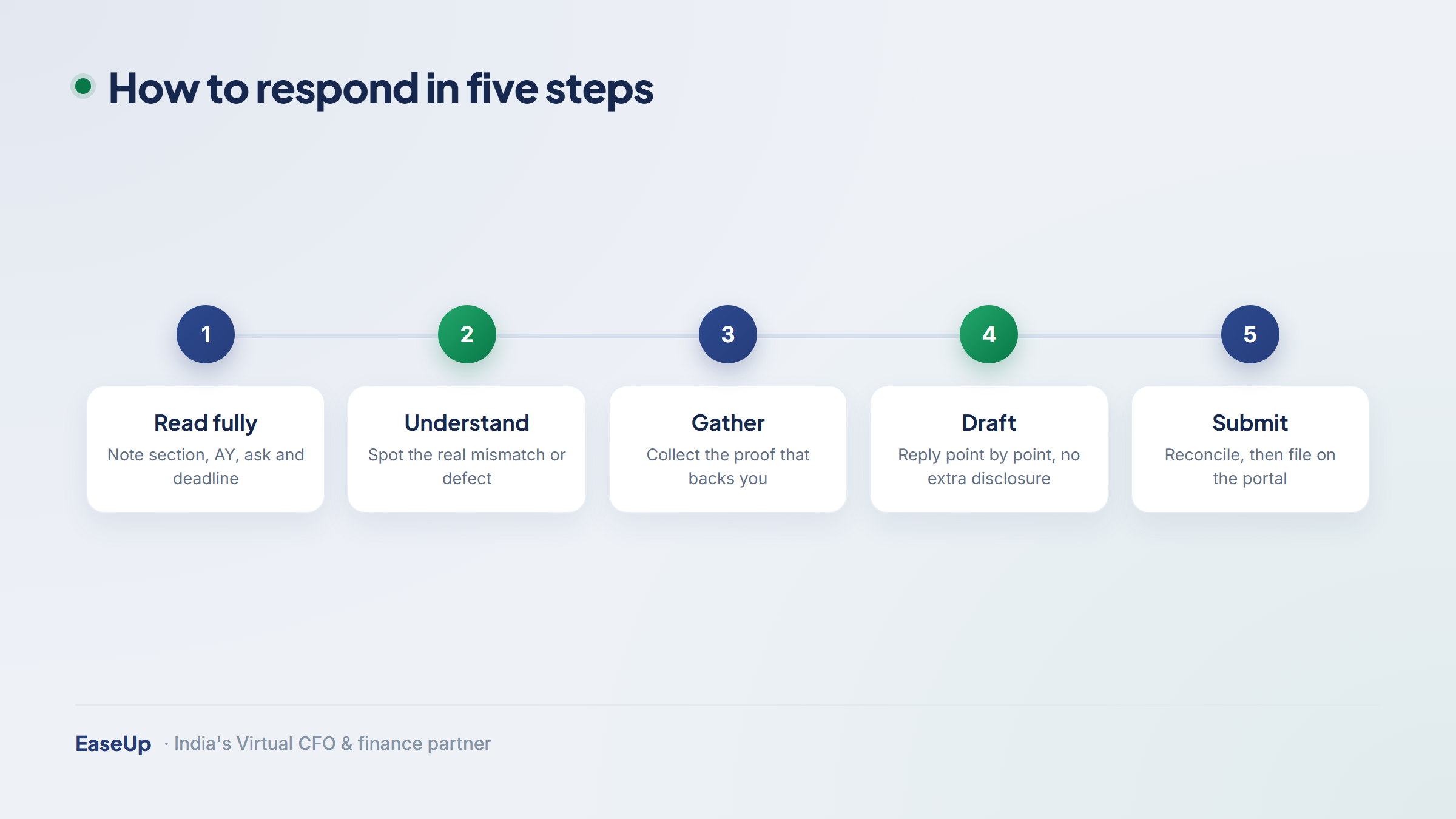
Read the notice fully — note the section, assessment year, exact information requested, and the deadline.
Understand the real issue — most notices come down to a mismatch, a wrong deduction, unreported income, or a return defect.
Gather the right documents — collect only what the notice asks for, plus the records that prove your position.
Draft a point-wise reply — answer each point factually, with a clear list of attachments. Avoid emotional or extra disclosure.
Reconcile, then submit — make sure your reply matches your return, books, bank entries and tax credits before you upload it on the portal.
The exact list depends on the notice, but these are the records most often needed. Keep them organised so evidence is easy to assemble.
Document type | Examples | Why it matters |
Filing records | PAN, Aadhaar, ITR acknowledgment, computation, filed return | Confirms what you originally filed |
Tax credit records | Form 16, Form 16A, Form 26AS, AIS, TIS | Reconciles tax credits and reported income |
Banking records | Bank, FD and loan statements | Supports the source of funds and transaction trail |
Deduction proofs | 80C proofs, insurance receipts, home-loan certificate | Backs up the deductions you claimed |
Business records | P&L, balance sheet, invoices, ledgers, GST workings | Key for business income scrutiny |
Transaction records | Sale/purchase deeds, broker statements, capital-gains workings | Explains high-value or capital transactions |
If your books are behind, notice responses get harder than they need to be. Clean records and a periodic financial audit make the evidence trail far easier to assemble.
A 143(1) intimation is usually the most common message taxpayers get. It is sent after your return is processed and shows any tax payable, refund, or adjustment the system made.
You only need to act if you disagree with the calculation. If a genuine error exists, file a rectification request under Section 154 on the portal. If the intimation matches your return, no reply is needed — just save it.
A 139(9) notice means your filed return has an error or missing information — a mismatched figure, an incomplete schedule, or a missing disclosure. You usually get 15 days to fix it.
Correct the defect and submit a revised response using the same ITR utility, marked as filed in response to Section 139(9). Miss the window and your return can be treated as invalid, as if it was never filed.
:info: Reconcile before you file: Most 139(9) and 143(1) issues are simple mismatches between your return and your AIS or Form 26AS. Fix the source data first, then respond — otherwise the same defect can resurface.
A 148 notice reopens a past year because the department believes income escaped assessment. Under the current rules, it must first issue a 148A show-cause notice and give you a chance to explain — usually between 7 and 30 days.
Time limits are now tighter than before. Reassessment is generally allowed within 3 years from the end of the assessment year, extending to about 5 years only where the escaped income crosses ₹50 lakh. You can read the department’s own guidance on the income tax e-Proceedings help pages.
Watch out: Never respond to a 148A notice casually. What you say at the show-cause stage shapes the entire reassessment. This is the point to bring in a professional, not after the 148 order is passed.
For reassessment and scrutiny matters, structured income tax notice support can help you frame the reply, assemble evidence and represent your position correctly.
Almost every response now goes through the portal, not paper. The path is consistent:
Log in at incometax.gov.in with your PAN and password.
Open Pending Actions → e-Proceedings.
Select the specific notice and read the requirement in full.
Upload your point-wise reply and attachments in the formats asked for.
Submit before the deadline and download the acknowledgment for your records.
Deadlines are the single biggest reason a routine notice turns into a problem. Here is what is at stake:
If you... | Likely consequence |
Respond on time, with clean documents | Issue usually closes with no further action |
Miss the 139(9) window | Return can be treated as invalid — as if never filed |
Ignore a 143(2) scrutiny notice | Best-judgement assessment and possible penalty |
Do not act on a 156 demand | Interest, recovery action and refund adjustment |
Skip a 148A reply | Reassessment proceeds without your side of the story |
Panicking or ignoring the notice instead of reading and acting on it calmly.
Replying to the wrong section — treating a scrutiny notice like a routine intimation.
Over-disclosing — adding information the notice never asked for.
Numbers that do not reconcile with your return, books, AIS or Form 26AS.
Handling reassessment alone when 148/148A cases clearly need professional support.
A simple 143(1) intimation you can often handle yourself. But scrutiny (143(2)), reassessment (148/148A), or any notice tied to your business books deserves expert eyes. A structured review helps you reply once, correctly, instead of trading letters for months.
If you are unsure which category your notice falls in, a short consultation can save you far more than it costs.
No. A notice is an official request to verify information, fix a return, or explain a mismatch. Most are routine and triggered by data mismatches with your AIS or Form 26AS, return defects, or high-value transactions. The key is to verify the notice, identify the section, and respond on time with clean documents.
Log in to the income tax e-Filing portal and check whether the notice appears under Pending Actions. Every genuine notice carries a Document Identification Number (DIN). Match the DIN, PAN, assessment year, section and issue date with your records, and use the department’s Authenticate Notice/Order tool to confirm it before you reply.
A 143(1) intimation is an automated summary sent after your return is processed, showing any tax, refund or adjustment. You act only if the calculation is wrong, usually via a Section 154 rectification. A 139(9) notice means your return is defective and must be corrected, typically within 15 days, or it can be treated as invalid.
It depends on the section. A 139(9) defective-return notice usually gives 15 days, a 156 demand notice around 30 days, and a 148A show-cause notice between 7 and 30 days. Others state the deadline in the notice itself. Always reply before the deadline, and request an adjournment on the portal if you need more time.
Reassessment notices under Section 148 and 148A carry high stakes, because what you say at the show-cause stage shapes the whole proceeding. Time limits are strict and the grounds are case-specific. It is strongly advisable to get professional support before responding rather than after an order is passed.
This guide is for general information only and does not constitute tax, legal or financial advice. Income tax provisions, sections and timelines change — confirm the current position with a qualified professional before you respond to any notice.


Your trusted partner for all your Financial needs.


Finance Management
Strategic Services