
TL;DR — GST notices in one minute
• A GST notice is a formal ask from the department — for a clarification, a document, a return, or a tax payment. The first rule is simple: never ignore it.
• The form you file back depends on the notice: REG-04 answers REG-03, ASMT-11 answers ASMT-10, and DRC-06 answers a DRC-01 show cause notice.
• Deadlines are tight — 7 working days for registration notices, 15 days for a GSTR-3A, and 30 days for scrutiny and demand notices.
• The strongest replies are point-by-point and document-backed — answer every allegation separately, not the notice as a whole.
• Miss the window and the officer can pass an ex-parte demand order (DRC-07). After that, your only route is a costly appeal.

A GST notice is an official communication the tax department sends when it wants something from a registered taxpayer — a clarification, extra documents, a pending return, or payment of tax it believes is due. It can flow from a return mismatch, an excess input-tax-credit (ITC) claim, a registration query, an audit, or a proposed demand.
The department issues it under a specific section and expects a reply on a specific form, by a specific date. Get all three right and most notices close quietly. The one rule that never changes: do not ignore it. Even when the demand looks plainly wrong, silence invites an ex-parte order, avoidable penalties, and drawn-out litigation.
Notices are also easier to prevent than to fight. Tight month-end books and reconciled returns cut the mismatch risk that triggers most notices — which is where steady accounting and compliance support earns its keep.
 Founder tip: The clock usually starts from the date of service, not the date you happened to open the portal. Set a calendar reminder the moment a notice lands on the GST portal or your registered email — a lost week is a lost defence.
Founders often say "GST notice" as if it were one thing. It is not. Each type has its own trigger, reply form, and timeline. Here are the ones you are most likely to see.
Notice form | What it usually means | Reply form | Typical timeline |
REG-03 | Clarification sought during registration or amendment | REG-04 | 7 working days |
REG-17 | Show cause notice proposing cancellation of registration | REG-18 | 7 working days |
GSTR-3A | Reminder for non-filing of returns (Section 46) | File the pending return | 15 days |
ASMT-10 | Scrutiny notice for discrepancies in returns | ASMT-11 | 30 days |
ADT-01 | Notice of departmental audit (Section 65) | Provide records / attend | As specified |
DRC-01A | Pre-show-cause intimation of tax ascertained as payable | DRC-01A Part B | As specified |
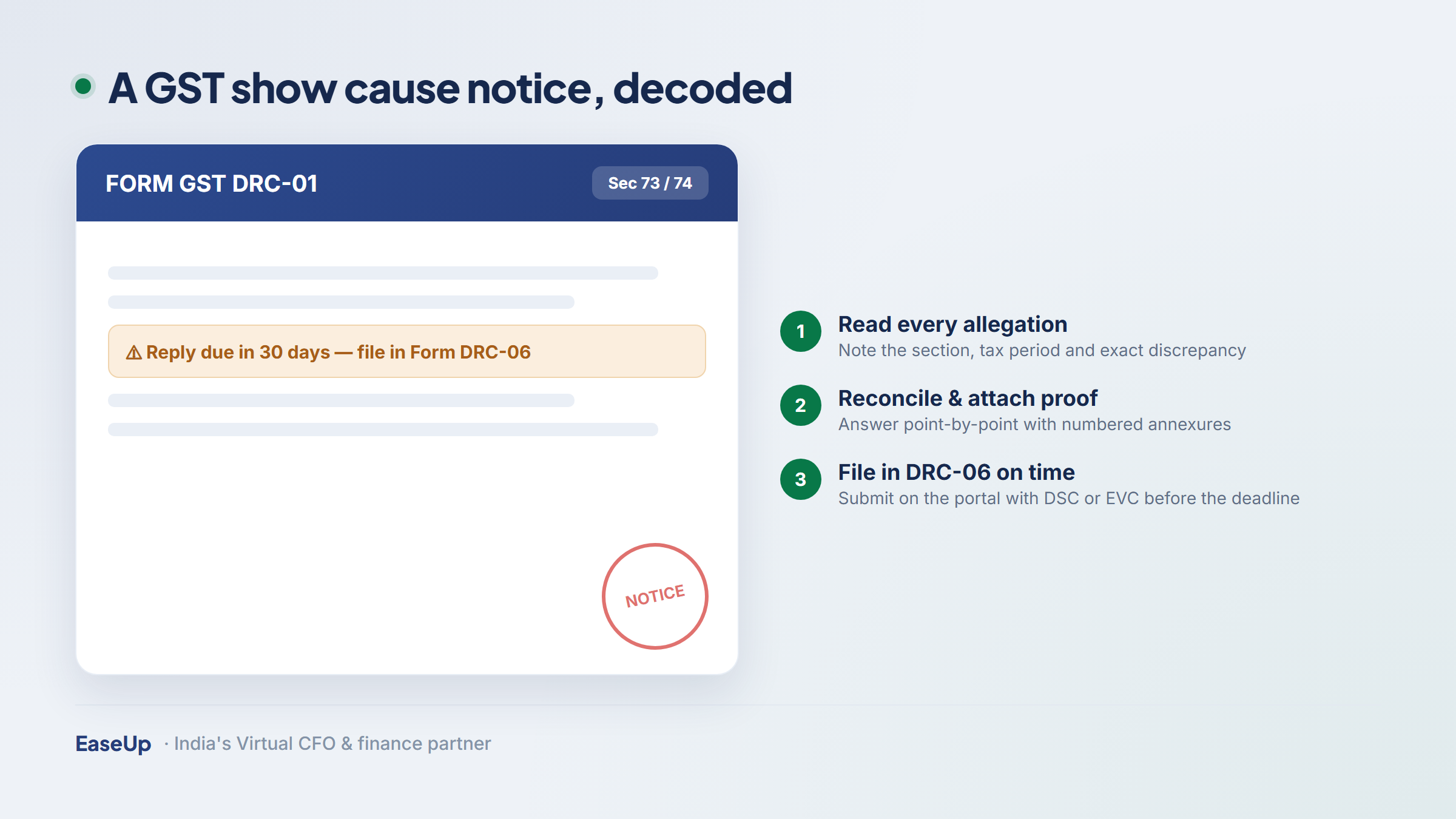
DRC-01 | Show cause notice demanding tax, interest or penalty | DRC-06 | 30 days |
These arrive around your GST registration itself. REG-03 asks for clarification or extra documents while your application or amendment is being processed — you reply in REG-04 within 7 working days, or the application can be rejected. REG-17 is more serious: a show cause notice proposing to cancel an existing registration, usually after continuous non-filing.
The response window here is short and unforgiving. If your registration is business-critical, delay directly hits invoicing, collections, and vendor confidence. Reply in REG-18, fix the underlying default, and attach proof of corrective action. You can track and respond to these on the official GST portal.
A GSTR-3A is a system-generated reminder under Section 46 that a return is overdue. There is nothing to argue — simply file the pending return (with any late fee and interest) within 15 days, and the notice is closed.
An ASMT-10 scrutiny notice is the common one. It is raised when the system spots mismatches between your GSTR-1, GSTR-3B, GSTR-2B, and e-way-bill data. Typical triggers include:
GSTR-1 vs GSTR-3B: outward supplies reported in one but not the other.
ITC overreach: credit claimed in GSTR-3B higher than what appears in GSTR-2B.
Unusual ratios: ITC very high compared with output tax liability.
Pattern breaks: return figures inconsistent with your transaction history.
You reply in ASMT-11 within 30 days, with a reconciliation that explains each gap. If accepted, the matter closes; if not, it can escalate into a demand. A detailed, standalone walkthrough of the ASMT-10 scrutiny reply sits alongside this guide.
:info: Timing vs. error: Many "mismatches" are just timing differences — an invoice reported in a later month, or credit claimed once the supplier filed. Show the reconciliation across periods and a scary-looking gap often disappears on paper.
Under Section 65, the department can audit your records. It starts with an ADT-01 notice, issued at least 15 days before the audit, telling you what period and records are in scope. This is not a demand — it is a request to open your books.
Treat it as a document exercise, not a fight. Pull together the returns, ledgers, invoices, and reconciliations for the audit period, and present them cleanly. Findings, if any, come later as an ADT-02 report and may then convert into a DRC-01. Well-organised GST filing records make this stage far less painful.
These are the serious ones, because they carry a rupee demand. A DRC-01A is a pre-show-cause intimation — an early heads-up that tax has been ascertained as payable. It is a chance to pay or explain before formal proceedings begin. Reply in Part B of the same form. A strong response here often stops escalation cold.
If it is not resolved, a DRC-01 show cause notice follows — formal adjudication for short payment, excess credit, or a wrong refund. You reply in DRC-06 within 30 days. The section it is raised under decides the penalty:
Section | When it applies | Exposure |
Section 73 | Non-fraud: genuine error, omission or misinterpretation | Tax + interest + 10% penalty (or ₹10,000, whichever is higher) |
Section 74 | Fraud, wilful misstatement or suppression of facts | Tax + interest + a penalty of 15% to 100%, depending on when you pay — 15% if paid before the show cause notice, 25% within 30 days of it, 50% within 30 days of the order, and 100% after that |
Section 74A | Unified provision for FY 2024-25 onwards | Common timeline; penalty depends on fraud vs non-fraud |
 Watch out: Never send a generic denial to a DRC-01. If any part of the liability is genuinely payable, deal with that portion separately and pay it — it caps the penalty. Contest only the parts that are wrong, and back each point with a factual and legal basis.
Before drafting a single line, read the notice like a checklist. Confirm each of these:
Reference number and date — and whether the deadline runs from service or issue.
DIN and issuing authority — a valid Document Identification Number confirms the notice is genuine.
The section it is issued under — this frames your whole defence.
The exact allegation — read every annexure; the real issue is often buried in the body, not the subject line.
The reply form and deadline — the wrong form is treated as no reply.
The documents requested — and who internally owns each one.
The process is the same across most notice types. Follow it in order and you rarely go wrong.
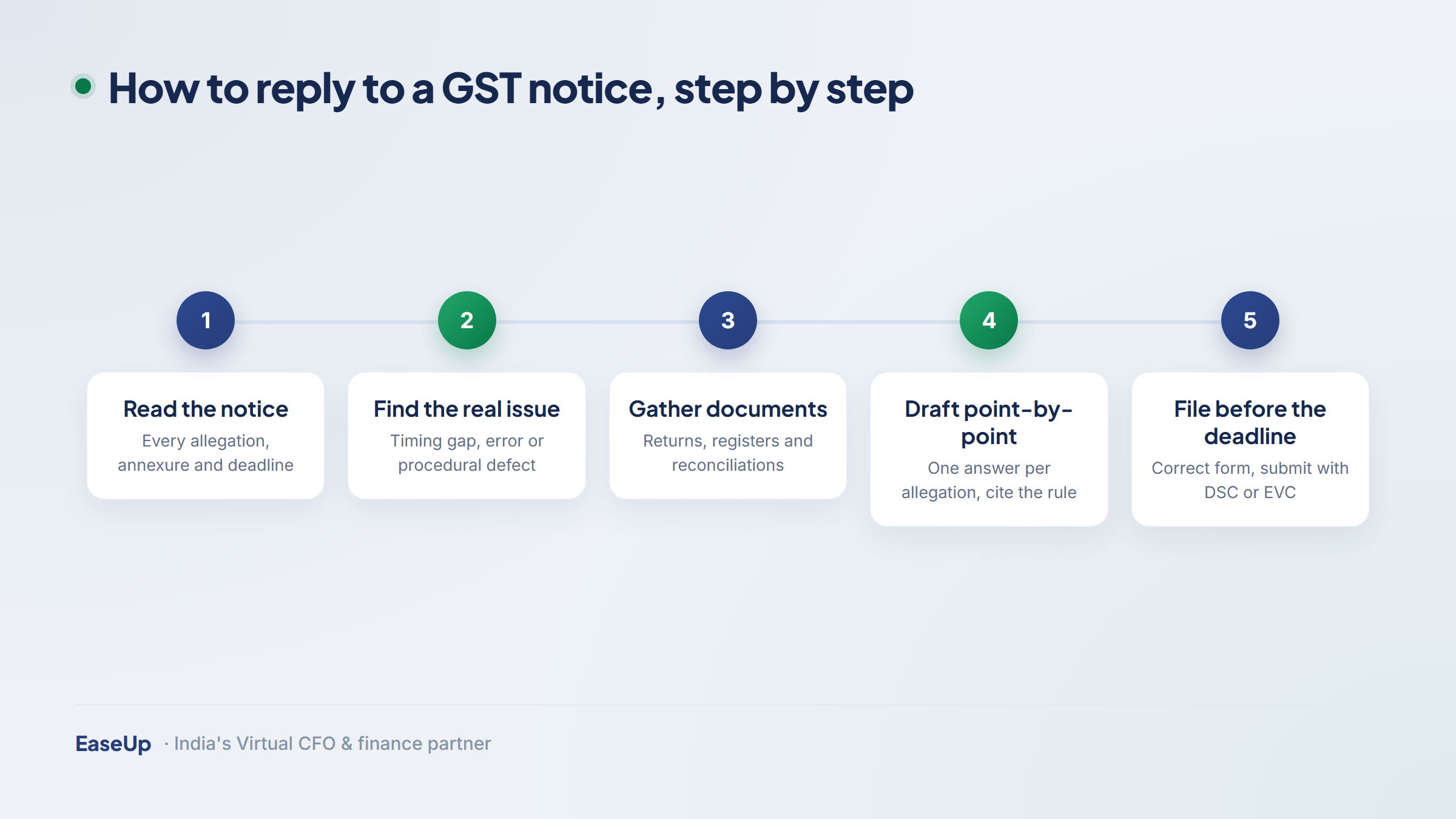
Read the full notice — download it, read every allegation and annexure, and note the type, tax period, deadline, potential exposure, and reply form.
Find the real issue — is it a timing mismatch, a genuine error, a later amendment, or a procedural defect? A notice is only the surface.
Gather documents — the best replies are document-led. Collect the returns, registers, reconciliations, and proofs the issue demands.
Draft point-by-point — answer each allegation separately, cite the relevant section and rule, and attach numbered annexures the officer can follow.
File before the deadline — log in, open the notice under your applications, upload the reply on the correct form, and submit with DSC or EVC.
Your document set depends on the notice, but most replies draw from the same shelf. Match the issue to the evidence:
Notice issue | Documents commonly needed |
GSTR-1 vs GSTR-3B mismatch | The relevant returns, a reconciliation statement, invoices, debit and credit notes, annual return support |
ITC mismatch | GSTR-2B, purchase register, supplier invoices, bank proof, goods-receipt or service proof, ITC reconciliation |
Demand notice (DRC-01) | Returns, ledgers, financial statements, prior submissions, reconciliations, legal notes, annexures |
Registration cancellation | Filed or pending return details, reason for delay, proof of business activity, corrective-action summary |
If your records live across spreadsheets, email threads, and accounting exports, replying well under pressure is hard. You can download your returns and notices directly from the GST services login to assemble the file quickly.
A strong reply is boring in the best way — clear, structured, and easy to verify. Restate each allegation, give your explanation, and point to the exact annexure that proves it. Lead with the facts, then the law.
One allegation, one response: never bundle answers together.
Reconcile in numbers: a table that ties GSTR-1, GSTR-3B, and GSTR-2B beats paragraphs of argument.
Cite the section and rule you are relying on, not just "as per GST law".
Number your annexures and reference them inline, so the officer never hunts for a document.
Ignoring the notice or assuming a wrong demand will simply lapse — it will not.
Replying to the notice as a whole instead of answering each allegation on its own.
Sending a bare denial with no reconciliation, invoices, or legal basis.
Missing the deadline by a day and losing the right to be heard.
Using the wrong reply form — an ASMT-10 answered outside ASMT-11 may be treated as no reply.
Once your reply is in, the officer reviews it. If satisfied, they close the matter with a DRC-05 order and nothing more is due. If not — or if you did not reply at all — they proceed to a DRC-07 demand order.
A DRC-07 is the outcome to avoid. It crystallises the demand, and your only remaining option is an appeal, which is slower and costlier than a good reply would have been. This is exactly why the first reply matters so much. When the exposure is material, looping in GST notice support early usually pays for itself.
Founder tip: If you genuinely need more time, ask for an adjournment before the deadline, not after. A short, reasoned request on record is far stronger than a silence the officer has to interpret.
A one-line REG-03 you can often clear yourself. A DRC-01 under Section 74, an audit, or a demand running into lakhs is not the place to learn on the job. The cost of a weak first reply — penalties, interest, and an appeal — usually dwarfs the cost of getting it right once.
You can verify the notice, cite the right provisions, and consult official guidance on the CBIC GST portal. But when the stakes are real, a specialist who drafts these every week will spot defences and traps you would not.
Ignoring a GST notice is the costliest choice you can make. If you do not reply within the deadline, the officer can pass an ex-parte demand order in Form DRC-07 based only on their view of the facts. That order crystallises the tax, interest, and penalty, and your only remaining route is a formal appeal — which is far slower and more expensive than a timely reply would have been.
It depends on the notice. Registration notices such as REG-03 and REG-17 usually allow 7 working days. A GSTR-3A non-filing reminder gives 15 days to file the pending return. Scrutiny notices (ASMT-10) and show cause demand notices (DRC-01) generally allow 30 days. Always confirm the exact deadline on the notice itself, and note whether it runs from the date of service or the date of issue.
DRC-01A is a pre-show-cause intimation — an early, informal heads-up that tax has been ascertained as payable, giving you a chance to pay or explain before formal proceedings begin. DRC-01 is the formal show cause notice that follows if the matter is not resolved. A strong response to a DRC-01A, filed in Part B of the form, can often stop the issue from escalating into a full DRC-01.
The reply form is tied to the notice. REG-03 is answered in REG-04, and REG-17 in REG-18. ASMT-10 is answered in ASMT-11. A DRC-01A is answered in its Part B, and a DRC-01 show cause notice is answered in DRC-06. A GSTR-3A is not answered by a form at all — you simply file the pending return. Using the wrong form can be treated as if you never replied.
Yes, in many cases. If you cannot compile a complete reply within the window, file a written request for an adjournment or extension before the original deadline expires, giving a clear reason. Extensions are granted at the authority’s discretion, so make the request early and keep it on record. Never let the deadline pass in silence and hope for leniency afterwards.
This guide is for general information only and does not constitute tax, legal or financial advice. GST provisions, forms and timelines change — confirm the current position with a qualified professional before you respond to any notice.


Your trusted partner for all your Financial needs.


Finance Management
Strategic Services