
TL;DR — recording a transaction in one minute
• Recording a business transaction means capturing every sale, purchase, payment or expense in your books with the right account, amount and tax treatment.
• Follow a simple loop: verify the document, check GST and TDS, pass the journal entry, post to ledgers, review the trial balance.
• India uses double-entry bookkeeping — every entry has an equal debit and credit, so your books always stay balanced.
• No entry without proof. Keep the tax invoice, voucher or contract — Companies Act records run for 8 years, GST records for 6 years (72 months).
• Most errors are tax errors: sales mismatches across GST returns, early ITC claims, and the wrong TDS section. Fix the process and you avoid notices.

Recording a business transaction means entering each sale, purchase, payment, receipt or expense in your books with the correct account, amount and tax treatment. Before you post anything, you check the supporting document and confirm whether GST, TDS or reverse charge applies.
Get this right and your accounts, tax returns and MIS reports all stay accurate. Skip the checks and one weak entry can trigger a GST mismatch, a filing error, or hours of cleanup at year-end. Clean books start at the point of entry, not at audit time.
If your entries are already piling up, structured bookkeeping brings order before the mess compounds.
India follows double-entry bookkeeping. Every transaction touches at least two accounts — one is debited and one is credited by the same amount. Because the two sides always match, your books stay balanced and your trial balance tells you at a glance if something is off.
Say you receive ₹1,18,000 from a customer. Your bank account is debited ₹1,18,000 and the customer’s receivable is credited ₹1,18,000. The money in equals the receivable cleared. That equal-and-opposite discipline is what keeps errors visible.
 Founder tip: You do not need to memorise debit and credit rules. Modern software applies them for you — but you do need to pick the right ledger and the right tax flag. That is where founders slip, not the arithmetic.
You can record almost any transaction with the same seven-step loop. Verify first, tax-check next, post, then review.
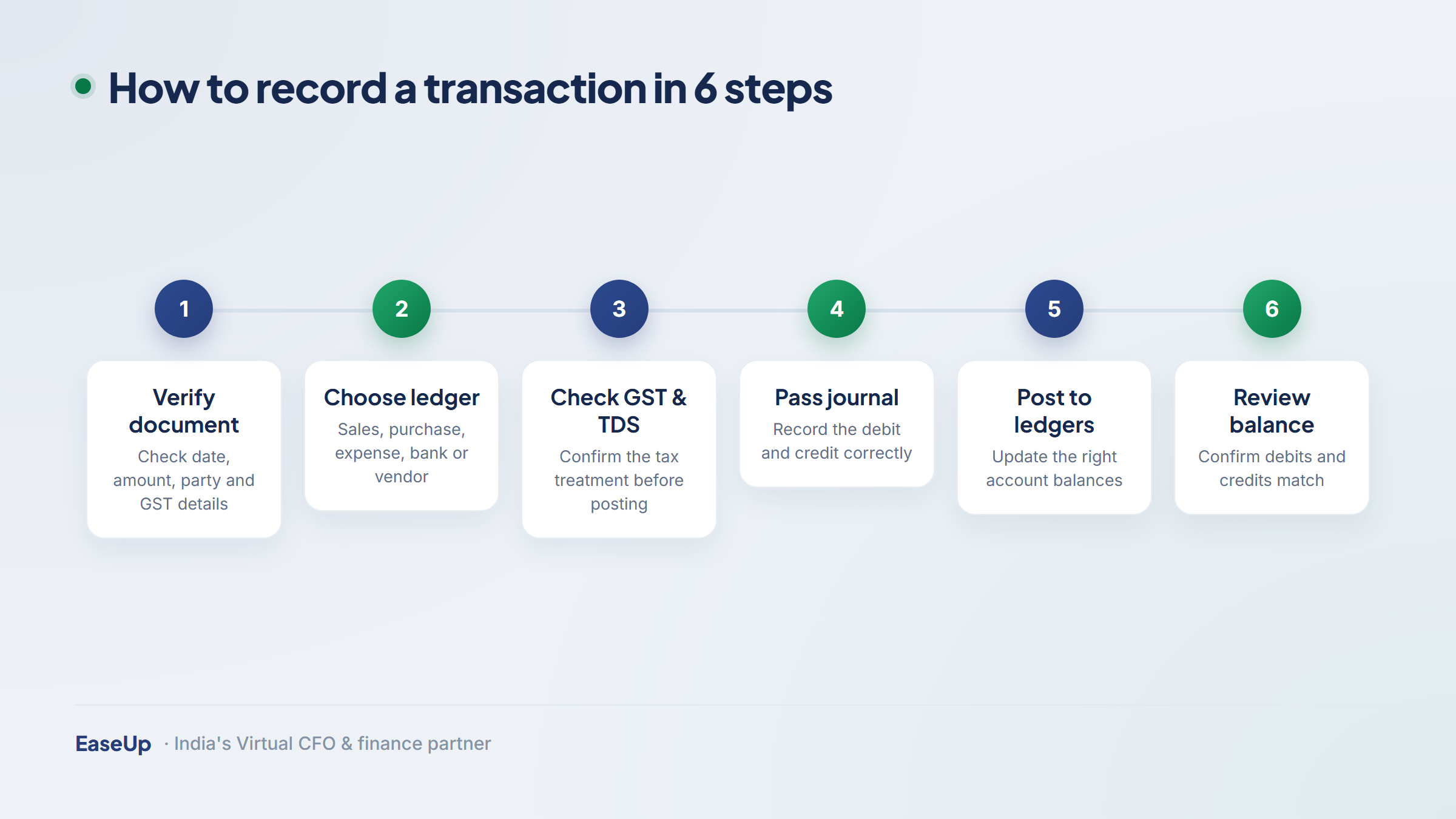
Verify the document — check the invoice, receipt or voucher. Confirm the date, amount, party name and GST details.
Choose the right ledger — pick the accounts affected: sales, purchase, expense, bank or vendor.
Classify the entry — place it under the correct business head so your reports and statements stay clear.
Check GST and TDS — confirm whether GST, TDS or reverse charge applies before you post.
Pass the journal entry — record the debit and credit with the correct values in your accounting software.
Post to the ledgers — make sure the entry updates the right account balances.
Review the trial balance — check that debits and credits match and spot any unusual balance early.
 Watch out: Never book an expense before you check TDS. Miss a deduction and you risk disallowance of the expense, interest, and extra cleanup when you file. The 30-second TDS check is cheaper than the correction.
You should never post an entry without proof. Keep the document that supports each transaction — it makes accounting and compliance, GST filing, statutory audit and lender due diligence far easier.
Document | When it applies | What it must carry |
Tax invoice | Every taxable B2B supply (Rule 46, CGST) | Your GSTIN, recipient GSTIN, HSN/SAC codes, unique serial number |
E-invoice (IRN) | Turnover above ₹5 crore in any FY since 2017-18 (Rule 48(4)) | A valid IRN and QR code from the government portal |
E-way bill | Moving goods worth over ₹50,000 | Transport and consignment details |
Vouchers | Internal payments, receipts and journals | Approval trail for the entry |
Debit / credit notes | Sales returns or price adjustments | Link back to the original invoice |
Retention is a legal duty, not a preference. Under Section 128 of the Companies Act, 2013, a company must keep its books for 8 financial years. Under Section 36 of the CGST Act, GST records must be kept for 72 months (6 years) from the due date of the annual return.
If any assessment, appeal or litigation is running, keep the records until that case is fully closed — even if the standard window has passed. You can confirm the current filing and record rules on the GST portal and the Ministry of Corporate Affairs portal.
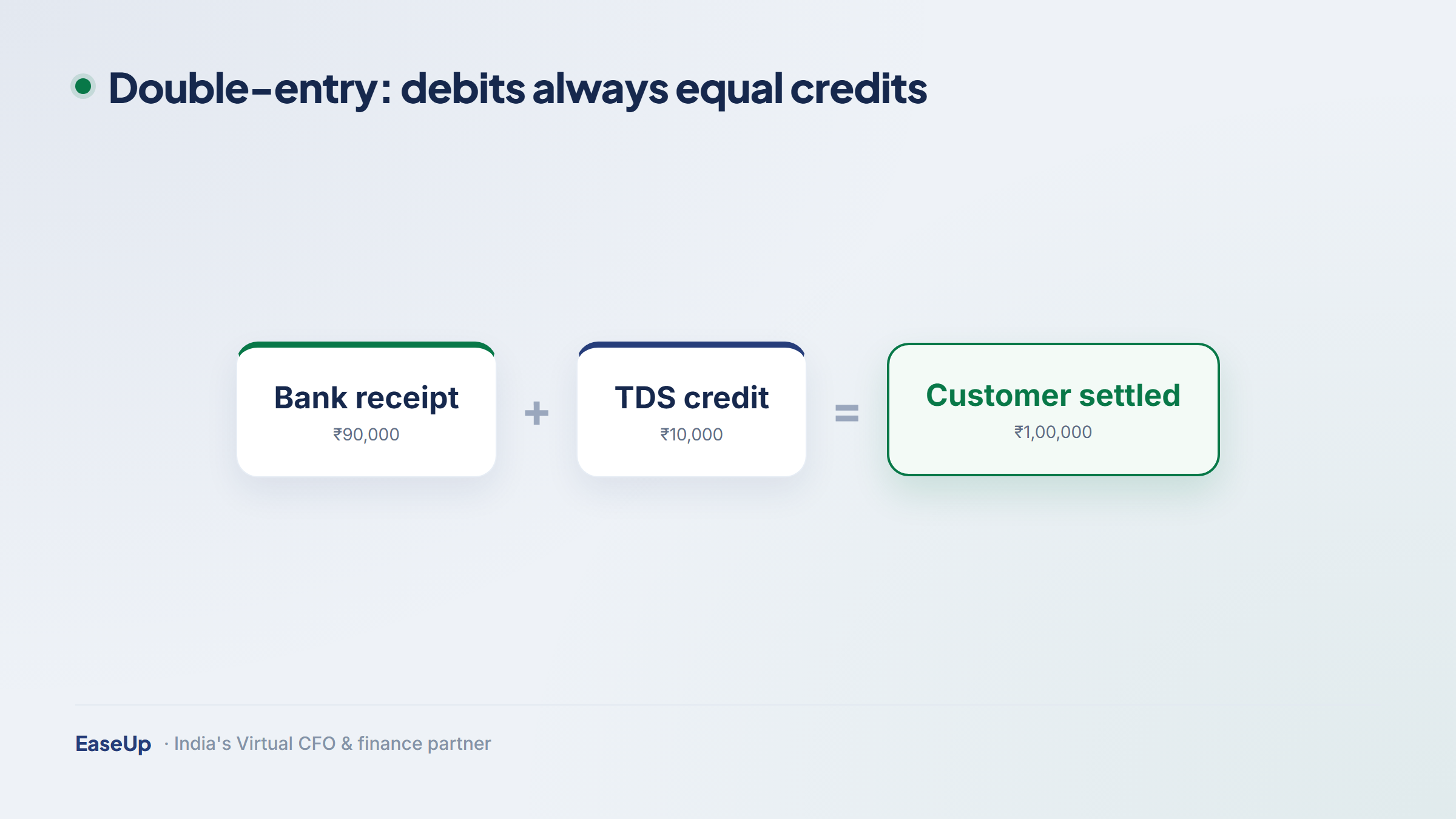
Use this when you raise a B2B invoice and the customer deducts TDS before paying. You record the sale, the output GST, the bank receipt and the TDS credit — separately.
Book the invoice — record the full sale value and the GST charged on it.
Record the receivable — show the total the customer owes, including GST.
Record the payment — post the bank receipt for the net amount after TDS.
Record the TDS separately — do not treat it as a loss. Book it as TDS credit receivable, which you claim against your own tax.
:info: Make the sale visible: Report the invoice in your GSTR-1 on time. If the buyer cannot see it in their GSTR-2B, they may hold payment or ask for corrections. Your entry and your return must tell the same story.
Use this when you pay legal fees and the reverse charge mechanism (RCM) applies. Here you record the expense first, then create the GST liability that you pay to the government yourself.
Record the legal expense — book the fee in the correct expense account.
Create the reverse-charge GST — raise the GST liability separately, because you pay this tax directly, not the supplier.
Raise the self-document — keep the internal payment voucher ready to support the tax entry.
Claim input credit if allowed — take the ITC only when the rule and your business use permit it.
Use this when you buy equipment or laptops for business use. Record it as a fixed asset, not a routine operating expense — the treatment changes your profit, your tax and your depreciation.
Record it as a fixed asset — do not book it under repairs or office expenses.
Check GST credit eligibility — claim input credit only if the asset qualifies under the rule.
Track payment timing — if the vendor is an MSME, a delayed payment can create compliance risk.
Start depreciation from the right date — so your books and asset register stay accurate.
Getting asset entries right also feeds cleaner MIS reporting, because your margins are not distorted by expensing something you should have capitalised.
The single most common recording error is the wrong TDS section. The rate and threshold depend on what you are paying for, so check before you post.
Section | Applies to | Rate | Threshold (FY 2025-26) |
194C | Payments to contractors | 1% (individual/HUF), 2% (others) | ₹30,000 single / ₹1,00,000 a year |
194J | Professional / technical fees | 10% professional, 2% technical | ₹50,000 a year |
Applying 194C at 2% where 194J at 10% should apply creates a short-deduction — and that means interest, corrections and follow-up notices. When in doubt, confirm the rate on the Income Tax Department TDS rates page.
Sales mismatch across returns — when GSTR-1 and GSTR-3B do not agree, you invite notices, payment delays and extra reconciliation.
Early ITC claims — claiming input tax credit before the invoice appears in GSTR-2B weakens your position and can force reversals later.
Wrong TDS section — deducting under 194C when 194J applies leads to short deduction, interest and corrections.
Missing e-invoice IRN — where e-invoicing is mandatory, a plain invoice without an IRN and QR code is a direct compliance breach.
Skipping the 26AS / AIS check — if a customer deducts TDS but never deposits it, your credit disappears and the gap surfaces only at filing.
The right tool depends on your size, your inventory and how much GST automation you want. Here is a quick comparison for Indian SMEs.
Feature | TallyPrime | Zoho Books |
Best for | Large inventory, CAs | Tech-first startups |
Indicative annual price | ₹22,500 + GST | ₹10,000 – ₹25,000 |
GSTR filing | Manual export | Direct API sync |
TDS module | Robust | User-friendly |
E-invoice | Native push | Native |
Multi-GSTIN | Complex setup | Integrated |
No tool records for you. It speeds up correct entries — but the ledger choice and the tax flag are still your call.
If entries are backing up, GST returns are not matching, or you are heading into an audit or fundraise, it pays to get expert hands on the books. A dedicated bookkeeping and accounting and compliance team keeps every entry tax-checked, documented and audit-ready — so month-end is a review, not a rescue.
It means entering each business event — a sale, purchase, payment, receipt or expense — into your books with the correct account, amount and tax treatment. In India you also confirm whether GST, TDS or reverse charge applies before you post, so your accounts, tax returns and reports all stay accurate.
Double-entry bookkeeping records every transaction in at least two accounts: one is debited and another is credited by the same amount. Because the two sides always match, your books stay balanced and your trial balance quickly reveals if an entry is wrong or missing.
Under Section 128 of the Companies Act, 2013, companies keep their books for 8 financial years. Under Section 36 of the CGST Act, GST records are kept for 72 months (6 years) from the due date of the annual return. If any case or assessment is pending, keep the records until it is fully closed.
Section 194C covers payments to contractors, deducted at 1% for individuals or HUFs and 2% for other entities, with a threshold of ₹30,000 per payment or ₹1,00,000 a year. Section 194J covers professional and technical fees at 10% (2% for technical services), with a ₹50,000 annual threshold for FY 2025-26. Using the wrong section causes short deduction and interest.
GSTR-1 reports your outward sales and GSTR-3B reports your summary tax. If the sales figures differ, the mismatch can trigger notices, hold up customer payments and force extra reconciliation. Recording each sale correctly and reporting it on time keeps both returns in agreement.
This guide is for general information only and does not constitute tax, legal or accounting advice. GST, TDS and record-keeping rules change — confirm the current position with a qualified professional before you rely on any entry treatment.


Your trusted partner for all your Financial needs.


Finance Management
Strategic Services