TL;DR — Investor meeting prep in one minute
• Investors judge more than your idea. They judge your clarity, numbers and judgment under pressure.
• Know the investor first: their stage, cheque size, sector and portfolio. Then frame your story to fit.
• Your financial story is the make-or-break part — revenue, burn, runway, margins and a clear use of funds.
• Prepare a tight 60-second opening, a clean deck, and honest answers to the hard questions.
• Have a data room ready before diligence. Missing cap tables and ROC filings kill more rounds than valuation fights.
You rarely get a second chance to make a first impression with an investor. Whether you are raising a pre-seed round, warming up for Series A, or meeting an angel who can open doors, the meeting can shape your whole fundraise.
Investors are not only checking your idea. They are checking your judgment, clarity and calm under pressure. A strong meeting shows you understand the business well enough to explain it simply.
Weak meetings usually fail for one of three reasons: the founder cannot explain the business crisply, the numbers do not hold up under questions, or the ask is vague and disconnected from milestones. If your financials still live in scattered spreadsheets, tightening your fundraise preparation before you start pitching saves you painful follow-ups later.
 Founder tip: Decide the single message you want the investor to remember after the meeting. Every slide, number and answer should push that one message. Focus beats polish.
Before the 15 tips, it helps to know what most investors quietly check in an early conversation. Frame your prep around these five things.
What they assess | What they want to see | What weakens confidence |
Market opportunity | A clear problem in a large, valuable market | A generic market story with no urgency |
Founder-market fit | A real reason your team should win | No credible edge or domain insight |
Traction | Proof that customers want what you built | Vision with no evidence |
Economics | A believable path to growth and returns | Confusing metrics or wild assumptions |
Execution readiness | A team that owns the next 12-18 months | Vague plans and unclear use of capital |
A coffee chat, a formal first pitch and a diligence session are very different conversations. Founders often over-prepare the wrong material because they never clarify the meeting type. Ask before you walk in.
Meeting type | Main goal | How to prepare |
Introductory call | Create interest and test fit | Sharp story, strong opening, top-line metrics |
First pitch meeting | Present the business case clearly | Full deck, key numbers, thoughtful Q&A prep |
Partner meeting | Build conviction across the team | Consistent narrative, stronger objection handling |
Diligence meeting | Validate assumptions and risks | Detailed financials, operating data, documents ready |
Not every investor is the right investor for you. Before the meeting, learn their fund size, cheque size, stage focus, sector and geography. Read their recent deals, interviews and public posts.
Warm introductions matter in India. Around 80% of successful raises start with a warm intro, while cold outreach converts below 5%. So the goal is simple: frame your story to fit what this investor already cares about.
Do they invest at your stage? A seed fund will not lead your Series B.
Have they backed similar models? SaaS, marketplace and D2C investors think very differently.
Do they lead rounds or follow? This changes who you need to close first.
What do they weigh most? Growth, margins, defensibility or founder insight.
Most institutional venture funds in India register with SEBI as Alternative Investment Funds. You can confirm a fund is registered on the SEBI portal before you share sensitive numbers.
This is where many strong pitches start to wobble. You need more than a revenue number and a runway guess. You need to explain how the business actually works with money.
At minimum, prepare a clean monthly revenue view, your current burn and runway, gross or contribution margin by model, customer concentration if it matters, forecast assumptions for the next 12-24 months, and a clear line on what this round unlocks.
For many teams, steady monthly virtual CFO support is what turns last-minute fundraising chaos into a confident, defensible narrative. It also means your numbers stay consistent from the deck to the data room.
 Watch out: Never let two documents disagree. If your deck says one revenue figure and your model says another, the investor stops trusting both. Reconcile every number before you send anything.
One of the first questions you will hear is some version of "Tell me about the company." Your answer should be short, clear and easy to repeat back. A simple structure works best:
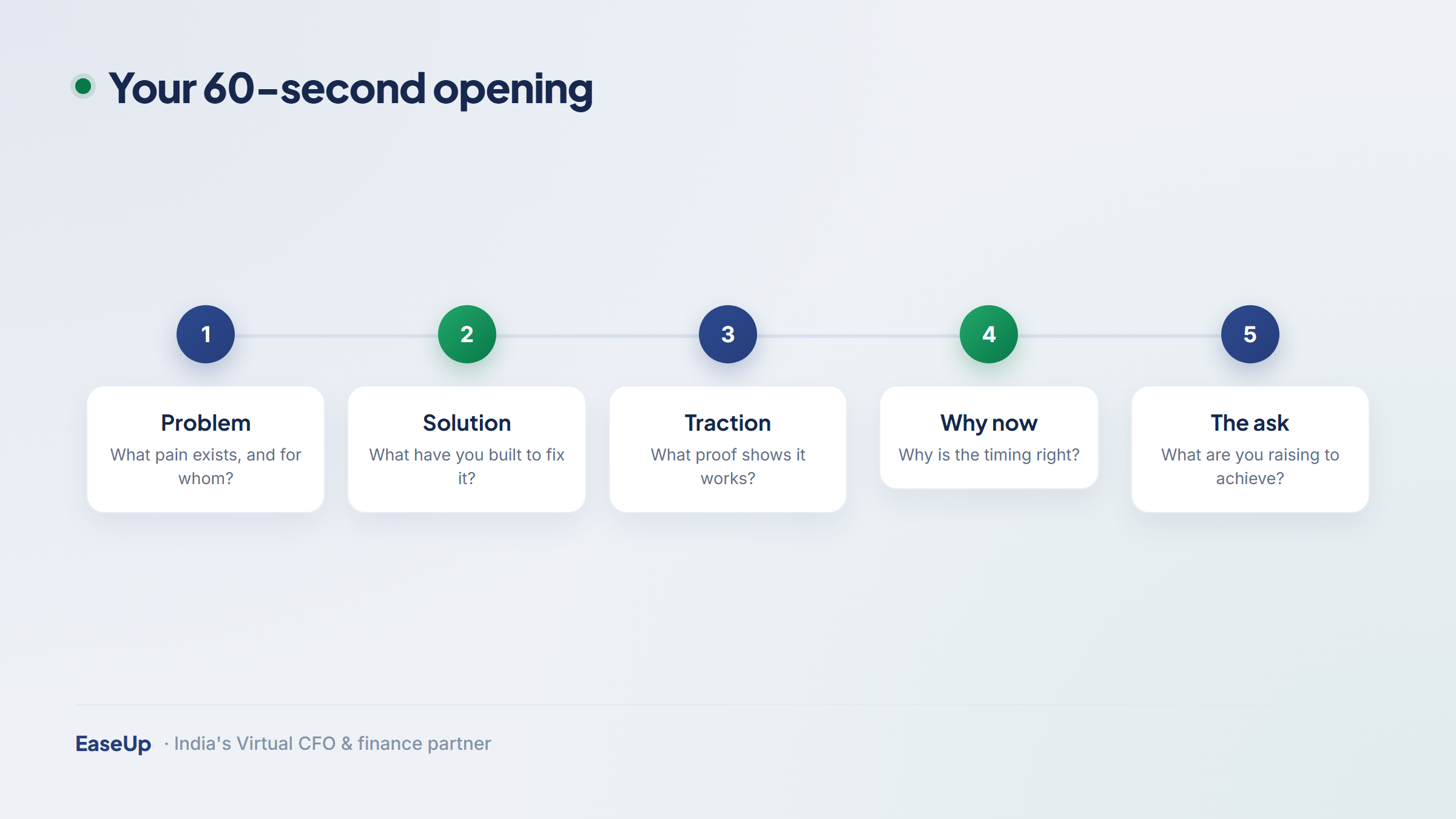
Problem — what pain exists, and for whom?
Solution — what have you built to fix it?
Traction — what proof suggests it is working?
Why now — why is the market timing right?
The ask — what are you raising to achieve?
If you ramble here, the rest of the meeting gets harder. If you are crisp, the meeting usually gets easier.
Your deck should walk the investor through the logic of the business. It should not make them read walls of text while you talk over them. In India, a 12-15 slide deck is standard, and going past 20 slides is a red flag.
A strong deck usually covers: problem, solution, market, traction, business model, go-to-market, competition, a financial snapshot, the team, and the ask with use of funds. Keep visuals clean and use numbers selectively. Say more in the room than the slide shows.
You can follow the official Startup India pitch deck guidelines for a stage-appropriate slide structure.
Investors listen differently when you open with evidence. Even modest traction is powerful when it is framed well. Traction does not always mean scale — it means proof that the business is working.
Growth: month-on-month revenue moving up and to the right.
Conversion: paid pilots turning into annual contracts.
Retention: customers staying and repeat purchases rising.
Efficiency: shorter sales cycles and improving gross margins.
Investors will pull on your metrics to see if they hold. You should recall the key ones from memory, and explain how each is calculated. Fumbling your own CAC or burn rate signals you are not close to the business.
Metric | Why investors ask | Have this ready |
MRR / ARR | Shows real, recurring demand | The latest figure and the growth rate |
Burn & runway | Shows how long the cash lasts | Monthly net burn and months of runway |
Gross margin | Shows if the model can scale | Margin by product or business line |
CAC & payback | Shows if growth is efficient | Cost to acquire and months to recover it |
Retention / churn | Shows if value actually sticks | Cohort retention or monthly churn |
If you are unsure any of these numbers are defensible, a quick business valuation exercise forces you to pressure-test the assumptions behind them before an investor does.
The best founders welcome tough questions instead of dodging them. Write down the five hardest questions about your business and rehearse honest, confident answers. Common ones include:
Why will you win? What stops a bigger, funded rival from copying you?
Why now? What has changed in the market to make this the moment?
What if growth stalls? How would you extend runway and adapt?
Why this ask? How does the amount map to clear milestones?
:info: Honesty builds trust: If you do not know an answer, say so and promise to follow up — then actually do it. A calm "I will get you that number by tomorrow" beats a confident guess that later turns out wrong.
A vague ask is one of the fastest ways to lose momentum. State how much you are raising, at what stage, and exactly what the money buys. Tie the amount to milestones, not to a round of hiring for its own sake.
Break the use of funds into simple buckets — product, team, sales and marketing, and a runway buffer. Show the investor the milestone this round gets you to, and why that milestone makes the next round easier to raise.
Founder tip: Anchor your ask to 18-24 months of runway toward a clear milestone. Raising too little forces another round before you have proof; raising too much dilutes you before your valuation has grown.
If the meeting goes well, diligence follows. Legal and financial diligence kills more rounds than valuation disagreements. Cap-table gaps, unsigned agreements and overdue filings are the usual culprits. So get your house in order early.
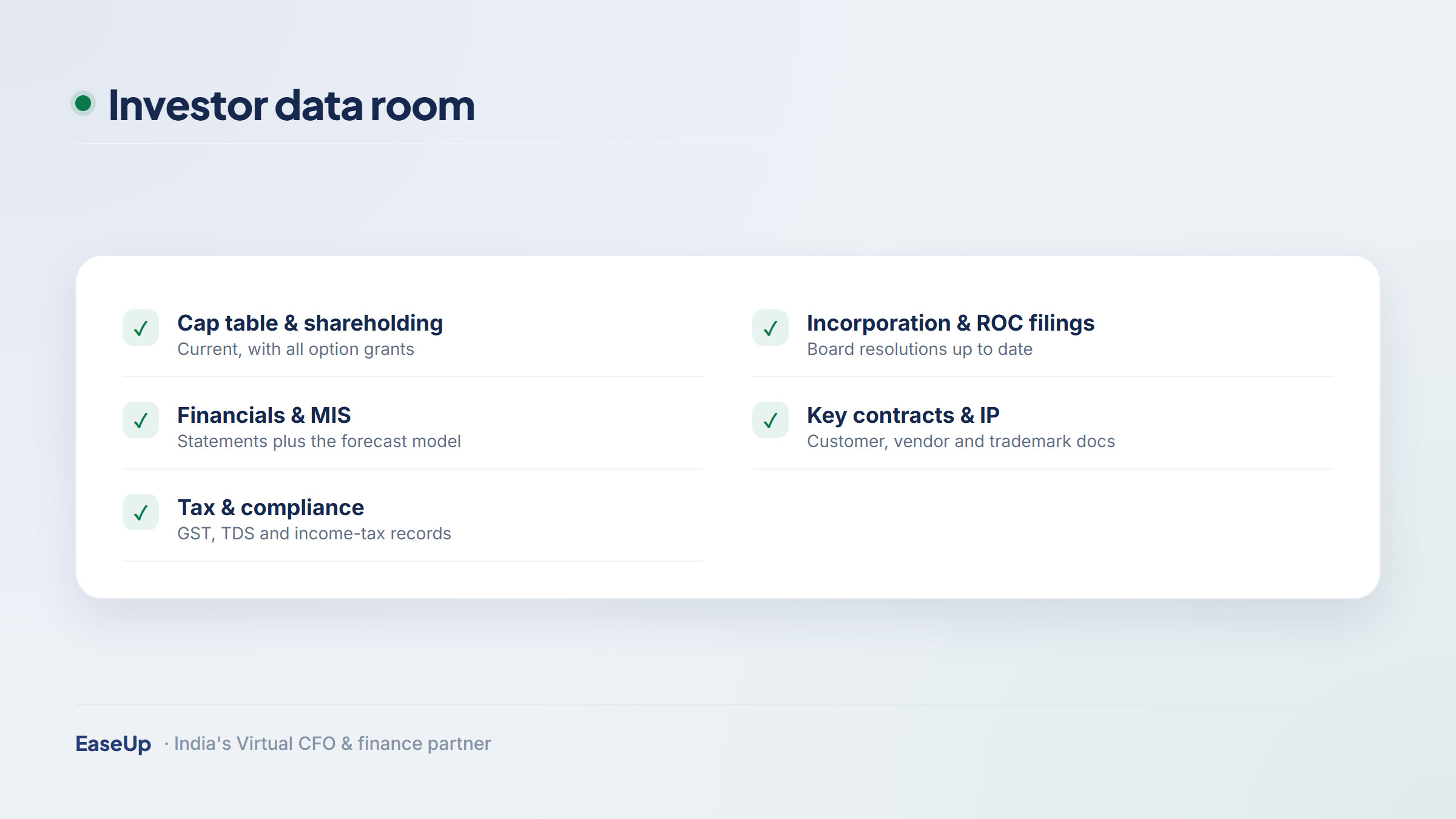
Document set | What to include |
Cap table & shareholding | A clean, current cap table with all option grants |
Corporate records | Incorporation papers, board resolutions and ROC filings |
Financials | Statements, monthly MIS and the forecast model |
Contracts & IP | Key customer, vendor and IP or trademark documents |
Tax & compliance | GST, TDS and income-tax filings, all up to date |
Keep company filings and board records current on the Ministry of Corporate Affairs portal. Investors and their lawyers will check these directly.
Pitching the wrong investor who never funds your stage or sector.
Talking product, not business — features instead of market, model and returns.
Numbers that do not reconcile across the deck, model and data room.
A vague ask with no link between the amount and clear milestones.
Getting defensive when challenged, instead of engaging calmly.
Most of these are preventable with preparation. The founders who close rounds are rarely the loudest in the room — they are the most prepared.
An investor raise touches finance, strategy and storytelling at once. If you are modelling your forecast, sizing the ask, or preparing a data room while still running the company, expert help prevents costly slips. A virtual CFO brings the numbers discipline, board-ready reporting and diligence readiness that let you focus on the pitch itself.
Start by researching the investor — their stage, cheque size, sector and portfolio — so you can frame your story to fit. Then get your financial story ready with clean revenue, burn, runway and margin numbers. Prepare a tight 60-second opening, a clean 12-15 slide deck, honest answers to hard questions, and a data room for diligence. Preparation, not polish, is what wins the room.
Investors validate five things early: a clear problem in a large market, a real reason your team should win, traction that proves customers want the product, believable economics, and a team that owns the next 12-18 months. They also judge your clarity and composure. A weak meeting usually fails because the founder cannot explain the business simply, the numbers do not hold up, or the ask is vague.
In India, a 12-15 slide deck is standard for a first meeting. Going past 20 slides is a red flag that you cannot prioritise. Cover problem, solution, market, traction, business model, go-to-market, competition, a financial snapshot, the team, and the ask with use of funds. The deck should guide the conversation, not replace it — say more in the room than the slide shows.
Have your monthly recurring revenue and growth rate, current net burn and runway in months, gross or contribution margin by business line, CAC and payback period, and cohort retention or churn. You should recall these from memory and explain how each is calculated. If any number feels shaky, pressure-test the assumptions behind it before an investor does.
A typical data room includes a clean, current cap table with all option grants, incorporation papers and ROC filings, financial statements with monthly MIS and the forecast model, key customer, vendor and IP contracts, and up-to-date GST, TDS and income-tax records. Cap-table gaps, unsigned agreements and overdue filings kill more rounds than valuation disagreements, so prepare these early.
This guide is for general information only and does not constitute financial, legal or investment advice. Fundraising norms and investor expectations vary — confirm your approach with a qualified professional before you start raising.


Your trusted partner for all your Financial needs.


Finance Management
Strategic Services