
TL;DR — Small business finance in one minute
• Keep personal and business money in separate accounts. Mixing them hides your real margins and creates a compliance mess.
• Track the big three: cash flow, burn rate and runway, and gross margin. You can be profitable on paper and still run out of cash.
• Treat your budget as a living forecast, not a January-only document. Review it monthly and keep a 10–15% buffer.
• Stay ahead of GST, TDS and ROC filings. A single missed deadline can block your input tax credit or attract penalties.
• When numbers outgrow a bookkeeper, a Virtual CFO adds strategy, forecasting and investor-ready reporting — without a full-time salary.
In India, MSMEs are the engine of the economy. They contribute roughly 31% of GDP and employ close to 33 crore people, according to the Economic Survey 2025-26. Yet many of these businesses still fail — and the leading reason is not a bad product. It is poor money management.
Financial management is the difference between a hobby and a real business. It is what tells you whether you can make payroll next month, take on a new order, or hire your next employee. This guide breaks the job into simple, India-specific habits any founder can start this week.
 Founder tip: Do not wait until things feel out of control. The founders who stay calm are the ones who built simple money habits early, while the business was still small enough to fix mistakes cheaply.
The most common mistake first-time founders make is mixing personal and business funds. This "commingling" makes it impossible to see your true margins, and it turns tax season into a nightmare.
Three habits fix it:
Dedicated business banking — never pay for a personal coffee with the business card, and never pay a vendor from your personal savings.
Cloud bookkeeping — move off manual spreadsheets to a platform like Zoho Books or Tally so your numbers update in real time.
An audit trail — keep a digital folder for every invoice and receipt. In the world of GST and income tax, if it is not documented, it did not happen.
Getting this right from day one is the whole point of clean bookkeeping. It is the foundation every other number rests on.
To run your business, look past the bank balance. Three numbers tell you almost everything about your financial health.
A. Cash flow is the timing of money in and out. You can be profitable on paper yet have nothing in the bank because customers have not paid you. This mismatch is the single biggest killer of small firms.
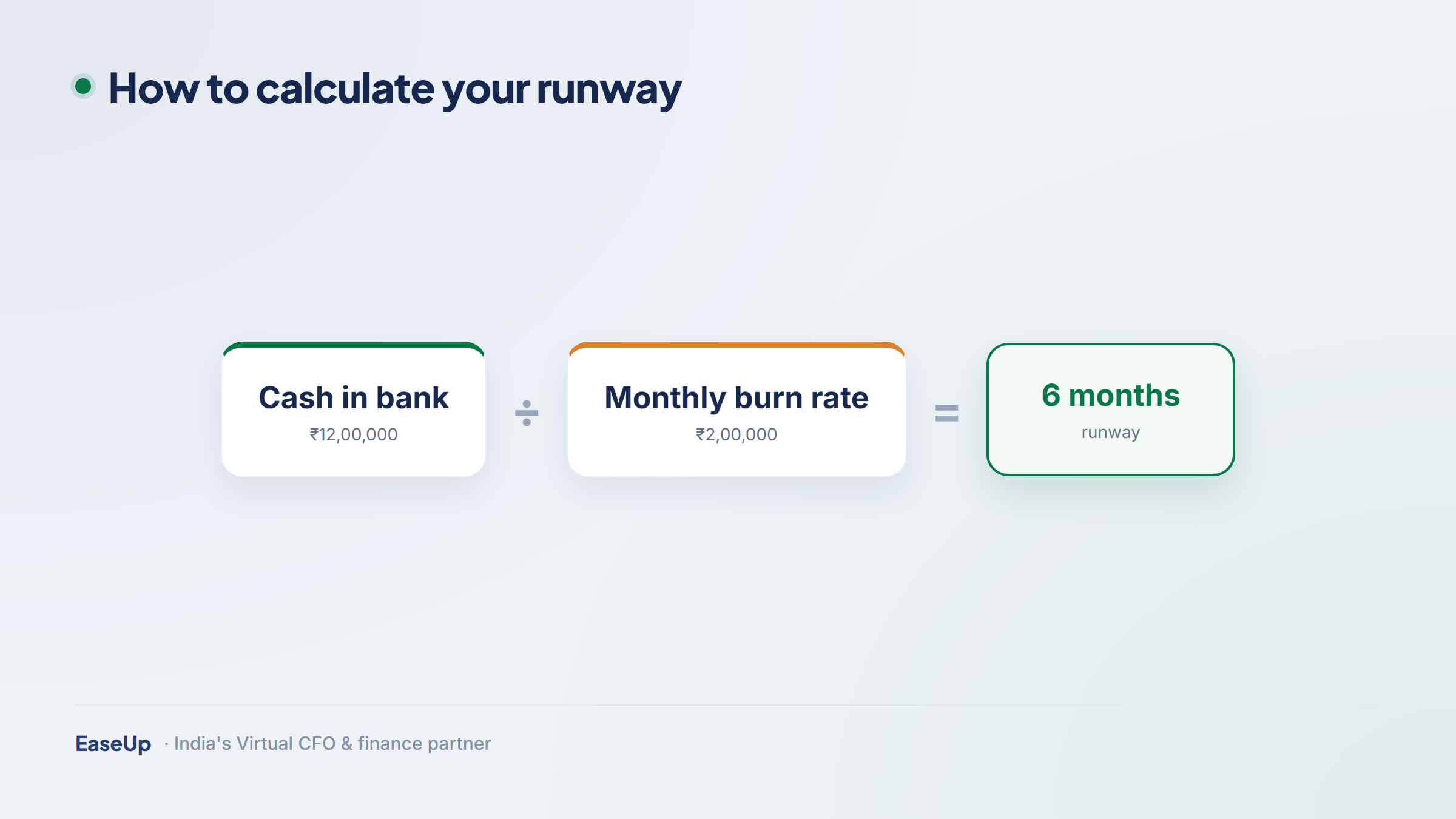
B. Burn rate and runway are your survival clock. Burn rate is the cash you lose each month. Runway is how many months you can last before the money runs out.
C. Gross profit margin is your health check. It tells you whether your product is sustainable after the cost of goods sold. If margins shrink as you grow, the business model is broken and scaling will only lose money faster.
 Watch out: If your runway drops below six months, act now. That is the window to cut costs or start a funding round — not the moment it hits zero. Founders who wait until month two lose all their negotiating power.
Cash flow problems usually come from slow-paying customers, not from low profit. You can improve it in weeks without raising a rupee of new capital:
Invoice the moment work is done, not at the end of the month.
Set clear terms — use Net-15 or Net-30 and automate polite reminders for overdue invoices.
Offer a small early-payment discount to pull cash in sooner.
Negotiate longer terms with vendors so money leaves your account later than it arrives.
There is also a hidden India-specific squeeze. Under GST, you often have to pay output tax before your customer has paid you, and input tax credit refunds can lag. Plan for that timing gap so a tax month never catches you short.
A budget is not something you make in January and forget by February. It is a living forecast you review every month against what actually happened.
A working budget should cover:
Category | What it includes | Why it matters |
Fixed costs | Rent, software subscriptions, insurance | They do not fall when sales dip — plan for them first |
Variable costs | Marketing, raw materials, shipping | These flex with revenue and are where you cut first |
Payroll & compliance | Salaries plus PF, ESI and Professional Tax | The true cost of a hire is more than the salary |
The buffer | 10–15% set aside for surprises | Protects you from the unexpected without new debt |
In India, financial mismanagement often turns into legal penalties. A missed deadline can cost far more than the tax itself. Stay proactive on three fronts:
GST filings — file GSTR-1 and GSTR-3B accurately and on time, or you risk blocking your own input tax credit. Check due dates on the official GST portal.
TDS compliance — deduct tax at source on vendor and salary payments, and deposit it on time. From FY 2026, Section 194T also brings partner payments into TDS. The rules live on the Income Tax Department site.
ROC filings — keep your annual Registrar of Companies filings current to stay in "Active" status. Forms and deadlines are on the MCA portal.
Getting this right early is cheap. Bringing in accounting and compliance support before a fundraise avoids a huge clean-up bill later, when an investor’s due diligence exposes years of gaps.
Not all debt is bad. The trick is knowing which kind you are taking on before you sign.
Type | Example | The test |
Strategic debt | A credit line to buy inventory for a confirmed order | The return on investment beats the interest rate |
Toxic debt | A high-interest credit card to cover this month’s payroll | It only delays a problem you have not fixed |
Before any loan, ask two questions: is the return higher than the interest cost, and will this debt genuinely improve cash flow — or just push the pain to next quarter?
Most small businesses hit the same wall of problems. Knowing them in advance is half the battle.
Challenge | What it looks like | How to overcome it |
Limited access to capital | Loans refused for thin credit history or no collateral | Prepare investor-ready statements that prove viability |
Cash flow volatility | Irregular income and delayed payments strain payroll | Tighten receivables and hold an emergency fund |
Tax non-compliance | Missed GST or TDS deadlines trigger penalties | Automate filings and set calendar reminders |
Over-reliance on one client | A single client is over half your revenue | Diversify the customer base deliberately |
Founder dependence | The business stalls whenever you step away | Build systems and automated reporting |
Founder tip: If one client is more than 50% of your revenue, treat that as an emergency, not a win. Start winning smaller clients now, while the big one is still happy.
You do not need a finance degree to build a durable business. Start these four practices today:
Budget dynamically — review monthly, not once a year, so you catch problems while they are small.
Keep money separate — dedicated business accounts keep your books clean and legal.
Automate tracking — let modern tools handle reporting so your numbers are always current.
Build an emergency fund — aim for the 3-6 month rule: enough cash to cover operating costs for half a year.
As your business grows, a part-time bookkeeper is no longer enough. Bookkeeping tells you what already happened. You start needing someone to tell you what to do next. That is the job of a Virtual CFO.
Founders bring one in for a few clear reasons:
Fundraising support — investor-ready models, pitch decks and financial projections.
Unit economics — working out which products and customers actually make money.
Proactive debt management — structuring finance to protect cash flow, not strain it.
Internal controls — preventing fraud and waste as the team grows.
A Virtual CFO gives you a senior finance brain at a fraction of a full-time salary — the same strategy without the overhead.
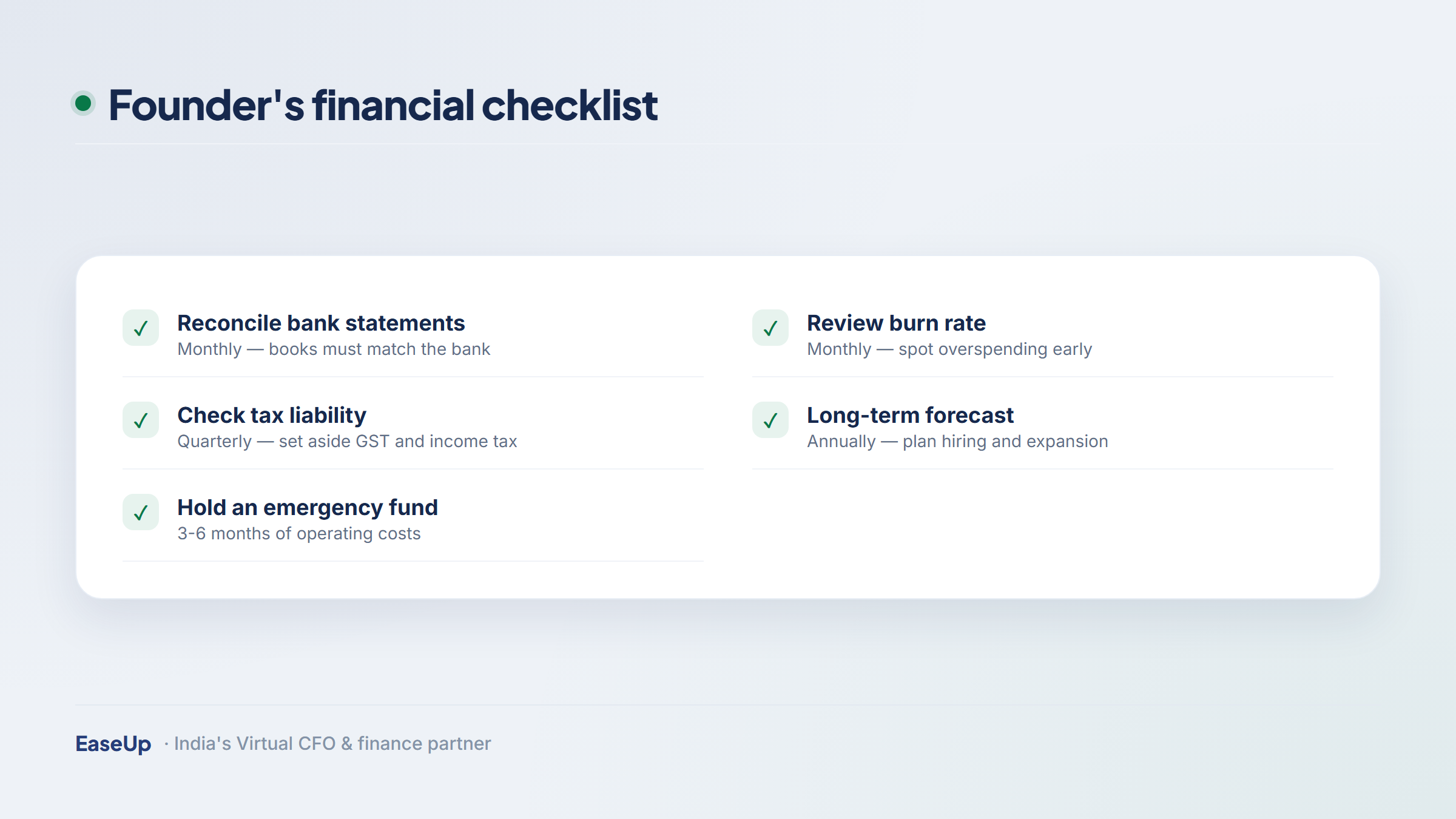
Money management is a rhythm, not a one-off task. This simple cadence keeps you in control:
Frequency | Task | Goal |
Monthly | Reconcile bank statements | Make sure your books match your bank |
Monthly | Review burn rate | Check you are not spending faster than planned |
Quarterly | Review tax liability | Set aside enough cash for GST and income tax |
Annually | Long-term forecasting | Plan next year’s hiring and expansion |
Separating your accounts, mastering cash flow and staying compliant will take you a long way. But when the numbers start to feel overwhelming, that is a signal to get help — not to guess.
EaseUp takes the financial weight off founders, from day-to-day bookkeeping to high-level Virtual CFO advisory. Stop guessing your growth and get the clarity you need to scale with confidence.
Cash runway is usually the most important. Revenue and profit matter, but runway tells you exactly how many months you can survive at your current burn rate. As long as you have runway, you have time to fix everything else. Track it every month.
Invoice as soon as work is done, offer a small discount for early payment, automate reminders for overdue invoices, and negotiate longer payment terms with your vendors. These steps pull cash in sooner and push it out later, without taking on any new debt.
Most failures come from poor cash flow management, limited access to capital, and not planning for future expenses. A business can be profitable on paper yet still collapse because customers pay late and the bank account runs dry. Systems and forecasting prevent this.
The core ones are GST returns (GSTR-1 and GSTR-3B), TDS deductions and deposits, and annual ROC filings for registered companies. Missing any of these can lead to penalties or a blocked input tax credit, so automate them and keep a calendar of due dates.
Most SMEs do not need a full-time CFO until they cross significant revenue milestones. Before that, a Virtual CFO gives you the same strategic value — forecasting, fundraising support and unit-economics analysis — at a fraction of the cost of a full-time hire.
This guide is for general information only and does not constitute tax, legal or financial advice. Rules and thresholds change — confirm the current position with a qualified professional before acting on it.


Your trusted partner for all your Financial needs.


Finance Management
Strategic Services