
To do a business valuation in India, first identify the transaction, then choose the method that fits the business, and finally get the report certified by the right professional. In most cases, growth-stage startups use DCF, later-stage or profitable businesses are benchmarked with comparable multiples, asset-heavy companies use NAV as a floor, and very early-stage businesses may need OPM or PWERM to reflect uncertainty.
The goal is not just to arrive at a number. It is to produce a valuation that stands up with investors, tax authorities, regulators, and acquirers because the method, assumptions, and certifier all match the event. If you are issuing shares, raising foreign capital, creating an ESOP pool, or planning a merger, the correct approach changes with the transaction.
In India, that usually means aligning the valuation with the Companies Act, FEMA, and Rule 11UA before the report is issued. Get the method or certifier wrong, and you can delay a deal, weaken your position in negotiations, or create avoidable compliance and tax issues.
A valuation report is not universally reusable across every corporate milestone. The legal trigger behind the transaction determines both the valuation method and the type of professional who is allowed to certify it. Use the table below as a practical reference before you issue shares, structure ESOPs, or proceed with a merger-related transaction.
Corporate Event | Governing Law / Section | Who Must Certify |
|---|---|---|
Raising FDI / Foreign Capital | FEMA Pricing Guidelines | SEBI Registered Merchant Banker, CA or Cost Accountant |
Issuing Shares to Domestic Investors | Companies Act, Sec 42 & Sec 62 | IBBI-Registered Valuer |
Setting up an ESOP Pool | Income Tax Rules, Rule 3(8) | Category-I Merchant Banker |
Mergers, Acquisitions, or Swaps | Companies Act, Sec 230–232 | IBBI-Registered Valuer |
IMPORTANT
Always verify your valuer's credentials directly on the IBBI Registered Valuers Portal before signing the engagement. Using a professional without the correct, active registration will invalidate your filings.
If you are unsure which valuation route applies to your next round, ESOP plan, or restructuring event, get the transaction mapped before you appoint the certifier. That early step saves time, reduces rework, and keeps the process compliant from the start.
There is no single valuation formula that works for every business. The right method depends on how predictable your cash flows are, how asset-heavy the company is, what stage of growth you are in, and what a regulator or investor will expect to see. The comparison below shows when each method is most useful and what assumptions typically drive the final number.
Practitioner note: We often see founders bring a DCF prepared for a fundraise and try to reuse the same logic for an ESOP grant or FEMA-related transaction. The numbers may still look reasonable, but the report usually has to be rebuilt because the legal trigger, certifier, and supporting documentation are different.
Valuation Method | Primary Use Case | Key Drivers & Tolerances |
|---|---|---|
Discounted Cash Flow (DCF) | Growth-stage startups & SaaS | 5-year revenue projections, WACC, terminal growth rate |
Comparable Company Multiple (CCM) | Profitable companies & Series A+ | EV/Revenue, EV/EBITDA multiples, listed peer metrics |
Net Asset Value (NAV) | Asset-heavy or holding companies | Book value of tangible assets, Ind AS revaluation |
OPM / PWERM | Early-stage, high-uncertainty | Probability-weighted outcomes, option pricing math |
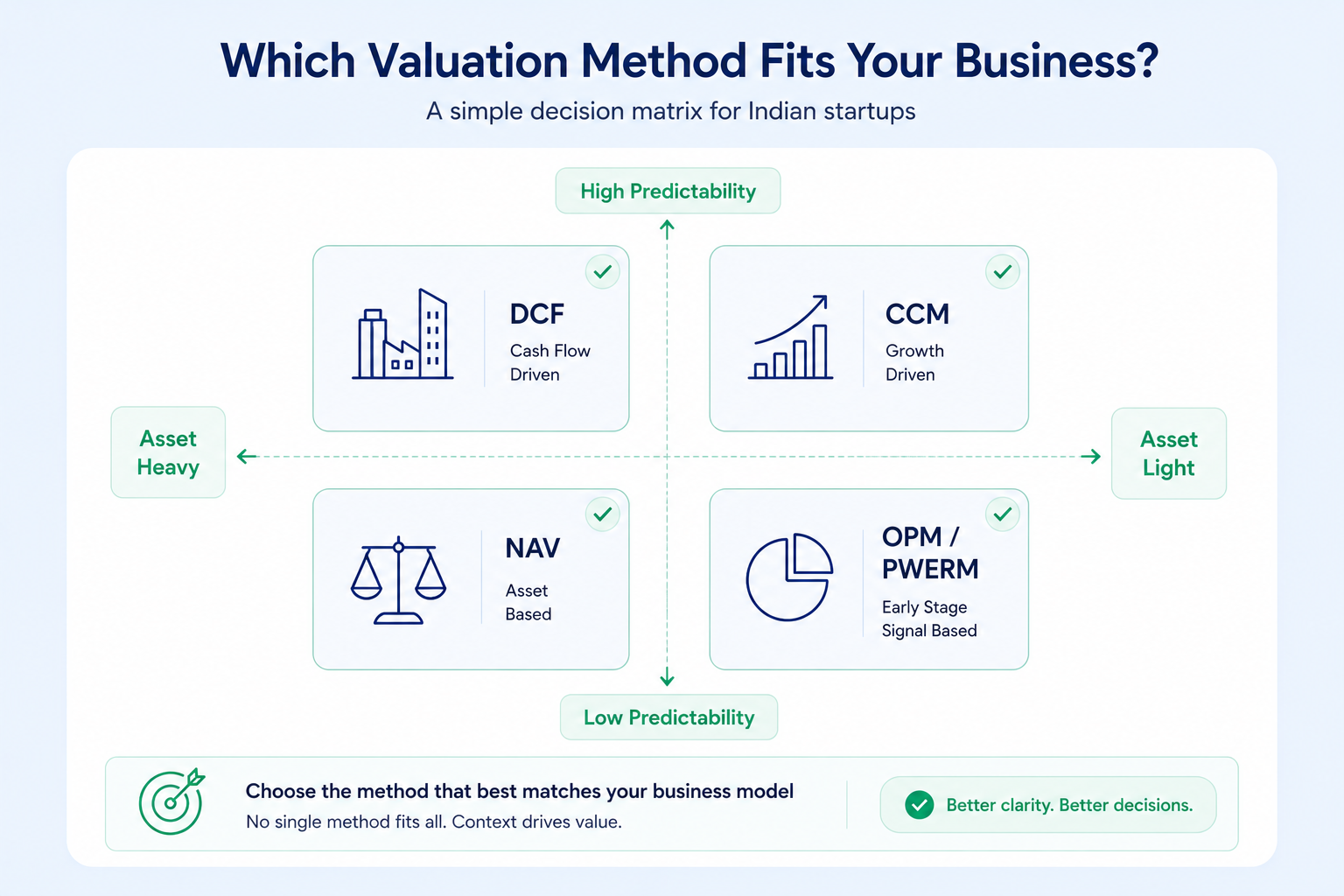
The right method depends on your stage, business model, and financial profile. Use these simple rules as a starting point:
For a high-growth SaaS business, DCF is usually the best fit. It works well when your recurring revenue and future cash flows are reasonably predictable.
For a Series A or later round, CCM is often useful. It compares your business with similar public companies or recent private deals using metrics such as ARR, revenue, or EBITDA.
For an asset-heavy business or an insolvency case, NAV helps set a valuation floor based on your net tangible assets.
For a pre-revenue or seed-stage company, OPM or PWERM is better suited to uncertainty. These methods are useful when the business is too early for stable cash-flow forecasts.
Most valuation disputes do not begin with arithmetic mistakes. They begin with weak assumptions, the wrong certifier, or poor documentation. If you want your valuation to hold up during diligence or tax review, avoid the four issues below first.
Unrealistic projections: If your DCF assumes aggressive growth without a clear bottom-up plan, it can be challenged quickly. Forecasts need to be backed by realistic assumptions on revenue, hiring, pricing, and execution. Otherwise, the valuation may be rejected and your shares may be reassessed.
Wrong certifier: The person signing the report must match the transaction. An IBBI-registered valuer may be valid for Companies Act matters, but ESOP perquisite valuations require a Category-I Merchant Banker. A mismatch here can weaken the entire exercise.
Pricing far from certified FMV: The old 10% "safe harbour" under Rule 11UA applied to angel tax, which was abolished for shares issued from 1 April 2025 — so it no longer protects a share issuance. The live rule now: under FEMA, shares to non-residents must be issued at or above FMV, with no downward tolerance. Any large premium over FMV should still be backed by a documented commercial rationale to survive diligence and Section 68 source-of-funds queries.
Using an outdated report: A valuation report cannot be reused indefinitely. In most cases, it is treated as valid only for a limited period, and for FEMA filings it should align closely with the actual allotment date. Relying on an old report can create compliance problems.
A strong valuation starts long before the valuer begins modelling. If your cap table is inconsistent, your MIS is incomplete, or your financials are still being reconciled, the final report becomes harder to defend and easier to discount. These three preparation steps improve both the credibility of the exercise and the quality of the outcome.
Practitioner note: In live valuation assignments, the first bottleneck is usually not the model. It is mismatched working files — the cap table, CCPS terms, board approvals, and latest MIS often do not line up on day one. When those are reconciled before the valuer starts, review cycles tend to move faster and fewer assumptions need to be reopened during diligence.
Reconcile your cap table: Ensure all shares, options, and convertible instruments (like CCPS) align perfectly with your MCA filings. If you are preparing for investor scrutiny, read the what is due diligence guide to identify cap table red flags early.
Structure detailed MIS reports: Your management accounts should present clear metrics, including revenue by segment, gross margin, burn rate, and runway.
Secure audited financials: Valuers discount unaudited numbers immediately. Clean, audited books prove financial discipline, giving investors and regulators high confidence.
If you want to ensure your books are ready, working with a partner to build robust financial projections for investors is highly recommended. You can also evaluate the virtual cfo cost India pricing guide to see how outsourced expertise can handle this preparation end-to-end.
A business valuation should do two jobs at once: satisfy the legal requirement behind the transaction and support the commercial conversation around pricing. EaseUp helps founders and finance teams get both right with event-specific guidance, qualified certifiers, and documentation that stands up during review.
Access to the right SEBI or IBBI-qualified professional for the specific transaction at hand
Support across valuation, documentation, and filing coordination, including foreign investment compliance where needed
IBBI-registered valuers typically charge between ₹30,000 and ₹2,00,000 for startup equity valuations. Category-I Merchant Bankers for ESOP valuations usually charge ₹75,000 to ₹3,00,000, depending on complexity and scope.
The DCF (Discounted Cash Flow) method is forward-looking and projects future cash flows, while the CCM (Comparable Company Multiple) method values your business by comparing it with relevant public or private peers. In short, DCF is projection-based, while CCM is market-anchored.
Valuation reports are generally valid for six months. For FEMA and RBI filings, the valuation report should be contemporaneous with the actual share allotment so the pricing remains defensible at the time of the transaction.
You can prepare a rough internal estimate for planning purposes, but a self-prepared valuation has no legal standing for regulatory compliance, FDI, or formal share allotments. For those cases, you should engage the appropriate certified professional.


Your trusted partner for all your Financial needs.


Finance Management
Strategic Services