TL;DR — the 30-second version
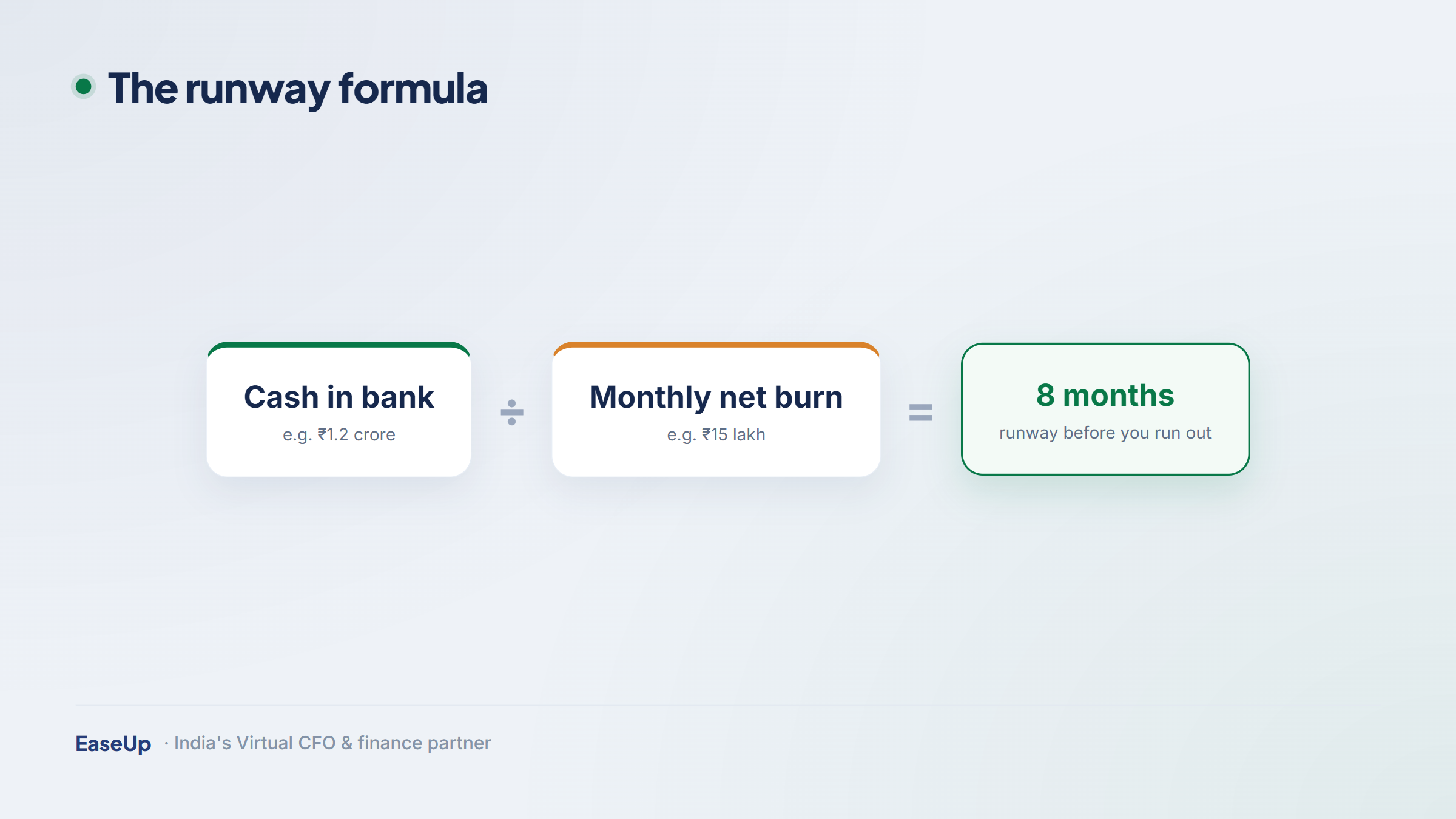
• Runway = cash in the bank ÷ monthly net burn. It tells you how many months you can survive before the money runs out.
• Net burn = monthly spend minus cash you actually collect. Use net burn, not gross burn, for a real runway number.
• Aim for 12-18 months of runway. Indian fundraising takes 4-8 months, so start raising while you still have 6+ months left.
• Example: Rs 1.2 crore in the bank, Rs 15 lakh net burn = 8 months of runway.
• In India, your burn also hides GST, TDS and advance-tax timing. Plan for them or your runway is shorter than the spreadsheet says.
Every founder has felt it: that quiet 2 a.m. question — how long until the money runs out? Your runway is the answer. It is one number, but it drives almost every big decision you make: when to hire, when to raise, when to cut, and when to push.
The good news is the maths is simple. The trap is that most founders use the wrong inputs, forget India-specific cash drains like GST and advance tax, and end up with a runway number that is too optimistic. This guide fixes that. Plain formulas, copyable rupee examples, and the FY 2025-26 reality of running a startup or SME in India.
Runway is the number of months your business can keep operating before it runs out of cash, assuming nothing else changes. Think of it like fuel in a plane. The plane is your company, the fuel is your cash, and the runway tells you how far you can fly before you need to refuel (raise money) or land safely (reach break-even).
Runway is not the same as profit or revenue. A company can be growing fast and still have a short runway. What matters is cash in the bank versus cash going out. That is it.
 Note: Runway is always measured in months, never in rupees. When an investor asks "what is your runway?", they want a number like "9 months", not your bank balance.
Runway (in months) = Cash in the bank ÷ Monthly net burn rate.
Cash in the bank is your total usable cash across current accounts, fixed deposits you can break, and any committed funding already received. Monthly net burn is how much cash you lose each month after counting the cash you collect.
The big mistake? Using gross burn (total spend) instead of net burn (spend minus revenue collected). Gross burn makes your runway look shorter than it is if you have real revenue. Net burn gives you the true picture.
 Watch out: Use cash actually collected, not invoiced revenue. If you raised an invoice but the client has not paid, that money is not in your runway. In India, payment delays of 60-90 days are common, so revenue on paper can be very different from cash in hand.
These two terms confuse a lot of founders, so let us make them concrete.
Gross burn. Your total monthly cash outflow — salaries, rent, cloud bills, marketing, compliance fees. Everything that leaves your account, regardless of revenue.
Net burn. Gross burn minus the cash revenue you actually collected that month. This is the number that empties your bank account.
Use net burn for your runway calculation. Track gross burn separately so you know your fixed cost base — it matters when revenue suddenly drops to zero, which is the scenario investors stress-test.
If your spend is steady, take one clean month. If it jumps around (most startups), use a 3-month average so one odd month does not throw the number off.
Pick your period. Use the last 3 months of bank statements for a reliable average.
Add up total cash out. Salaries, rent, software, marketing, vendor payments, taxes paid, EMIs — everything.
Add up total cash in. Only money that actually hit your account: customer payments, interest, GST refunds received.
Subtract. Cash out minus cash in = net burn for the period.
Divide by months. Net burn for the period ÷ number of months = average monthly net burn.
A simple, repeatable way to do this every month is the job of solid bookkeeping. If your books are messy, your burn number is a guess — and a guess is dangerous when survival is on the line.
Let us run a realistic FY 2025-26 example for a Bengaluru-based SaaS startup. Here is one month of cash flow.
Item | Amount (per month) | Type |
Cash in the bank | Rs 1,20,00,000 | Starting cash |
Salaries (team of 12) | Rs 18,00,000 | Cash out |
Office rent + utilities | Rs 2,50,000 | Cash out |
Cloud + SaaS tools | Rs 3,00,000 | Cash out |
Marketing + sales | Rs 4,00,000 | Cash out |
Compliance, legal, CA fees | Rs 1,50,000 | Cash out |
Gross burn (total out) | Rs 29,00,000 | Subtotal |
Revenue collected (cash) | Rs 14,00,000 | Cash in |
Net burn | Rs 15,00,000 | Result |
Runway = Rs 1,20,00,000 ÷ Rs 15,00,000 = 8 months.
So this startup has 8 months before it must either raise, cut costs, or hit break-even. Because Indian rounds take time, this founder should already be talking to investors today.
Runway is not just a startup word. A bootstrapped services SME — say a digital agency in Pune — needs it too, especially when a big client delays payment.
Scenario | Cash in bank | Monthly net burn | Runway |
Normal month | Rs 40,00,000 | Rs 5,00,000 | 8 months |
Top client pauses (revenue drops) | Rs 40,00,000 | Rs 12,00,000 | 3.3 months |
After cutting non-essential spend | Rs 40,00,000 | Rs 8,00,000 | 5 months |
Notice how runway collapsed from 8 months to 3.3 months the moment one client paused. This is why SME owners should run a "what if my biggest customer leaves?" version of the calculation. Strong financial planning and forecasting turns this from a panic into a plan.
Most global runway guides ignore the cash-flow quirks of running a business in India. These three line items quietly shorten your real runway:
GST. You collect Goods and Services Tax from customers and pay it to the government monthly. It is not your money, but it sits in your account until you remit it — easy to overspend by mistake. Input Tax Credit can also take a month or two to reconcile via your GSTR-2B. Reference the official portal at gst.gov.in.
TDS. Tax Deducted at Source on salaries, rent and vendor payments must be deposited by the 7th of the next month. TDS deducted in March, however, is due by 30 April, not 7 April. It is a fixed monthly cash outflow you cannot skip. See incometax.gov.in for due dates.
Advance tax. If your tax liability after TDS is likely to cross Rs 10,000 for the year, advance tax is due in four instalments across the year. A single instalment can be a big lumpy hit to one month's cash.
:check_mark_button: Founder tip: Keep GST and TDS collected in a separate mental (or actual) bucket. Treating tax money as spendable cash is one of the fastest ways founders accidentally torch their runway.
There is no single right answer, but here are practical benchmarks for the Indian market in FY 2025-26.
Stage | Healthy runway | Why |
Pre-seed / idea | 12-18 months | You need time to find product-market fit before raising again. |
Seed | 15-18 months | Enough to hit Series A metrics plus a 4-8 month raise. |
Series A and beyond | 18-24 months | Bigger rounds take longer; investors expect a buffer. |
Bootstrapped SME | 6-12 months | No external rescue, so a cash cushion is survival insurance. |
The golden rule: start raising when you have 6+ months of runway left, not when you have 2. Investors can smell desperation, and a short runway weakens your negotiating position.
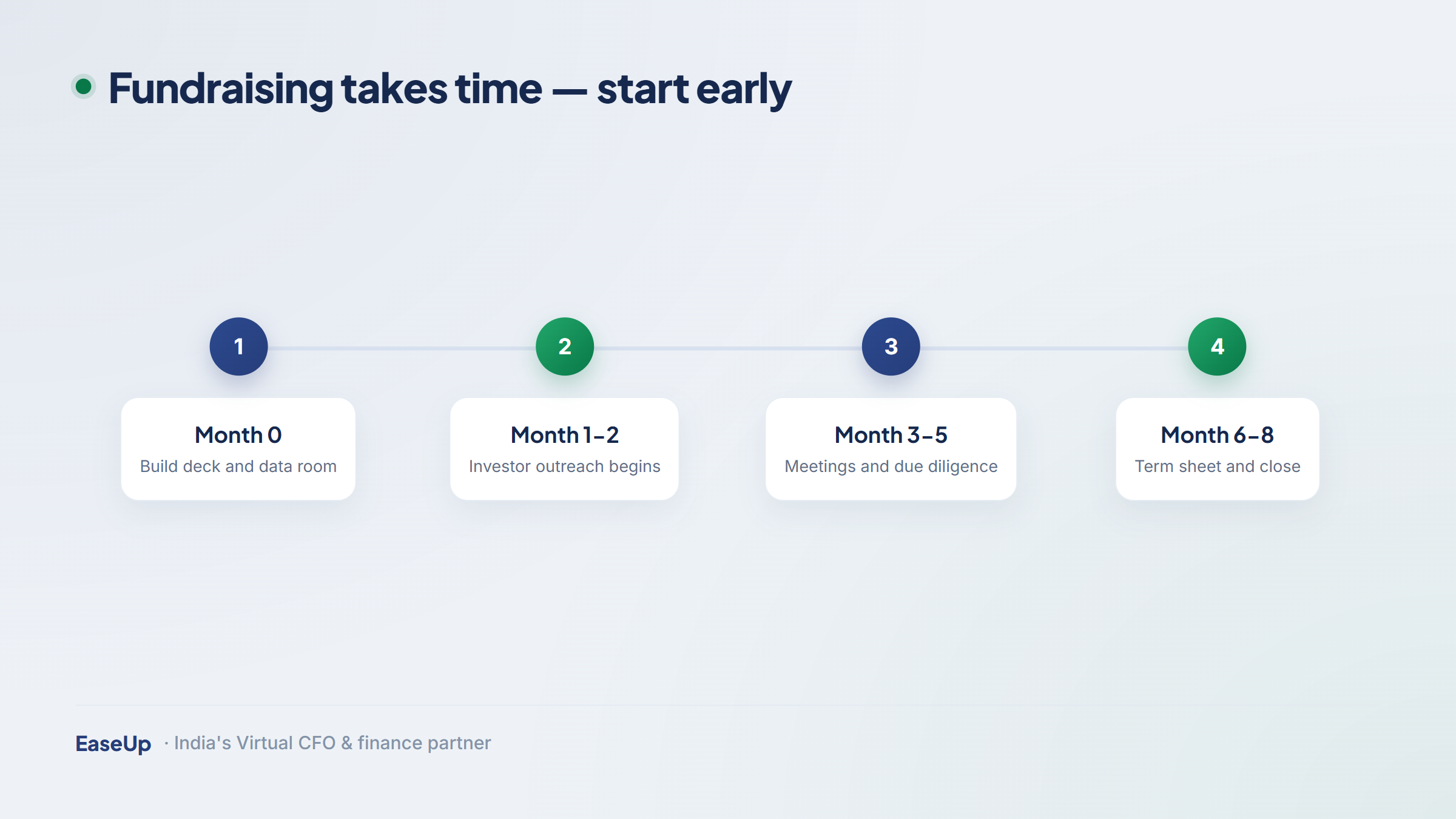
Here is the reality check that catches founders off guard: raising money in India takes time. From first investor meeting to money in the bank, expect 4-8 months — longer in a cautious market. If you start raising with only 3 months of runway, you may be negotiating from a position of weakness, or worse, running out mid-process.
Work backwards. If a raise takes 6 months and you want a 3-month safety buffer, you should kick off the process when you have at least 9 months of runway. The government-backed Startup India portal lists recognised investors and schemes that can help shorten the search.
When runway gets tight, you have two levers: spend less or collect more. Here are the moves that work, in roughly the order to try them.
Lever | What to do | Impact on runway |
Cut SaaS waste | Audit subscriptions; cancel unused tools | Quick, low risk |
Reduce DSO (Days Sales Outstanding) | Chase invoices; offer early-pay discounts | Frees trapped cash fast |
Renegotiate vendors | Ask for longer payment terms | Improves working capital |
Pause non-critical hires | Delay roles you can live without for 2 quarters | High impact, salaries dominate burn |
Optimise GST input credit | Reconcile ITC properly; claim what you are owed | Recovers real cash |
Annual pre-payments | Offer discounts for upfront annual contracts | Boosts cash collected today |
Variable over fixed costs | Use contractors instead of full-time where sensible | Lowers fixed burn |
Raise bridge capital | Venture debt, bridge SAFE, or revenue-based finance | Buys months, last resort |
You do not have to figure this out alone. A virtual CFO can model each of these levers, tell you which one buys the most months for the least pain, and build a 12-month cash plan you can actually trust.
Counting invoiced, not collected, revenue. Cash that has not arrived cannot fund your runway.
Forgetting tax outflows. GST, TDS and advance tax are real cash leaving your account.
Using a single best month. Always use a 3-month average so one good month does not fool you.
Ignoring upcoming one-off costs. Annual renewals, ESOP buybacks, or a big advance-tax instalment can wreck a month.
Raising too late. Start the conversation while you still have leverage and 6+ months of cash.
Watch out: Recalculate your runway every single month. It is not a one-time number. One slow sales month or one delayed payment can change it dramatically.
Most founders are brilliant at building product and terrible at watching cash — and that is completely normal. At EaseUp, our virtual CFO services give you a finance partner who tracks runway, models scenarios, and flags trouble months before it hits.
We combine clean bookkeeping, monthly forecasting, and India-specific tax planning so your runway number is always real, never a guess. You stay focused on growth; we keep the fuel gauge honest.
Runway (in months) = Cash in the bank ÷ Monthly net burn rate. For example, if you have Rs 1.2 crore in the bank and burn Rs 15 lakh net per month, your runway is 8 months. Always use net burn (spend minus cash actually collected), not gross burn, for an accurate number.
For most Indian startups, 12-18 months is healthy. At seed stage aim for 15-18 months, and at Series A or later aim for 18-24 months. Because fundraising in India typically takes 4-8 months, you want enough buffer to raise comfortably. Bootstrapped SMEs should keep at least 6-12 months of cushion since there is no external rescue.
Gross burn is your total monthly cash outflow — salaries, rent, cloud, marketing, compliance — regardless of revenue. Net burn is gross burn minus the cash revenue you actually collected that month. Net burn is the number that empties your bank account, so always use net burn to calculate runway. Track gross burn separately to understand your fixed cost base.
GST you collect from customers sits in your account until you remit it monthly, so it is easy to mistake for spendable cash. TDS on salaries, rent and vendors must be deposited by the 7th of the next month. Advance tax comes in four lumpy instalments. All three are real cash outflows that shorten your runway, so keep tax money in a separate bucket and factor it into your burn.
Start raising when you have at least 6 months of runway left, ideally more. Since a round in India can take 4-8 months from first meeting to wire, work backwards: if a raise takes 6 months and you want a 3-month buffer, begin when you have around 9 months of cash. Raising late from a short runway weakens your negotiating position.
This article is for general information only and is not financial, tax, or legal advice. Tax rules and compliance timelines change; please consult a qualified professional or EaseUp before making decisions for your business.


Your trusted partner for all your Financial needs.


Finance Management
Strategic Services