TL;DR — the 30-second version
• A GST scrutiny notice arrives in Form ASMT-10 under Section 61. It flags a mismatch in your returns — usually GSTR-1 vs GSTR-3B vs GSTR-2B.
• You reply in Form ASMT-11 on the GST portal within 30 days (a one-time extension of up to 15 days is allowed).
• Either accept and pay via DRC-03, or explain each point with a clear table and proof. Address every line — silence is treated as agreement.
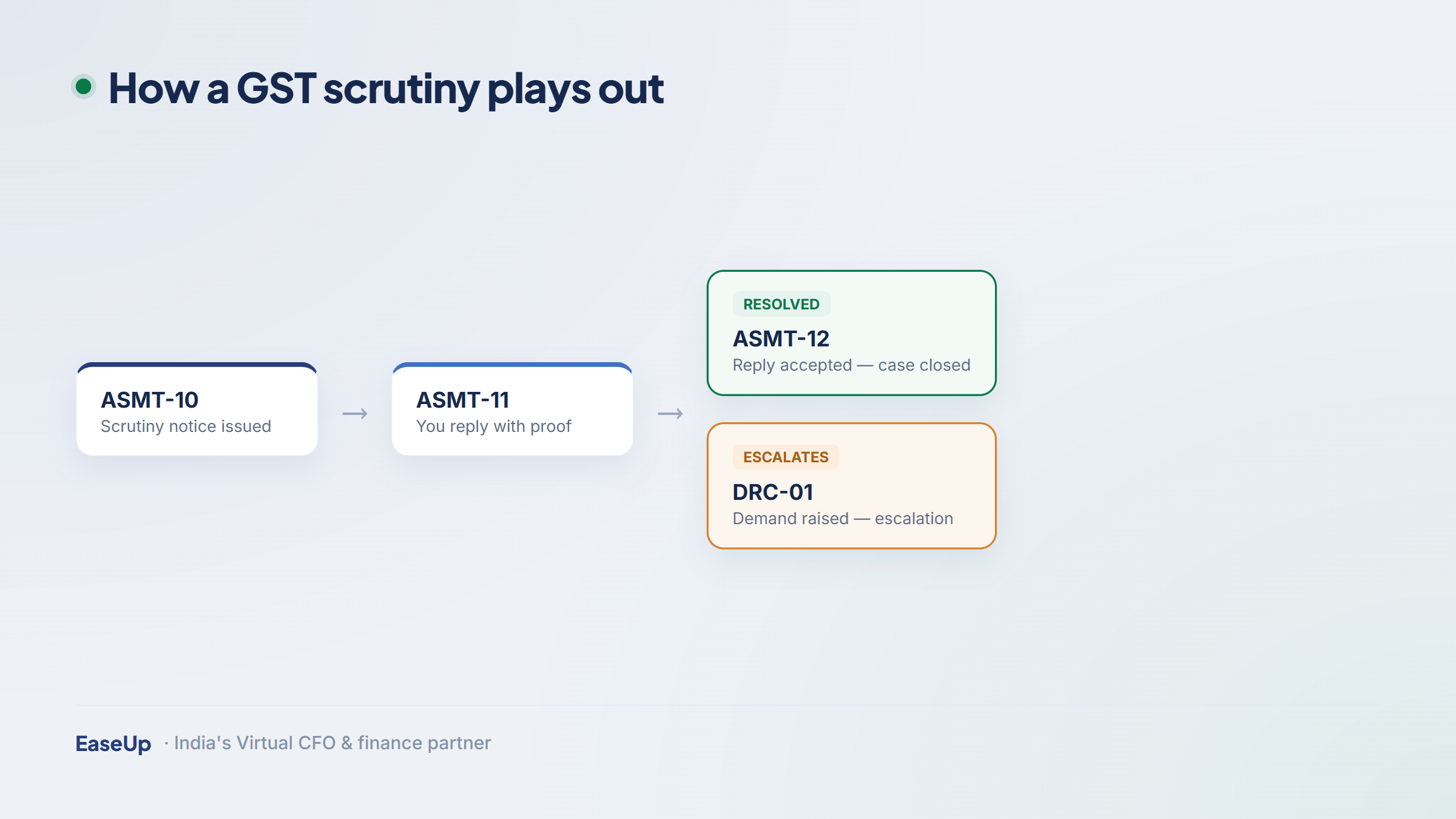
• A good reply closes the case with Form ASMT-12. A weak or missing reply escalates to a demand under Section 74A in DRC-01 (Section 73/74 still applies for periods up to FY 2023-24).
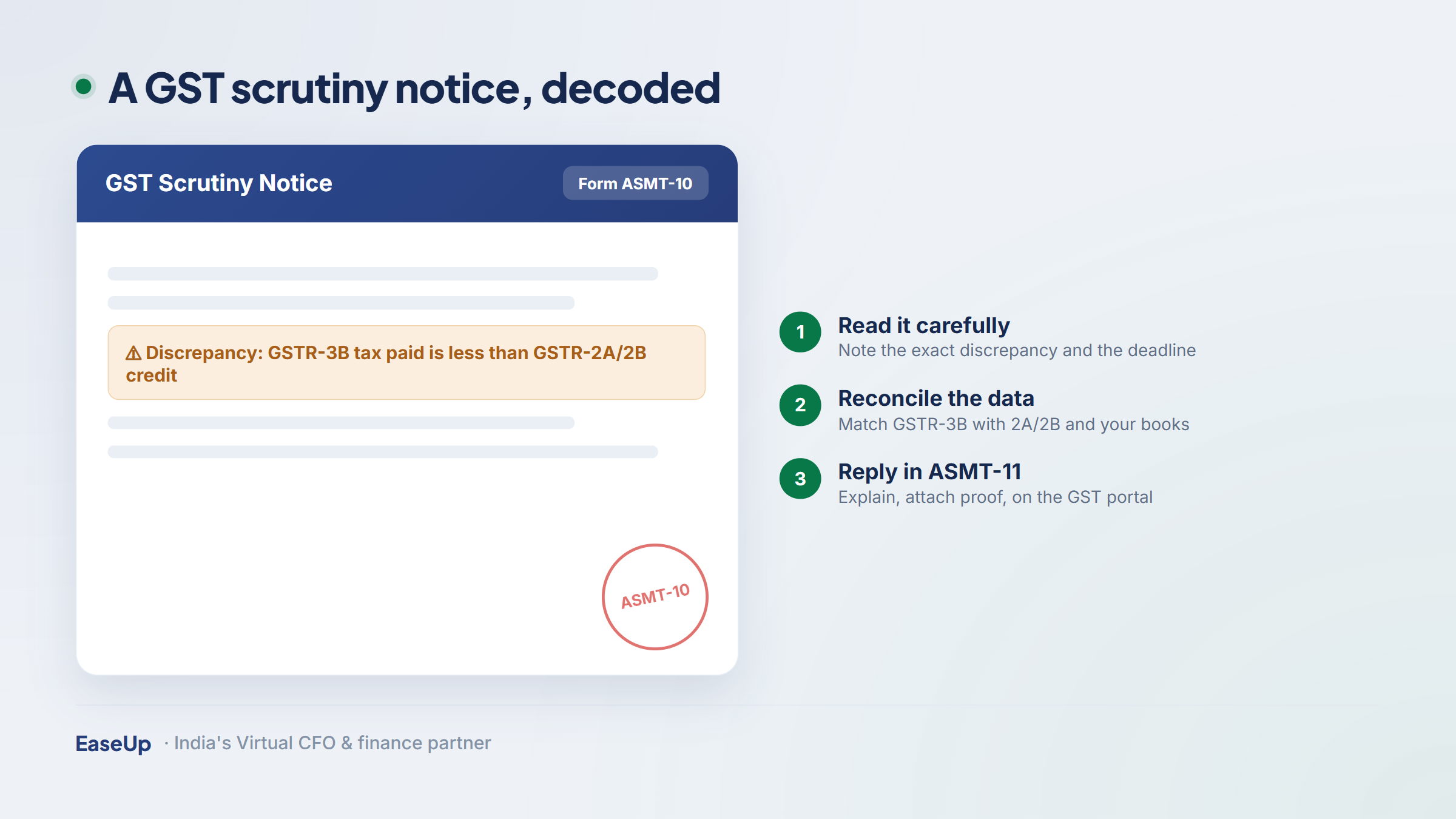
Opening the GST portal and seeing "ASMT-10 issued" is a gut-punch. Your mind jumps to penalties, raids and lawyers. Take a breath. A scrutiny notice is not a demand. It is the tax officer saying: "Your returns do not tie out — please explain." Most notices are settled with a calm, well-documented reply and zero extra tax.
This guide is for Indian startup founders and SME owners with 30 days on the clock. We decode the form. We show you how to draft a winning GST scrutiny notice reply. And we give you copy-ready tables with rupee examples. Updated for FY 2025-26.
A GST scrutiny notice is a formal intimation issued in Form GST ASMT-10. It falls under Section 61 of the CGST Act. The officer checks the returns you filed, spots a gap, and asks you to explain it. It is the gentlest stage of GST enforcement — well below an audit.
Think of it as a question, not a verdict. The officer has not decided you owe anything yet. Your reply, filed in Form ASMT-11, is your chance to answer before the matter can ever become a demand. Handle it well and it ends quietly.
 Note: A scrutiny notice is a "pre-adjudication" step. No tax, interest or penalty is confirmed until you reply and the officer reviews it. Do not panic-pay before you understand the discrepancy.
The GST system is heavily data-matched. The new automated return scrutiny module compares your returns against each other and against your suppliers’ filings. Most notices come from one of these mismatches:
GSTR-1 vs GSTR-3B. Outward sales declared in GSTR-1 do not match the tax paid in GSTR-3B.
GSTR-3B vs GSTR-2B. Input tax credit (ITC) claimed is higher than what appears in your auto-drafted GSTR-2B.
ITC from cancelled or non-filing suppliers. You claimed credit, but the supplier never paid or got de-registered.
E-way bill vs return mismatch. Goods movement on e-way bills exceeds the turnover declared.
Reverse charge (RCM) not paid. Liability on imports, legal fees or director payments was missed.
Late or nil filings. Sudden drops to nil after months of activity attract attention.
For startups, the usual culprit is fast-moving early-stage accounting: invoices booked late, ITC on launch spends, or a founder filing returns themselves before hiring help. Clean books prevent most of this. A monthly accounting and compliance process catches these mismatches before the officer does.
Timing is everything. The day the notice is issued on the portal, your clock starts. Here is the timeline in plain numbers.
Stage | Form | Deadline |
Notice issued by officer | ASMT-10 | Day 0 |
Your reply (or accept + pay) | ASMT-11 | Within 30 days |
Extension (one-time, officer’s discretion) | Request in writing | Up to 15 more days |
Case closed (officer satisfied) | ASMT-12 | After review |
Escalation (no/weak reply) | DRC-01 / DRC-01A | Section 74A demand |
 Watch out: Miss the 30 days and the officer can move straight to a demand under Section 74A, audit (Section 65) or special audit (Section 66). At that stage penalties and interest pile up fast. Reply on time, even if you need a short extension.
Once you understand the discrepancy, you face a simple fork in the road.
You agree with the officer. Pay the differential tax plus interest using Form DRC-03, then file ASMT-11 attaching the payment challan. Clean and final.
You disagree (fully or partly). File ASMT-11 with a point-by-point explanation and proof. You can accept some points and contest others in the same reply.
Do not pay just to make it stop. Many notices are pure reconciliation gaps. They are timing differences that resolve once you show the working. But do not fight a genuine shortfall either. Paying early caps the interest. A virtual CFO can tell you which fork is cheaper.
Filing the reply is done entirely online. Here is the exact path on the GST portal.
Log in and go to Services → User Services → View Additional Notices and Orders.
Open the ASMT-10 notice and read every discrepancy listed. Note the para numbers.
Click "Reply" to open Form ASMT-11 for that specific notice.
Enter your explanation against each discrepancy, and fill the reconciliation amounts.
Attach supporting documents — reconciliation statement, invoices, ledgers, challans (one consolidated PDF works best).
Verify and submit using DSC (Digital Signature Certificate) or EVC (Electronic Verification Code). Download the acknowledgement.
Officers love clarity. The single best move is to answer in a table: discrepancy, your explanation, the amount, and the proof. Below is a sample for a Bengaluru SaaS startup that got an ASMT-10 for a GSTR-3B vs GSTR-2B ITC mismatch.
Discrepancy (per ASMT-10) | Founder’s explanation | Amount (Rs) | Proof attached |
ITC in 3B exceeds 2B | Supplier filed GSTR-1 late; credit appeared in the next month’s 2B | Rs 1,80,000 | Vendor invoices + later 2B |
Sales 3B < e-way bills | Stock transfer to own branch, not a taxable sale | Rs 4,20,000 | Delivery challans, branch GSTIN |
RCM on legal fees unpaid | Agreed — paid via DRC-03 with interest | Rs 27,000 | DRC-03 challan |
ITC from cancelled vendor | Credit reversed voluntarily in current 3B | Rs 9,500 | 3B reversal entry |
:check_mark_button: Founder tip: Quote the exact para number from the ASMT-10 for every row. When your reply mirrors the officer’s structure, it gets read, understood and closed far faster.
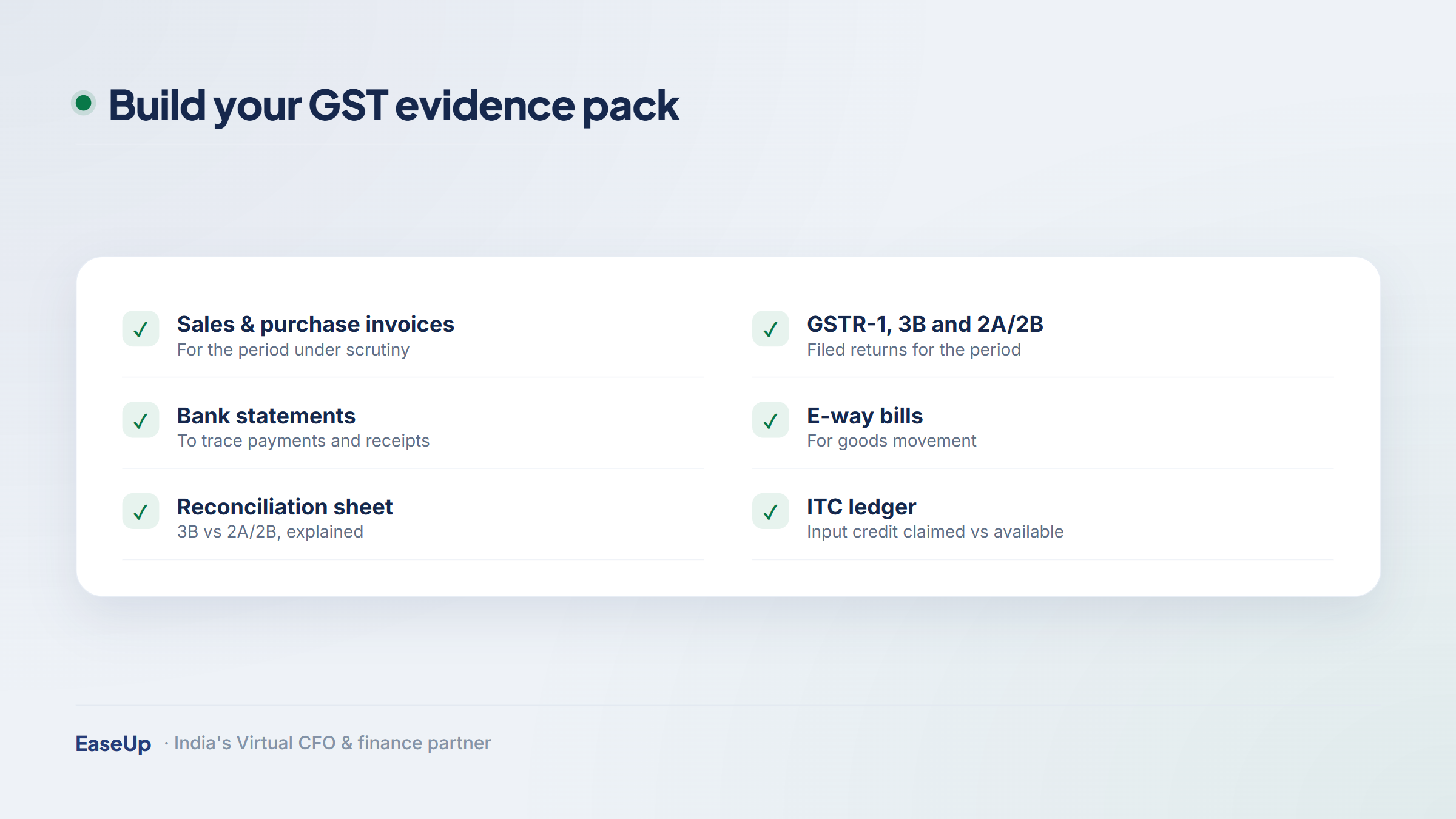
A claim without proof is just an opinion. Attach everything you reference. For most notices, this pack covers it:
Reconciliation statement. GSTR-1 vs 3B vs 2B, month-wise, showing the mismatch resolves.
Sales and purchase invoices. The specific ones tied to the flagged transactions.
Bank statements. To prove receipts, payments and RCM where relevant.
E-way bills and delivery challans. For any goods-movement mismatch.
Ledgers and the ITC register. Your books backing the figures.
DRC-03 challan. If you accepted and paid any part of the liability.
The officer reads dozens of replies a week. Make yours easy to say yes to.
Answer every line. Any point you skip is treated as accepted. Go para by para.
Be factual, not emotional. No pleading. State facts, cite the section, attach the proof.
Lead with the reconciliation. Show the gap mathematically closing — numbers persuade.
Keep one consolidated PDF. Bookmarked and labelled, so the officer finds each annexure fast.
Mirror their language. Use the same terms and para numbers as the ASMT-10.
Watch out: Never ignore a notice hoping it lapses. Non-response is the single biggest reason small businesses end up with a confirmed demand and a frozen GST registration. Reply, even if only to ask for the 15-day extension.
Once you submit ASMT-11, the proper officer reviews your explanation. Three outcomes are possible.
Satisfied. The officer drops the proceedings and issues Form ASMT-12. Case closed — keep this on file forever.
Partly satisfied. The officer may seek more documents or a clarification. Respond promptly.
Not satisfied. Not satisfied. The matter escalates to a show-cause notice in DRC-01 under Section 74A — non-fraud and fraud cases now sit under one section, with the distinction affecting the penalty rather than which section applies — or to an audit. You still get to defend, but the stakes rise.
The lesson is simple: invest in the first reply. A strong ASMT-11 ends most cases at ASMT-12. For complex or high-value notices, structured accounting and compliance support pays for itself many times over.
Numbers focus the mind. Here is what a Rs 1,00,000 differential liability can cost depending on how you handle the notice.
Scenario | Tax (Rs) | Interest @18% (~6 mo) | Penalty | Total exposure (Rs) |
Reconciled — no real shortfall | 0 | 0 | 0 | 0 |
Accepted early, paid via DRC-03 | 1,00,000 | 9,000 | Nil (paid pre-SCN) | 1,09,000 |
Ignored → Section 74A demand | 1,00,000 | 9,000 | 10% (Rs 10,000) | 1,19,000 |
Section 74A (alleged fraud) | 1,00,000 | 9,000 | Up to 100% (Rs 1,00,000) | 2,09,000 |
The gap between the best and worst row is the whole point. The figures above are illustrative; confirm current rates on the Income Tax and GST portals and with your advisor.
Note: Since November 2024, Section 74A has replaced Sections 73 and 74 for all periods from FY 2024-25 onwards — the fraud/non-fraud split now decides your penalty, not which section applies. One real upside: the window to pay early and get the reduced or nil penalty was extended from 30 days to 60 days from the notice.
The cheapest scrutiny notice is the one you never get. Build these habits.
Reconcile monthly. Match GSTR-1, 3B and 2B every single month, not at year-end.
Claim ITC only from 2B. If it is not in your 2B, do not claim it yet.
Track your RCM list. Imports, legal fees, director sitting fees, GTA — pay and claim on time.
Vet vendors. Check GSTIN validity before paying; avoid credit from non-filers.
Keep an audit-ready archive. Invoices, e-way bills and challans, filed and searchable.
Founders who outsource this to a virtual CFO rarely see ASMT-10s — the mismatches get caught and fixed before any return is filed.
Handle a simple timing-difference notice yourself. But bring in a Chartered Accountant or finance partner when: the disputed amount is large, the notice alleges fraud (Section 74), multiple periods are involved, or you are unsure of the legal position.
A specialist drafts a tighter reply, anticipates the officer’s follow-up, and protects your registration and credit rating. You can verify any advisor’s credentials on the ICAI member directory. At EaseUp, our team handles the notice end-to-end so you can stay focused on building.
You must file your reply in Form ASMT-11 within 30 days from the date the ASMT-10 notice is issued on the GST portal. The proper officer can grant a one-time extension of up to 15 more days if you request it in writing before the deadline. Missing both windows lets the officer escalate to a demand under Section 73 or 74.
For a simple notice — say a GSTR-1 vs GSTR-3B timing difference — a founder with clean books can file ASMT-11 themselves on the portal. But if the amount is large, several tax periods are involved, or the notice alleges fraud under Section 74, hire a Chartered Accountant or a finance partner. A weak first reply often turns a Rs 0 reconciliation into a confirmed demand.
Ignoring an ASMT-10 is the worst option. The officer can proceed to a Section 73 or 74 show-cause notice (Form DRC-01), order an audit under Section 65, or a special audit under Section 66. This brings confirmed tax, interest at 18% per year, penalties, and in serious cases suspension of your GST registration. Always reply, even if only to seek the 15-day extension.
ASMT-11 is filed entirely online on the GST portal under Services → User Services → View Additional Notices and Orders. You open the specific ASMT-10, click Reply, enter your explanation for each discrepancy, attach supporting documents, and submit using a Digital Signature Certificate (DSC) or Electronic Verification Code (EVC). Download the acknowledgement for your records.
ASMT-10 is the scrutiny notice the officer issues to flag a discrepancy. ASMT-11 is the reply you file explaining or accepting it. ASMT-12 is the order the officer issues to close the case when your reply is satisfactory. So the happy path is ASMT-10 in, ASMT-11 back, ASMT-12 to shut it down — with no demand raised.
This article is for general information only and is not legal, tax or financial advice. GST rules, forms and rates change; verify current requirements on the official GST portal and consult a qualified professional before acting on any notice.


Your trusted partner for all your Financial needs.


Finance Management
Strategic Services