TL;DR — IT and software tax in one minute
• IT and software services stay at 18% under GST 2.0 — the reform simplified the overall slab structure, but the rate on software was 18% before and remains 18% now.
• Export your services abroad and they are zero-rated — but only if you file a valid LUT for the year. From 30 March 2026, even intermediary and BPO work to foreign clients qualifies.
• Buying software? Classify the payment first. TDS may land under 194J (rights), 194C (project work), 194Q (goods) or 195 (foreign vendor) — the invoice label does not decide it.
• Pay for foreign AI tools or APIs? You owe 18% IGST under reverse charge, which you can claim straight back as input credit.
• Planning an M&A? Share vs asset purchase changes the tax bill materially, and IT value hides in IP and contracts — structure it before you sign.
After the GST 2.0 overhaul removed the 12% bracket, the picture for IT got simpler but stricter. Nearly all domestic software services now attract a flat 18% GST. That covers SaaS subscriptions, custom development, implementation and support.
The rate is rarely the problem. Most compliance pain comes from getting the classification, invoicing and credit checks wrong. A misfiled code or an expired invoice can freeze your customer’s credit and trigger a dispute far bigger than the tax itself. If returns feel like a monthly scramble, structured GST filing support pays for itself.
 Founder tip: Bundled contracts are a trap. If one invoice mixes a software product with support services, the whole invoice is billed at 18% — you cannot split it back to a lower rate. Price your contracts with that in mind.
IT services sit under SAC group 9983. Above ₹5 crore turnover, 6-digit SAC coding is mandatory, and the GSTN’s automated systems compare the code you use against the work you describe. Pick the wrong one and you can trigger an audit flag on your own return.
Service | SAC code | GST rate |
Software design & development | 998314 | 18% |
IT consulting & support | 998313 | 18% |
Hosting / SaaS access | 998315 | 18% |
IT management services | 998311 | 18% |
Using 998311 (management) when you actually did 998314 (development) is one of the most common mismatch flags. When your books and your codes agree, audits stay boring — which is exactly how a good accounting and compliance partner likes them.
When your client is genuinely abroad and paid in convertible foreign exchange, your service is a zero-rated export — no GST charged. That is the single biggest cash-flow advantage Indian IT firms have.
But there is a catch that catches people every year. To export without paying IGST upfront, you must file a Letter of Undertaking (LUT) in Form GST RFD-11 for that financial year. Miss it, and the department can treat a clear export as a domestic sale and demand 18% tax you then have to chase back.
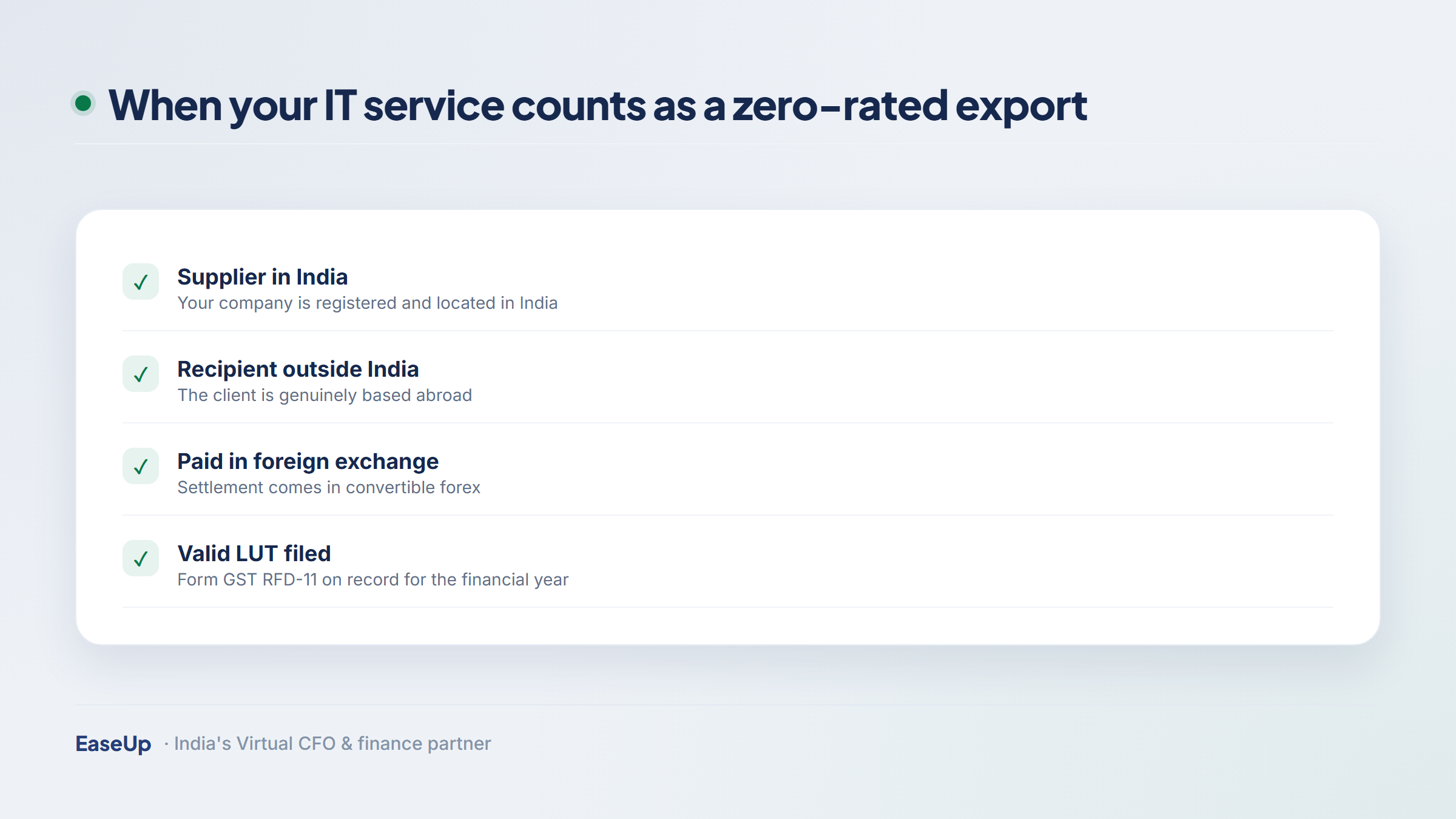
 Watch out: An LUT does not roll over automatically. File a fresh LUT at the start of every financial year (for FY 2026-27, do it now). Without it, every export invoice is legally treated as taxable at 18%.
You can file the LUT and check the current process on the official GST portal.
For a decade, many BPOs and tech-support firms were labelled "intermediaries" and forced to pay 18% GST on foreign contracts, with no refund path. The Finance Act 2026 omitted Section 13(8)(b) of the IGST Act, effective 30 March 2026.
The result: intermediary and facilitation services to an overseas client now qualify as zero-rated exports under the default place-of-supply rule. One important condition — only services supplied on or after 30 March 2026 get the benefit — the trigger is when the service is rendered, not the invoice date. If your firm has cross-border delivery arms, this reshapes your billing; a review of your international trade structure is worth doing now.
If your team pays for foreign AI APIs, cloud services or large training datasets, you are an importer of services. That means:
Pay the tax yourself — self-assess and pay 18% IGST on the foreign payment under the Reverse Charge Mechanism (RCM).
Claim it straight back — in the same month’s GSTR-3B, take 100% of that RCM payment as input tax credit.
:info: Why the GSTN cares: The portal now uses AI matching to check that your RCM payments line up with the "software licence" expenses in your books. A mismatch can lead to automated GSTIN suspension — so log every foreign tool payment, not just the big ones.
Two portal changes now decide whether your invoices are even valid. First, the 30-day reporting limit: for firms with turnover of ₹10 crore and above, an e-invoice must be reported to the IRP within 30 days. Miss the window and the portal blocks IRN generation — the invoice becomes legally null, and your client cannot claim credit on it.
Second, the Invoice Management System (IMS). Every week you must Accept, Reject or mark Pending each invoice your suppliers upload. Do nothing, and the portal treats it as deemed acceptance — if a supplier filed a wrong invoice and you did not reject it, you carry the tax difference. Your GSTR-3B is now auto-populated and hard-locked to your GSTR-2B.
Founder tip: Put an IMS review on a fixed weekly calendar slot, the same way you run payroll. Silence is treated as a yes, so a five-minute check protects your credit and your cash.
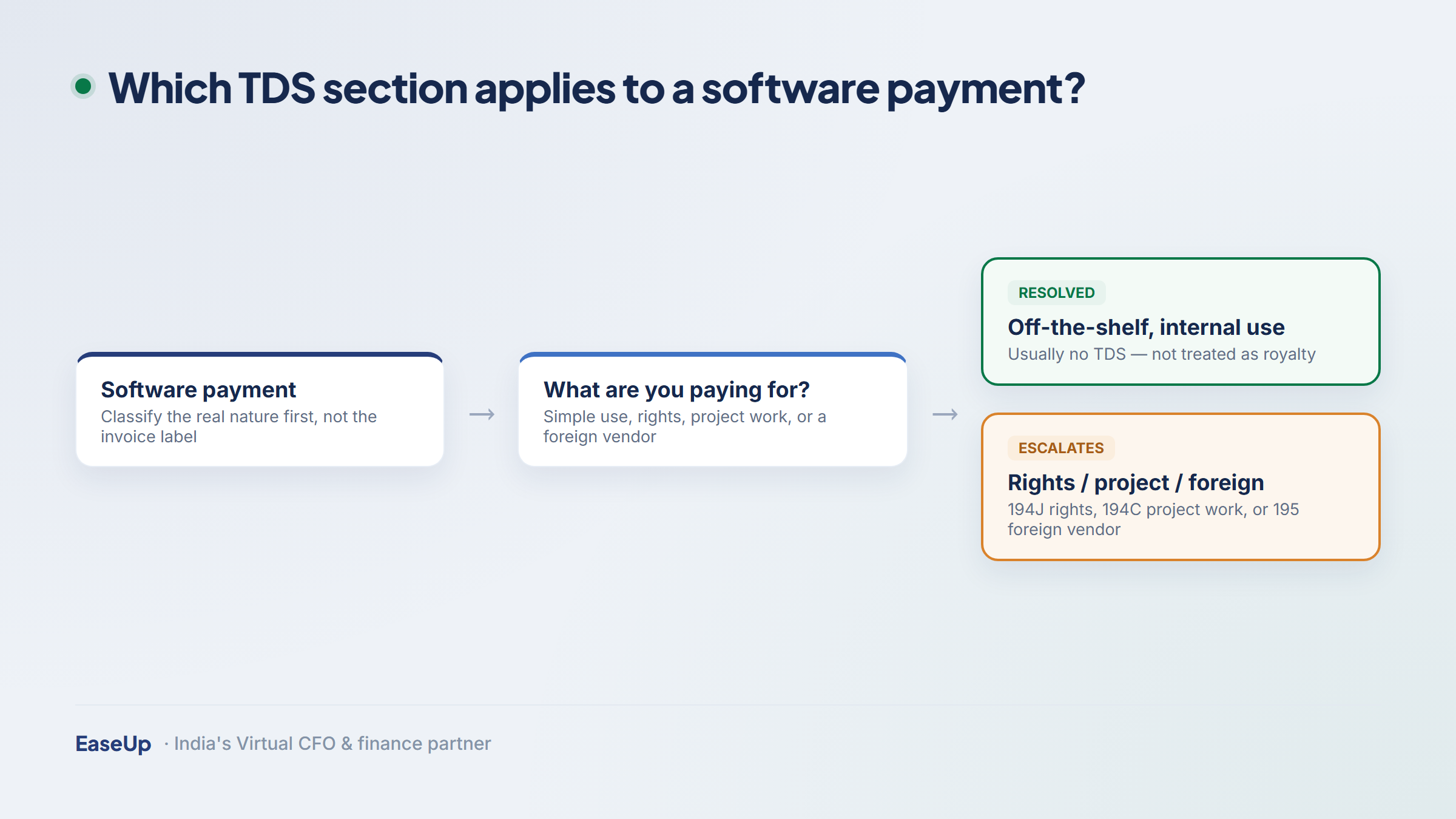
When you pay for software, TDS depends on the real nature of the payment — not the words on the invoice. The same "software" line can be a licence right, a service, a project, or plain goods, and each points to a different section.
One rule works every time: classify first, then test the section. The more a deal moves from simple use toward rights, services or project work, the more careful the review needs to be.
Section | When it applies | Indicative rate |
194J | Payment for software rights, royalty or covered technical features | 10% |
194C | Implementation, custom build or execution-heavy project work | 2% (1% for individual/HUF) |
194Q | Software treated as goods, once thresholds are met | 0.1% |
195 | Any payment to a foreign (non-resident) vendor | Per Act / DTAA |
Two 2026 pointers: the Section 194J threshold has risen to ₹50,000 per year, and since 1 October 2024 a payment covered by 194J is explicitly outside 194C — so the two no longer overlap. You can confirm current rates on the Income Tax Department’s TDS rate page.
This is where many finance teams over-deduct. The Supreme Court has held that payment for off-the-shelf, shrink-wrapped software bought for internal use is not royalty. No transfer of copyright means no TDS on that payment.
The trigger for 194J is the grant of rights — rights to modify, reproduce, distribute or sublicense. A standard licence to simply run the software does not cross that line, however the invoice is worded. Test the rights the contract actually gives you.
Paying an overseas vendor adds a step. Under Section 195 you first ask whether India can tax the payment at all, then whether a tax treaty (DTAA) reduces or removes it. Get that order right and you avoid both over-deduction and a demand notice later.
Check chargeability first: is the payment royalty, or just a right to use a standard product?
Then the treaty: collect a Tax Residency Certificate and Form 10F to support the DTAA rate.
Keep the paper trail: contract, invoice and an internal tax note documenting your position before you release funds.
The Income Tax Act 2025 replaced the 1961 Act from 1 April 2026. For IT companies, the practical effects are:
Revised TDS: new rates apply for software royalties and technical fees — re-check your deduction rates for FY 2026-27.
Simplified ITR forms: schedules for IT startups have been streamlined.
New regime default: most employees now sit under the New Tax Regime, with lower slabs but no HRA exemption — help your team compare before they choose.
M&A in IT is rarely about hard assets — it is about IP, recurring revenue and talent. Because so much value is intangible, deal structure moves the tax bill more than in most sectors. The first question is almost always share purchase versus asset purchase.
Deal type | What the buyer gets | Typical tax angle |
Share purchase | The legal entity, with assets and liabilities intact | Seller pays capital gains; buyer inherits history and exposure |
Asset purchase | Selected assets — IP, contracts, code — only | More control over liabilities; different depreciation and gains treatment |
Sellers face capital gains that swing with holding period and structure. IP ownership, deferred revenue and cross-border billing all need clean documentation before diligence begins. A cross-border and international trade review early on protects deal value.
In an IT transaction, hidden risk usually sits in intangibles: is the IP owned correctly, is revenue truly recurring, are key engineers likely to stay, and are the GST and TDS positions clean? A single unfiled LUT or a pattern of over-deducted TDS can dent valuation or stall a deal.
You can access the statutory forms and filing requirements for corporate actions on the Ministry of Corporate Affairs portal. But the real protection is keeping your indirect tax, TDS and books audit-ready long before anyone runs diligence on you.
Almost all domestic IT and software services are taxed at a flat 18% GST under SAC group 9983, after the GST 2.0 overhaul removed the old 12% bracket. This covers SaaS subscriptions, custom development, implementation and support. Exports of IT services are zero-rated, provided a valid Letter of Undertaking is on file for the year.
No. When the recipient is outside India, the service is a zero-rated export and no GST is charged. To export without paying IGST upfront, you must file a Letter of Undertaking (Form GST RFD-11) for that financial year. Without a valid LUT, the department can treat the export as a domestic sale and demand 18% tax.
It depends on the nature of the payment. Off-the-shelf software bought for internal use is usually not royalty, so no TDS applies. Payments for software rights fall under Section 194J at 10%, implementation and project work under Section 194C at 2% (1% for individuals/HUF), goods purchases under Section 194Q, and foreign vendors under Section 195. Classify the payment before deducting.
Yes, under the Reverse Charge Mechanism. If you import services such as foreign AI APIs, cloud tools or datasets, you must self-assess and pay 18% IGST yourself. You can then claim the full amount back as input tax credit in the same month’s GSTR-3B, so the net cash impact is neutral if you record it correctly.
In a share purchase, the buyer acquires the legal entity with its assets and liabilities intact, and the seller pays capital gains tax. In an asset purchase, the buyer picks selected assets such as IP, code and contracts, gaining more control over liabilities but facing different depreciation and gains treatment. Because IT value sits in intangibles, the structure can change the net tax outcome significantly.
This guide is for general information only and does not constitute tax, legal or financial advice. GST, TDS and income-tax provisions change frequently — confirm your specific SAC codes, TDS sections and filings with a qualified professional before you act.


Your trusted partner for all your Financial needs.


Finance Management
Strategic Services