
TL;DR — Startup financial reporting in one minute
• Financial reporting turns raw transactions into decisions. For a startup it is a survival tool, not a year-end chore.
• Master the three core reports — the income statement, the balance sheet and the cash flow statement. Each answers a different question about your business.
• Investors read burn rate, runway and unit economics before they read your pitch. Track them every month, not every quarter.
• Know which framework applies to you: Accounting Standards (AS) for smaller companies, Ind AS for larger ones. Most early startups stay on AS.
• A clean, current investor data room can cut due-diligence time sharply. Late or messy reporting is the fastest way to lose board confidence.

Financial reporting is the discipline of turning every rupee that moves through your business into a small set of statements you can actually read. It answers three plain questions: are we making money, what do we own and owe, and will we run out of cash?
For an early-stage company, this is not paperwork for the tax office. It is the instrument panel you fly by. Founders who ignore it end up making big decisions — hiring, pricing, raising — on gut feel and a bank balance. Founders who read their numbers monthly catch problems while they are still small.
Good reporting also builds trust. When an investor, lender or auditor asks a question, a founder who can explain every line moves faster and negotiates from strength. If your books are behind, a MIS and management reporting partner can get you to a monthly rhythm before it hurts.
 Founder tip: Decide who reads each report before you build it. A board deck, a bank and your own team need different cuts of the same numbers. Reporting that has no reader is wasted work.
Treated well, reporting does more than record the past — it shapes the next quarter. Here is what a solid monthly system actually buys you.
Fewer cash surprises: watching cash movement means you never hit a payroll you cannot fund.
Faster fundraising: a clean data room lets investors verify your story quickly instead of stalling in due diligence.
Honest priorities: knowing whether you are "default alive" or "default dead" forces the right calls on spend and hiring.
No compliance shocks: timely books mean GST, TDS and ROC filings happen on time, avoiding penalties and interest.
None of this needs a large finance team. It needs a repeatable process and someone accountable for the monthly close.
Almost everything in startup finance rolls up into three statements. Read together, they are your vital signs. Read alone, each hides something.
Report | What it shows | The big question | How often |
Income statement (P&L) | Revenue, costs and profit over a period | Is the business model creating value? | Monthly |
Balance sheet | Assets, liabilities and equity at a point in time | What do we own versus what do we owe? | Monthly / Quarterly |
Cash flow statement | Actual cash entering and leaving the bank | Will we run out of cash — and when? | Weekly / Monthly |
The trap is reading only the P&L. It can show a "paper profit" while your bank balance is falling, because revenue booked on credit is not cash in hand. Always pair it with the cash flow statement.
 Watch out: Revenue is not cash. A profitable-looking P&L with cash "trapped" in unpaid invoices is a classic startup blind spot. Track your accounts receivable ageing alongside profit, or you will feel rich on paper and broke in the bank.
India runs two accounting tracks. Most startups sit on the simpler one and only graduate later. Knowing where you fall keeps your statements compliant without over-engineering them.
Framework | Who it applies to | What it means for you |
Accounting Standards (AS) | Most private companies and MSMEs below the Ind AS thresholds | The default for early startups; simpler disclosures |
Indian Accounting Standards (Ind AS) | Listed companies and large unlisted companies crossing net-worth limits | Aligned with IFRS; heavier disclosure and fair-value rules |
Cash-basis book-keeping | Very early, pre-revenue or founder-run outfits | Simple, but not GAAP-compliant; investors expect accrual |
Every company must still prepare financial statements and file Form AOC-4 with the registrar each year under the Companies Act. You can check the current forms and thresholds on the Ministry of Corporate Affairs portal. When you cross into Ind AS territory, an accounting and compliance team should handle the transition.
Cash accounting records money only when it moves. Accrual accounting records revenue when it is earned and costs when they are incurred, regardless of when cash changes hands. Accrual gives a truer picture of performance — and almost every investor and auditor expects it.
The practical rule: switch to accrual the moment you raise institutional capital or start selling on credit. Accrual is also the basis for GAAP and Ind AS compliance, so the sooner you adopt it, the less painful the eventual clean-up. Your GST returns already assume accrual-style invoicing; you can see the return structure on the GST portal.
:info: A quick contrast: Under cash accounting, a ₹5,00,000 invoice you raised in March but collect in May counts as May income. Under accrual, it is March income. Investors compare startups on accrual, so mixing the two makes your growth look erratic.
Your statements feed a short list of ratios that decide how fundable you look. Track these every month and you will never be caught off guard in a board meeting.
MRR / ARR growth: is your predictable, recurring revenue rising month on month?
Gross margin: what is left after the direct cost of delivering your product. A shrinking margin as you scale means the model is broken.
CAC and LTV: what it costs to acquire a customer versus the value they bring. Investors want LTV comfortably above CAC.
CAC payback period: how many months of margin it takes to earn back one customer’s acquisition cost.
Churn rate: how fast customers leak out of the bucket you are filling.
These are not vanity numbers. Together they tell an investor whether growth is efficient or just expensive. If you are unsure which to prioritise, a virtual CFO can build the dashboard and benchmark you against your stage.
Burn rate is how much cash you consume each month. Runway is how many months of life that cash buys you. It is the single number every investor asks about first, because it is a countdown to the month you can no longer make payroll.
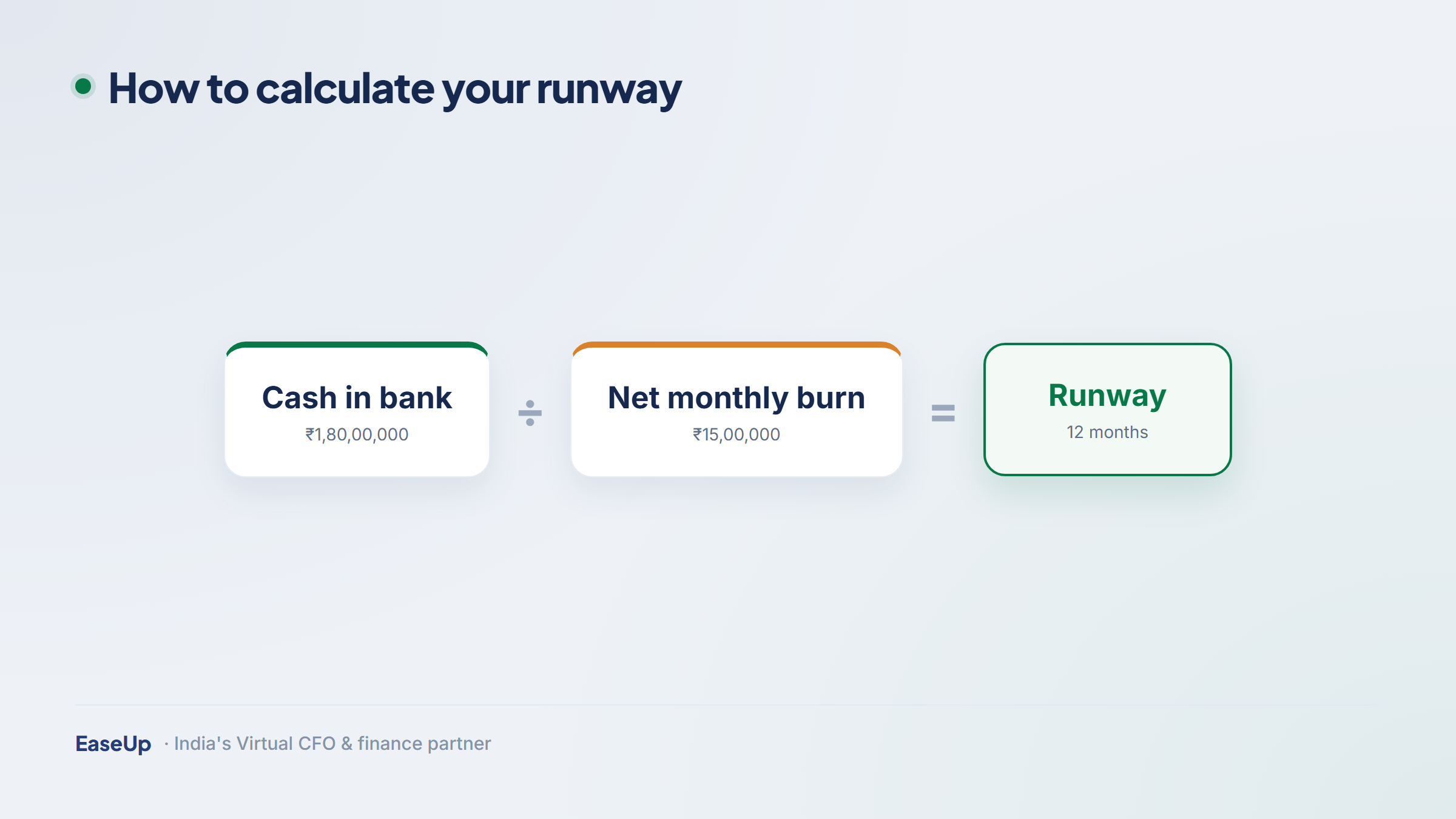
Say you hold ₹1.8 crore and your net burn is ₹15 lakh a month. Your runway is ₹1,80,00,000 ÷ ₹15,00,000 = 12 months. Most investors want to see 12 to 18 months of runway after they invest, so fall below six months and you are in the fundraising red zone.
Use net burn (cash out minus cash in), calculated on a trailing three-month average so a single lumpy month does not distort the picture.
Coined by Paul Graham, this is the sharpest lens for a founder. Default alive means your current growth and cash reach profitability before the money runs out. Default dead means it does not — and you must change something now.
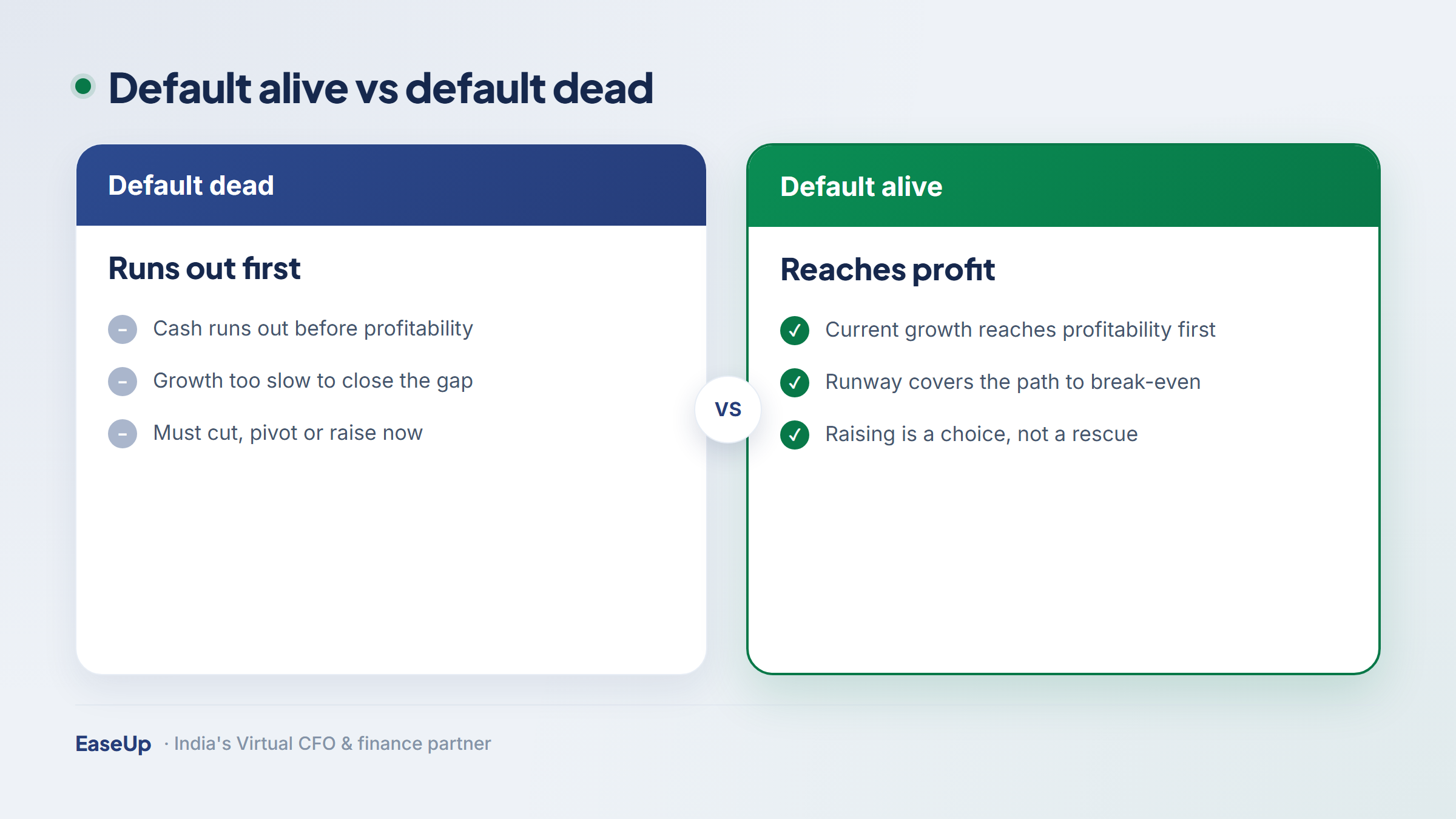
The honest answer to "are we default alive?" reshapes every decision — whether to hire, when to raise, and how deeply to cut. DPIIT-recognised startups can plan this alongside the benefits listed on the Startup India portal. If the answer is "dead", you want to know months early, not weeks.
Investor-ready reporting is a habit, not a heroic year-end effort. Successful founders run a strict monthly close. At the end of each month, review:
Revenue and MRR/ARR growth — is predictable revenue climbing, and where is it coming from?
Operating expenses by category — with month-on-month variance so surprises stand out.
Burn rate and runway — on a cash basis, using the trailing three-month average.
Receivables and payables ageing — to see cash that is stuck coming in or going out.
Unit economics — CAC, LTV and payback, so growth stays efficient as you scale.
Close the books within a week or two of month-end. If you are reading February’s numbers in May, you are steering by history, not reality.
Different reports serve different rhythms. Mapping them to a calendar keeps you compliant and investor-ready without drowning in spreadsheets.
Frequency | Review focus | Strategic goal |
Weekly | Cash balance and receivables | Survival and liquidity |
Monthly | P&L, burn rate, unit economics | Operational efficiency |
Quarterly | Balance sheet and projections | Investor transparency |
Annually | Audited statements, AOC-4, tax strategy | Regulatory compliance |
When you raise, investors will ask for a data room — an organised folder of your financials and legal records. What they scrutinise is predictable, so build it before you need it.
Financial statements: monthly management accounts plus your last audited statements.
Bank statements: typically 12 to 24 months, to verify burn and receipts against your reports.
Tax and statutory: GST return history, TDS filings, AOC-4 and ROC records.
Metrics pack: a clear MIS with burn, runway, CAC, LTV and cohort data.
Manual spreadsheets are a high-risk way to run this. Modern startups use integrated tools such as Zoho Books or Tally to automate entries and keep dashboards audit-ready. You can confirm your filed statements and TDS records on the Income Tax Department portal.
Most reporting failures are not technical — they are habits. Here are the ones that quietly destroy investor trust.
Mistake | Why it hurts |
Watching revenue, ignoring burn | You see growth but miss how much cash it cost to buy |
Mixing personal and business expenses | A major red flag that unravels trust during due diligence |
Delayed monthly closings | Decisions get made on stale data instead of reality |
Inconsistent classification | Treating one-off fees as recurring inflates valuation and invites disputes |
No accrual discipline | Cash-basis books make growth look erratic to investors |
Reporting touches accounting, tax, fundraising and strategy at once. When you are preparing to raise, modelling three-year projections, or fighting to extend runway, expert help pays for itself. A virtual CFO brings the reporting rigour, board-deck discipline and cash-flow modelling that most early teams lack — so you can spend your time building product, not fighting spreadsheets.
The income statement (or profit and loss account), the balance sheet, and the cash flow statement. The income statement shows revenue, costs and profit over a period; the balance sheet shows what you own and owe at a point in time; and the cash flow statement shows the actual movement of cash in and out of your bank. Read together, they give a complete picture of performance, position and liquidity.
Most startups should switch as soon as they raise institutional capital or start selling on credit. Accrual accounting records revenue when it is earned and costs when they are incurred, which gives a truer view of performance. It is also required for GAAP and Ind AS compliance and is expected by almost all venture investors, so adopting it early avoids a painful clean-up later.
Net burn is the cash you spend minus the cash you receive each month, ideally averaged over the trailing three months. Runway is your cash in the bank divided by that net monthly burn, expressed in months. For example, ₹1.8 crore in cash with a ₹15 lakh monthly burn gives a 12-month runway. Most investors want to see 12 to 18 months of runway after they invest.
Most early-stage private companies and MSMEs follow the Accounting Standards (AS), which are simpler. Larger unlisted companies that cross prescribed net-worth thresholds, and all listed companies, must apply Indian Accounting Standards (Ind AS), which align with IFRS. Every company must still prepare financial statements and file Form AOC-4 with the registrar each year, regardless of which framework applies.
Investors typically ask for monthly management accounts, your last audited financial statements, 12 to 24 months of bank statements, GST and TDS filing history, AOC-4 and ROC records, and a metrics pack covering burn rate, runway, CAC, LTV and cohort data. Keeping this organised in a data room before you raise can significantly shorten due diligence.
This guide is for general information only and does not constitute accounting, tax, legal or financial advice. Reporting standards and thresholds change — confirm the current position with a qualified professional before you finalise your books or investor reports.


Your trusted partner for all your Financial needs.


Finance Management
Strategic Services