
TL;DR — Investor-ready projections in one minute
• Investors do not want a perfect forecast. They want a defensible one — numbers built on operating drivers they can challenge.
• A strong model is really a 3-statement model: profit & loss, balance sheet and cash flow, all linked so one assumption flows through the whole picture.
• Build revenue bottom-up from customers, pricing and churn — not a top-line "we will grow 10x" wish.
• Show unit economics, burn and runway. Indian investors now expect a healthy 18–24 month runway and CAC payback under 12 months.
• Always model three scenarios — base, upside and downside. Downside awareness builds more trust than optimism.

The question behind every investor meeting is simple: "What has to be true for this plan to work?" Founders often assume projections are about predicting the future to the rupee. They are not.
Good projections show that you understand the economics of your business, the risks in front of you, and the decisions you will make when reality does not match the plan. A model that answers those questions with logic instead of optimism already puts you ahead of most founders in the room.
If you are heading into a seed round, Series A, venture-debt conversation or a diligence process, this is the finance layer investors judge you on. Many founders bring in virtual CFO support before those conversations start.
 Founder tip: Before you touch a spreadsheet, write one line: "This plan works if ___." Every assumption in your model should defend that sentence. If an assumption exists only to hit a target, it is a wish, not a driver.
These words get used loosely, so let us pin them down before we build.
Term | What it means | What it is for |
Financial projection | A forward view of revenue, costs and cash over time | Communicating your growth story and funding need |
Financial model | The engine of assumptions and drivers that produces the projection | Testing decisions on pricing, hiring and spend |
3-statement model | Linked profit & loss, balance sheet and cash flow | Proving the plan is financially survivable, not just profitable on paper |
The 3-statement model is the standard investors and valuers use in India — it also sits underneath a discounted cash flow (DCF) valuation. Get it linked properly and one changed assumption updates your whole story at once.
Strip away the formatting and every investor is really checking whether your numbers answer six things:
What drives revenue in this business — the real operating levers, not a top-line percentage?
How fast can you acquire customers, and at what cost?
Which margins improve as you scale?
How much cash will you burn before you hit the next milestone?
What happens in a downside case — slower sales, higher CAC, longer cycles?
Why is this plan achievable for your team, right now?
Answer those with evidence and your projections stop being a spreadsheet and become an underwriting case. That shift — from a story investors find interesting to a business they can back — is the whole job of the model.
For most early-stage companies, a strong model runs monthly for the next 12 months and quarterly for the following 24. Underneath, five building blocks do the work.
Building block | What it includes | Why investors care |
Revenue model | Pricing, customer volume, contract value, expansion and churn | Shows growth comes from commercial logic, not a top-line guess |
Acquisition model | Channels, spend, lead flow, conversion, CAC and payback | Shows how efficiently spend turns into paying customers |
Cost structure | Cost of delivery, sales & marketing, product, and overheads | Makes margins and scalability easy to judge |
Headcount plan | Current team, planned hires, timing and productivity ramp | Connects people cost to the growth plan honestly |
Cash flow & runway | Monthly burn, cash balance, runway and break-even timing | Shows how long you survive before you must raise again |
The fastest way to lose credibility is to jump from modest current revenue to a giant Year-3 number with no operating plan between them. Build the number from drivers investors can challenge:
SaaS: starting MRR, new customers per month, average contract value, expansion revenue, churn — leading to net new MRR.
Marketplace: supply growth + demand growth + take rate.
Services: billable capacity + utilisation + pricing + renewal rate.
D2C: traffic + conversion + average order value + repeat-purchase rate.
EY and most Indian VCs favour bottom-up for the short term (1–2 years) and a top-down sanity check against market size for the longer horizon. If your books are messy, clean them first — better historical hygiene from disciplined MIS and reporting leads to sharper forward assumptions.
 Watch out: Revenue is not cash. A model that books revenue the month a deal is signed — ignoring billing cycles and collections — will overstate your runway and hide a liquidity gap. Model when cash actually lands, not when the invoice is raised.
Investors want to see gross margin, contribution margin, CAC payback and retention getting stronger as you scale, not flat forever. Two numbers carry most of the weight:
CAC payback: how many months of gross margin it takes to earn back the cost of winning a customer. Target under 12 months; best-in-class SaaS hits 6–9.
LTV:CAC ratio: lifetime gross-margin value versus acquisition cost. A healthy benchmark is around 3:1 — you earn about ₹3 for every ₹1 spent acquiring a customer.
If those ratios are weak today but improving in your model, say so plainly and show the driver. A believable trajectory beats a suspiciously perfect one. This is where a virtual CFO earns their keep — pressure-testing each ratio before an investor does.
This is where founder models most often break. Runway is the single number that decides how much time you have, and it is simple to compute:
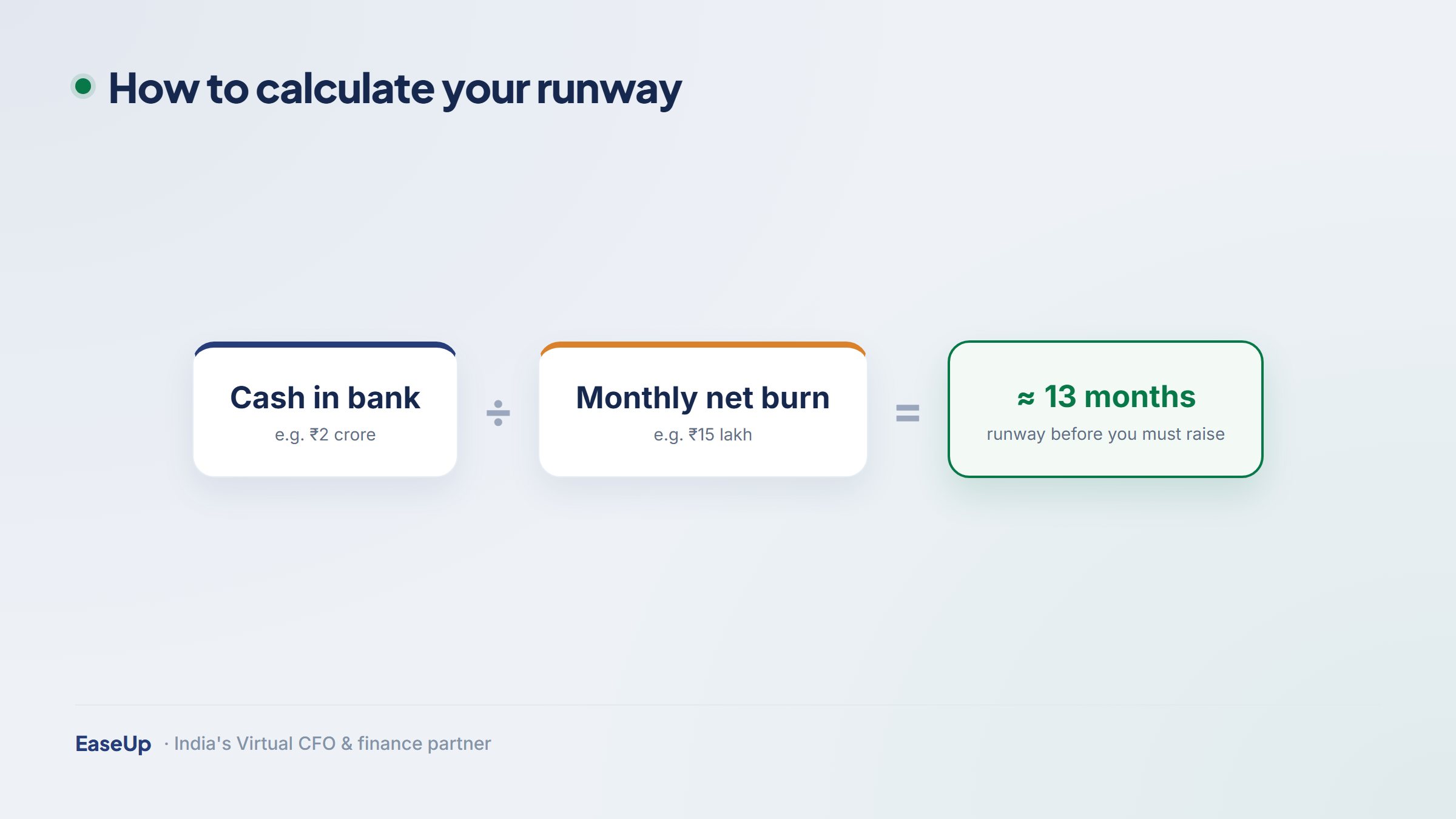
Say you hold ₹2 crore and burn ₹15 lakh a month net of revenue. Your runway is roughly ₹2,00,00,000 ÷ ₹15,00,000 ≈ 13 months. Indian investors turned sharply burn-conscious after 2022 and now look for a healthy 18–24 month runway post-investment. As a rough guide, SaaS startups sit around ₹8–15 lakh net burn a month; e-commerce runs higher.
:info: Why 18–24 months: A longer runway lets you weather a slow quarter, run a full raise (a Series A in India often takes 5–9 months), and negotiate from strength rather than desperation. Under 6 months of runway is a red flag investors spot instantly.
People are usually the largest line in a startup model, so investors read your hiring plan closely. Show who you have today, who you plan to hire, when each hire starts, how long each role takes to become productive, and the function it supports. A realistic hiring plan is far more persuasive than an aggressive one that assumes every hire lands on day one at full output.
Strong founders never model a single optimistic future. They stress the plan and show what happens when things go slower than hoped.
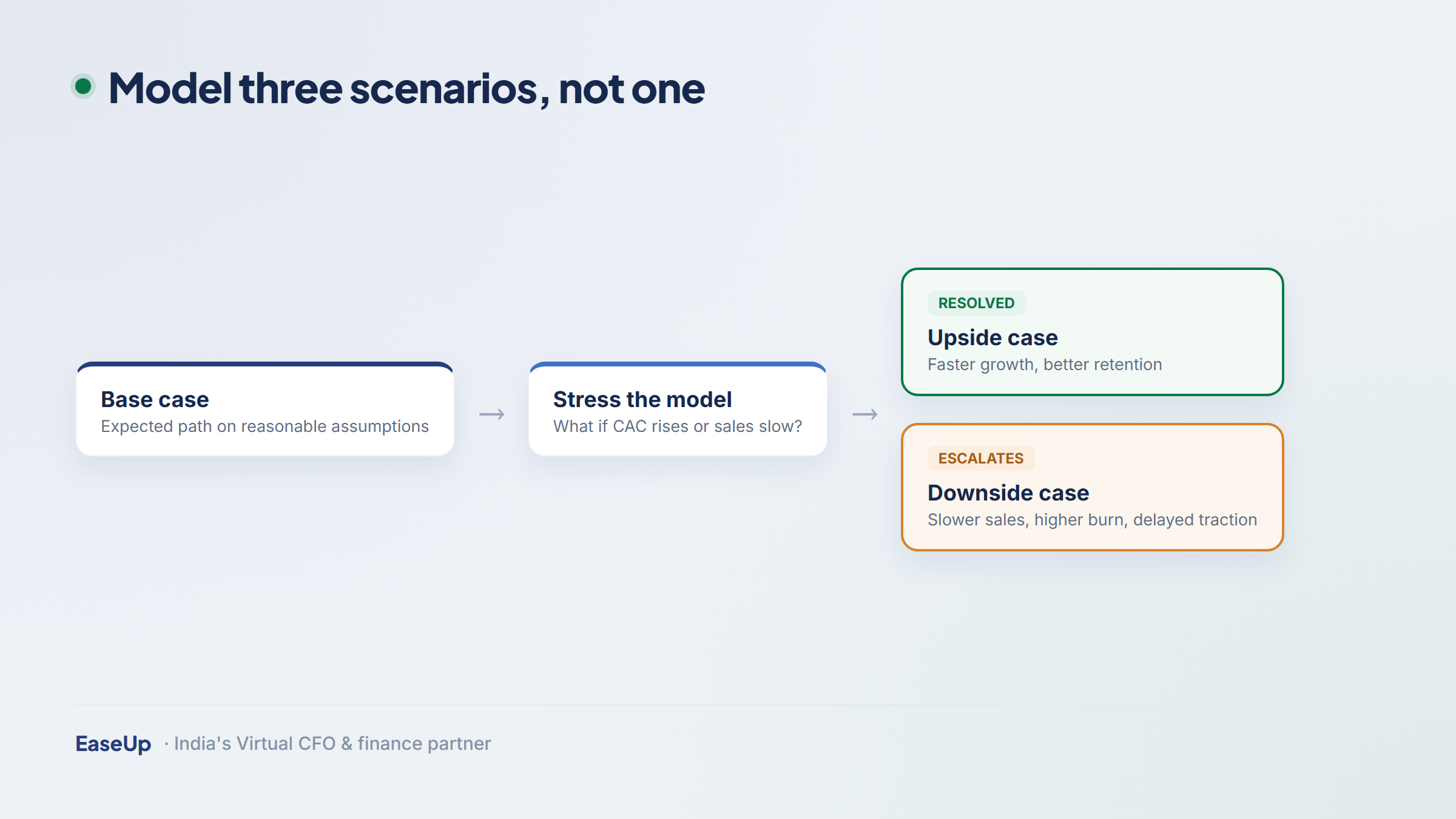
Scenario | What it tests | Why investors want it |
Base case | The expected path on reasonable assumptions | Your honest central plan |
Upside case | Faster growth, better conversion, stronger retention | Shows the size of the prize |
Downside case | Slower sales, higher burn, delayed traction | Shows you can survive and adapt |
Downside awareness is a trust signal. When you can explain calmly what you would cut and how runway holds if CAC rises, sophisticated investors relax — because they can see management thinking beyond ideal conditions.
The gap between an optimistic founder and a serious one shows up in language. Same ambition, very different credibility.
Weak version | Strong version |
"We expect to grow fast" | Growth built from acquisition, pricing and retention assumptions |
"We will be profitable soon" | Contribution profitability in this scenario, operating profitability in that stage |
"We need funding for growth" | Capital funds hiring, product and distribution through defined milestones |
"Marketing will improve" | CAC by channel with conversion rates you can defend |
Many startups either raise too little and run out of cash, or raise with weak justification and lose investor confidence. A good model answers four things about the round: how much capital, what it funds, how long it lasts, and which milestones it unlocks before the next raise. When the ask sits inside a clear fundraise preparation plan, investors can also judge dilution and the timing of your next round.
Fantasy growth with no operating plan connecting today to Year 3.
Assumptions you cannot explain in one plain-English sentence.
Ignoring cash timing — booking revenue but forgetting collections and billing cycles.
Leaving out working capital and one-off costs, so burn looks smaller than it is.
Only one scenario, with no downside case to show discipline.
These are the exact gaps diligence teams probe. Fixing them before the meeting — often with a virtual CFO reviewing the build — is far cheaper than losing a term sheet over them.
Your model does not live in a vacuum. When you actually price a round, the valuation it supports has to satisfy Indian rules.
DPIIT recognition: check eligibility and register on the Startup India portal — it also unlocks tax and funding benefits.
Share pricing & valuation: unlisted-company valuation reports for pricing are governed by norms overseen by the Companies Act, and, for foreign investment, RBI pricing guidelines under FEMA. For a private startup, however, the valuer is an IBBI-registered Registered Valuer under Section 247, overseen by the MCA/IBBI.
Filings: allotments and resolutions are filed with the Ministry of Corporate Affairs.
Your projections feed the DCF that underpins these valuations, so the same model has to be both a persuasion tool and a compliant one.
For an early-stage Indian startup, model monthly for the next 12 months and quarterly for the following 24 months, giving a three-year view in total. Build the first one to two years bottom-up from operating drivers, and use a top-down check against market size for the outer years. Investors know the numbers will change; they are testing your logic, not your crystal ball.
A 3-statement model links the profit and loss statement, the balance sheet and the cash flow statement so that one assumption flows through all three. It is the standard format investors and valuers use in India, and it sits underneath a discounted cash flow valuation. Its job is to prove a plan is financially survivable, not just profitable on paper.
After 2022, Indian investors became far more burn-conscious and now typically look for a healthy 18 to 24 months of runway following an investment, with CAC payback under 12 months and a clear path to the next milestone. Runway of under six months is treated as a red flag, because it forces a raise from a position of weakness.
Net burn is your monthly cash out minus cash in. Runway is cash in the bank divided by monthly net burn. For example, ₹2 crore in the bank with ₹15 lakh net burn a month gives roughly 13 months of runway. Always base it on when cash actually moves, not when revenue is booked, or the number will be too optimistic.
A downside case shows that management thinks beyond ideal conditions. When you can explain what happens if sales slow, CAC rises or cycles stretch — and what you would cut to protect runway — investors trust you more. Modelling only an optimistic base case signals a lack of discipline, which weakens confidence during diligence.
This guide is for general information only and does not constitute financial, tax or legal advice. Valuation, tax and fundraising rules change — confirm the current position with a qualified professional before you build a model or raise capital.


Your trusted partner for all your Financial needs.


Finance Management
Strategic Services