Financial advisory services transform business strategy by helping you make better decisions about cash flow, pricing, margins, and growth before problems become expensive. For an Indian SME, that means using finance not just to report the past, but to guide the next move.
Instead of reacting to delayed reports, tax deadlines, or cash crunches, you get forward-looking visibility into what to do next whether that is tightening working capital, improving pricing, preparing for a loan or fundraise, or fixing compliance risks before they escalate.
Financial advisory services in the Indian SME context are strategic, senior-level finance interventions designed to optimize capital efficiency, compliance, and growth. Unlike traditional auditing, which is a retrospective compliance check, financial advisory is proactive.
Advisors focus on helping SMEs manage cash flow runway, design profitable pricing models, navigate complex regulatory requirements, and build financial structures that attract capital. For businesses transitioning from small operations to mid-sized enterprises, a financial advisor serves as a fractional strategic director, providing enterprise-grade expertise without the cost of a full-time finance executive.
Many founders mistake routine transactional entries for strategic finance. Choosing the wrong support level leads to compliance gaps or wasted capital.
Support Type | Best For | What it Delivers | Key Limitation |
|---|---|---|---|
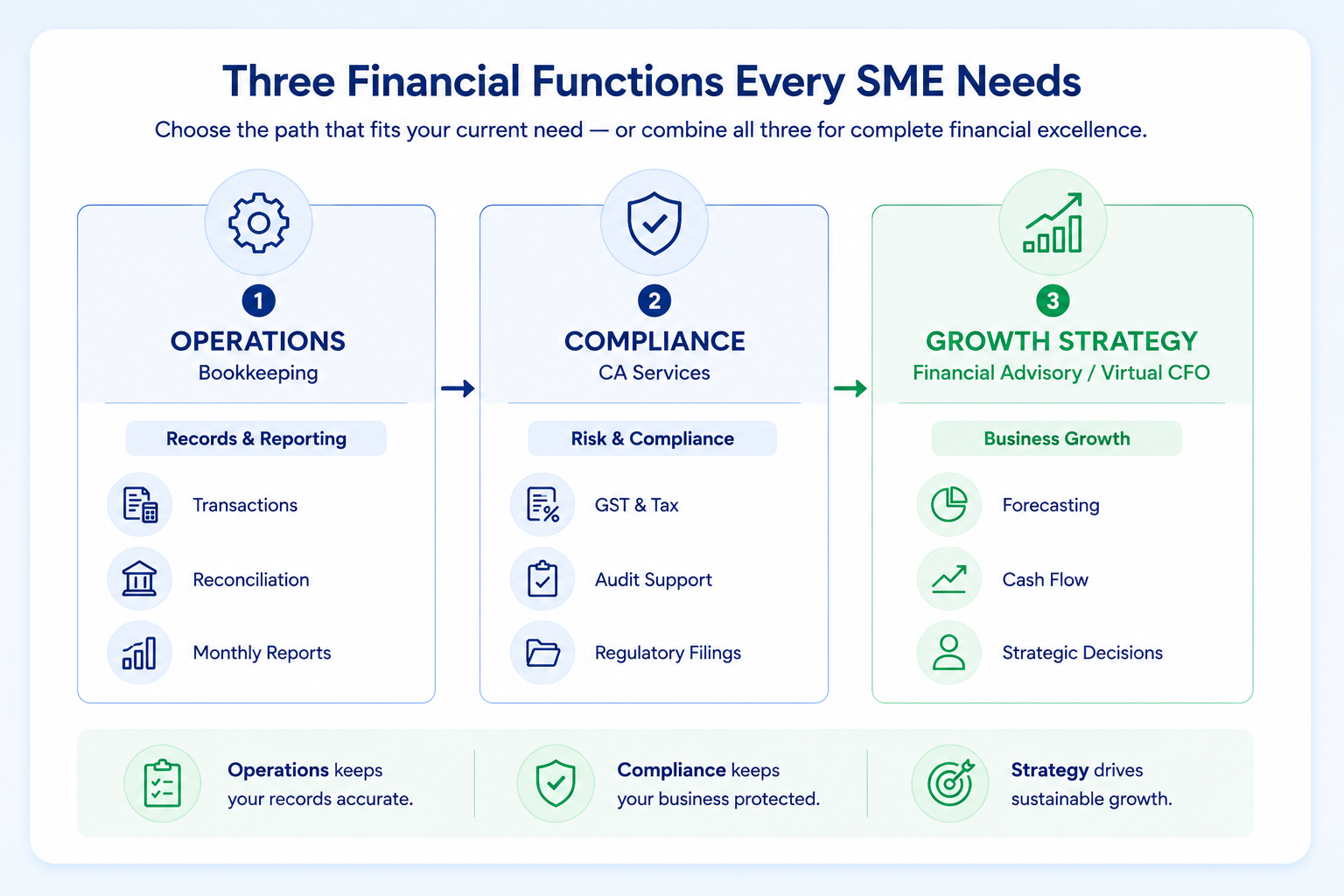
Bookkeeping | Operational transactions | Invoice recording, bank reconciliations, expense categorizations | No forecasting, budgeting, or strategic advice |
CA / Compliance | Tax and statutory filings | GST filings, tax audits, ROC annual filings, income tax returns | Retrospective focus; not aligned with growth strategy |
Financial Advisory | Mid-market strategic growth | Capital structuring, pricing models, M&A prep, unit economics optimization | Requires clean baseline books to be effective |
Virtual CFO | High-growth scaling | Fully integrated cash forecasting, board reporting, due diligence management | Higher cost; requires active founder partnership |
For most growing SMEs, a combined bookkeeping and financial advisory model provides the ideal balance of transaction accuracy and forward-looking strategy.
A professional advisory engagement is structured around a regular monthly rhythm that delivers three core outputs:
A Rolling 13-Week Cash Flow Forecast: A weekly breakdown of upcoming collections, statutory tax payments, payroll obligations, and cash buffer zones.
Segmented MIS Reports: A monthly performance pack breaking down revenue and margins by product, service line, or sales channel to highlight profitable and unprofitable segments.
Strategic Variance Analysis: A monthly review comparing actual performance against target budgets to identify cost leakages or pricing discrepancies early.
Your business has likely outgrown basic bookkeeping if it experiences any of these symptoms:
Revenue is growing but cash balance in the bank remains flat or decreases.
Monthly financial statements are delivered after the 20th of the following month, making them useless for active decisions.
You rely on founder memory and custom spreadsheets to track upcoming supplier payments and receivables.
GST and TDS calculations feel reactive and cause cash crunches at the deadline.
You cannot isolate project-level or product-level gross margins.
You are preparing for an external audit, bank loan application, or mergers and acquisitions due diligence.
Banks or lenders ask for projected financial statements and debt service coverage ratios (DSCR) that you cannot produce.
Promoter personal expenses are mixed up with operating business expenses in the primary ledger.
You are struggling to price new enterprise contracts correctly due to unclear overhead calculations.
The business is facing statutory penalties, late fees, or interest charges on recurring filings.
Navigating Indian compliance requires shifting from reactive filing to proactive planning. Financial advisors structure your processes to protect cash flow and reduce regulatory risks:
GST Structure: Managing zero-rated exports via Letter of Undertaking (LUT) and supervising Rule 89 refunds to ensure input tax credit (ITC) on office rentals and software services is not locked up.
Income Tax Act compliance: Reconciling quarterly TDS deductions (Section 194J/194C) and managing Form 26AS records to avoid mismatches. Advisors also monitor tax audit thresholds under Section 44AB (₹1 Crore for cash/₹10 Crore for digital transactions).
MCA Compliance: Streamlining annual filing requirements (Form AOC-4, MGT-7) and mandatory audit trail compliance to protect director standing.
FEMA and RBI Guidelines: Overseeing foreign inward remittances and ensuring Foreign Inward Remittance Certificates (FIRC) are matched against exports within the mandatory 9-month realization window.
Our team at EaseUp integrates these compliance controls into your monthly accounting rhythm, keeping your books audit-ready. Explore our accounting and compliance support to secure your operations.
A financial advisor transforms your strategy by pulling four key operational levers:
Pricing Models: Moving from gut-feel markups to value-based or structured cost-plus pricing that factor in true delivery overhead.
Margin Optimization: Identifying and trimming low-margin client segments and resource leakages.
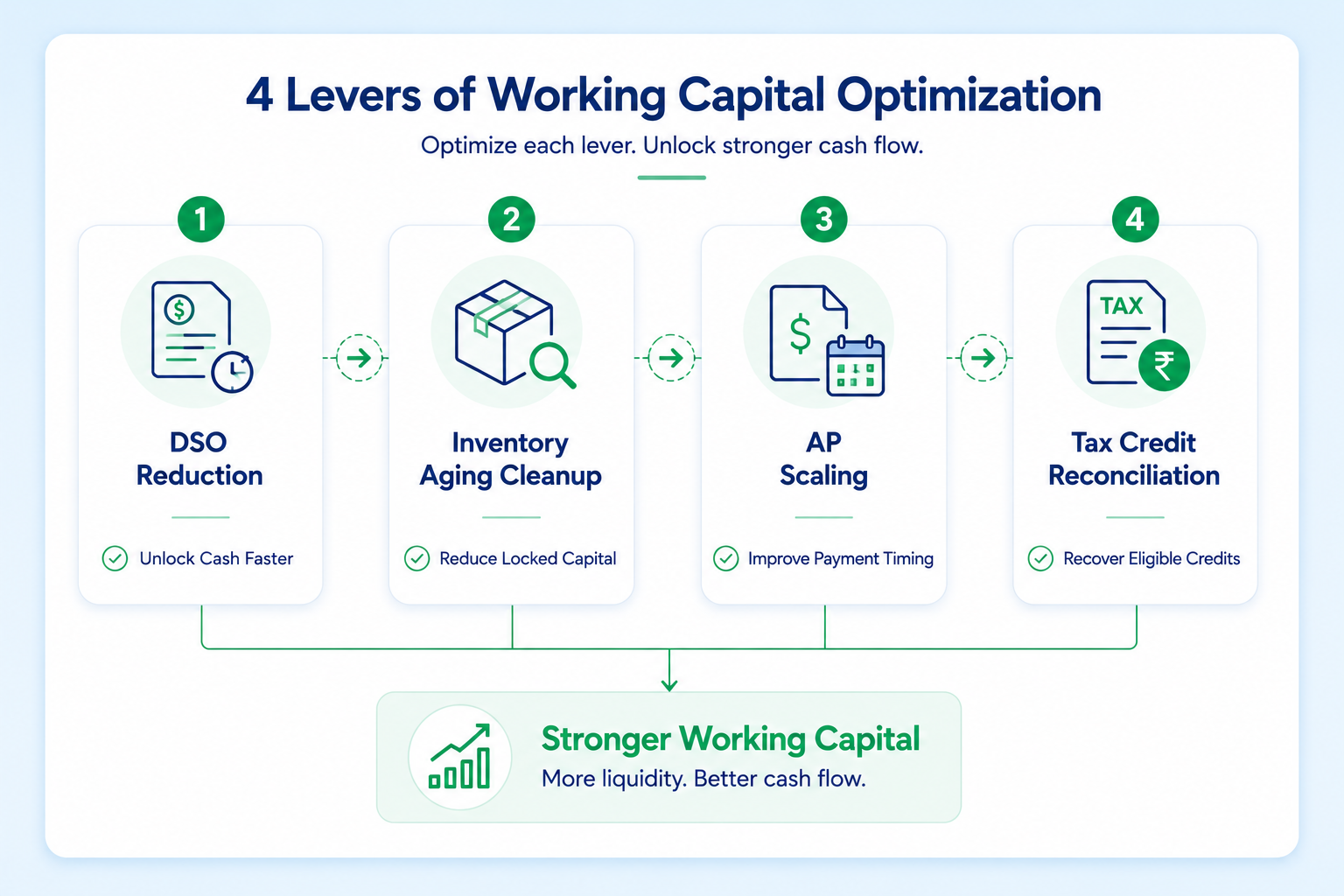
Working Capital Acceleration: Optimizing your inventory holding cycles and tightening credit terms to release cash.
Fundraising Readiness: Preparing institutional-grade reporting, valuations, and due diligence rooms for venture capital or mergers and acquisitions. If you are preparing for transaction scaling, read our guide on mergers and acquisition prep.
SME financial advisory retainers are tied to scale and complexity. In 2026, the standard Indian market pricing reflects these ranges:
Seed & Early Stage (₹30,000 – ₹50,000 / month): Basic MIS setup, rolling cash flow tracking, and oversight of a junior accountant.
Mid-Market Growth (₹60,000 – ₹1,20,000 / month): Custom pricing templates, unit economics analysis, working capital optimization, and direct advisor attendance at monthly review meetings.
Strategic Expansion (₹1,50,000 – ₹2,50,000 / month): Advanced tax planning, international transaction structuring, transfer pricing audits, and active fundraising or M&A support.
To choose the right partner, evaluate candidates on four criteria:
Industry Experience: Ask if they have handled businesses with your specific cash cycles (e.g., inventory models for D2C vs. milestone billing for IT services).
Operational Integration: Ensure they do not just write reports, but active supervise the bookkeeping stack to verify source data accuracy.
Regulatory Competence: Confirm their familiarity with Indian direct and indirect tax laws, FEMA rules, and ICAI standards.
Technology Stack: Choose partners who use modern accounting software (Zoho Books, QuickBooks, or Tally Prime) and automated reporting integrations over manual entry.
At EaseUp, we work as your fractional finance department. Our onboarding process is designed to build momentum quickly without disrupting daily business operations:
Phase 1 (Week 1–2): Diagnostic & Cleanup: We audit historical ledgers, reconcile pending GST/TDS entries, and clear compliance backlog.
Phase 2 (Week 3–4): Dashboard Setup: We build custom monthly MIS reporting frameworks and launch the rolling 13-week cash flow model.
Phase 3 (Month 2 onwards): Ongoing Partnership: We deliver monthly variance reports, run compliance checks, and lead strategic reviews to guide your business decisions.
A Delhi-based packaging manufacturer with an annual turnover of ₹12 Crore had steady orders but constant cash flow pressure, frequently relying on high-interest overdraft lines to meet monthly payroll.
EaseUp structured an advisory engagement to address the root causes:
DSO Reduction: We identified that client payments averaged 73 days. By introducing milestone-based billing and a structured collections follow-up protocol, payment terms were compressed to 45 days.
Inventory Optimization: We discovered ₹1.8 Crore in slow-moving raw materials. We implemented a Just-In-Time (JIT) procurement system, freeing up ₹40 Lakh in locked cash.
GST Reconciliation: Re-aligned input tax credit (ITC) tracking, clearing ₹15 Lakh in blocked refunds.
Result: The company compressed its overall cash conversion cycle by 28 days, eliminated bank overdraft reliance, and generated sufficient internal cash flow to fund a new production line.
Financial advisory is not just about cleaner books or better reporting for Indian SMEs. It shapes how clearly you see cash flow, margins, pricing decisions, compliance exposure, borrowing readiness, and growth options. As the business gets more complex, forward-looking finance becomes a strategic advantage, not just a back-office task.
If your team is dealing with delayed reports, GST or TDS pressure, working capital strain, unclear profitability, lender requests, or fundraise and due diligence preparation, now is the right time to tighten the finance function with the right advisory support.
Need a professional finance partner to improve cash flow visibility, strengthen compliance, and bring more structure to pricing, reporting, and growth decisions? Learn how our Virtual CFO services can support your next stage of scale.
A regular CA typically focuses on statutory audits, tax returns, and compliance filings. A financial advisor focuses on forward-looking business strategy, cash flow planning, cost control, pricing models, and helping founders use numbers to drive profitability.
No. Growing SMEs and startups actually gain the most from financial advisory. It gives them access to senior financial expertise (like a CFO) on a fractional basis, helping them build sound financial structures before scaling.
It is a rolling, week-by-week projection of actual cash inflows and outflows. It helps SMEs plan for upcoming obligations like quarterly advance tax, monthly GST payments, and payroll, preventing sudden cash deficits.
Working capital advisory focuses on speeding up collection times (reducing DSO) and optimizing inventory levels. By releasing cash locked in receivables and unsold inventory, the business reduces its dependency on expensive short-term bank debt, directly lowering interest expenses.
Most SMEs see improvements in cash visibility and collections follow-up within the first 30 to 45 days. Major structural changes, such as pricing adjustments or working capital cycle reductions, typically show measurable impact within 90 days.


Your trusted partner for all your Financial needs.


Finance Management
Strategic Services