TL;DR — ESOPs in one minute
• An ESOP gives your team the right to buy company shares at a fixed price after a vesting period — a way to reward talent without burning cash.
• India has six common structures: ESOS, ESPP, RSU, RSA, SAR and Phantom Equity. ESOS is the startup default.
• Tax hits twice: a perquisite at exercise (salary income, TDS by employer) and capital gains at sale.
• DPIIT-recognised startups can defer the exercise tax by up to 48–60 months — a big cash-flow relief for your team.
• Issuing one is a compliance exercise: special resolution, a valuer, MGT-14 and PAS-3 filings. Get the structure right before you promise options.
An Employee Stock Option Plan (ESOP) gives eligible employees the right — not the obligation — to buy shares in your company at a pre-agreed price, after they complete a vesting period. If the company grows and the shares become more valuable, employees can buy at the old, lower price and pocket the difference.
For a cash-strapped startup, that is powerful. You reward and retain key people without inflating fixed salaries, while giving them a real reason to think like owners. Around 70% of Indian companies now use ESOPs as part of their long-term incentive strategy.
The catch: an ESOP rolled out without a clear structure creates confusion around eligibility, valuation, tax and dilution. If you are weighing ESOPs against your hiring plan and runway, a virtual CFO can model the impact before you issue a single option.
 Founder tip: Decide why you are granting options — retention, hiring leverage, or rewarding early risk — before you decide how many. The "why" drives your pool size, vesting and eligibility rules.
Aspect | What it means | Why it matters |
Purpose | A right for employees to acquire shares | Builds an ownership mindset and lifts retention |
Best fit | Startups & SMEs rewarding talent without big salary hikes | Preserves cash while staying competitive on hiring |
Value for the team | Employees gain as the company grows in value | Aligns individual upside with company success |
Main cost to founders | Equity dilution over time | Needs planning so the cap table stays healthy |
Key risk | Poor structure, tax or compliance surprises | Fixable with the right plan and advice upfront |
Founders often use "ESOP" as a catch-all, but the structures differ a lot in ownership, dilution and cash impact. Here are the six you will hear about most.
Structure | How it works | Best suited to |
ESOS | Right to buy shares at a fixed price after vesting — the classic startup option | Seed to Series B startups building an ownership culture |
ESPP | Lets employees buy shares, usually at a discount | Firms that want broad, voluntary employee ownership |
RSU | A promise of shares that vest over time (legally works like an ESOP in India) | Growth and pre-IPO companies |
RSA | Actual shares granted upfront, subject to restrictions | Senior or founding hires you want as shareholders now |
SAR | Cash payout equal to the rise in share value — no shares issued | Rewarding people without diluting the cap table |
Phantom | Cash reward that mirrors share value; no real equity | Consultants, advisors and broad teams |
 Watch out: Phantom equity and SARs create a cash liability on your balance sheet, because you settle in cash, not shares. Founders routinely underestimate this. ESOS, RSU and RSA pass value through the cap table instead.
Seed to Series B: ESOS is the default. It is well understood, conserves cash and rewards long-term commitment.
Growth / pre-IPO: RSUs bring transparency and align with global compensation norms as you scale.
Broad or non-employee rewards: SARs or Phantom Equity let you incentivise advisors and wide teams without adding shareholders.
Your choice depends on stage, cash flow, valuation comfort and compliance readiness. When equity design sits alongside your fundraising and cap-table strategy, it pays to align the plan from day one.
This is where most confusion lives. For share-settled plans (ESOS, RSU, RSA), tax arises at two separate moments:
At exercise — when you convert vested options into shares. The gain is taxed as a perquisite (part of salary income), and your employer deducts TDS under Section 192.
At sale — when you sell those shares. Any further gain is taxed as capital gains.
SARs are the exception — a cash payout taxed once as salary, with no capital-gains stage. You can read the government’s own summary on the Income Tax Department’s ESOP taxation page.
The taxable perquisite is simply the difference between the fair market value (FMV) on the exercise date and the price the employee pays:
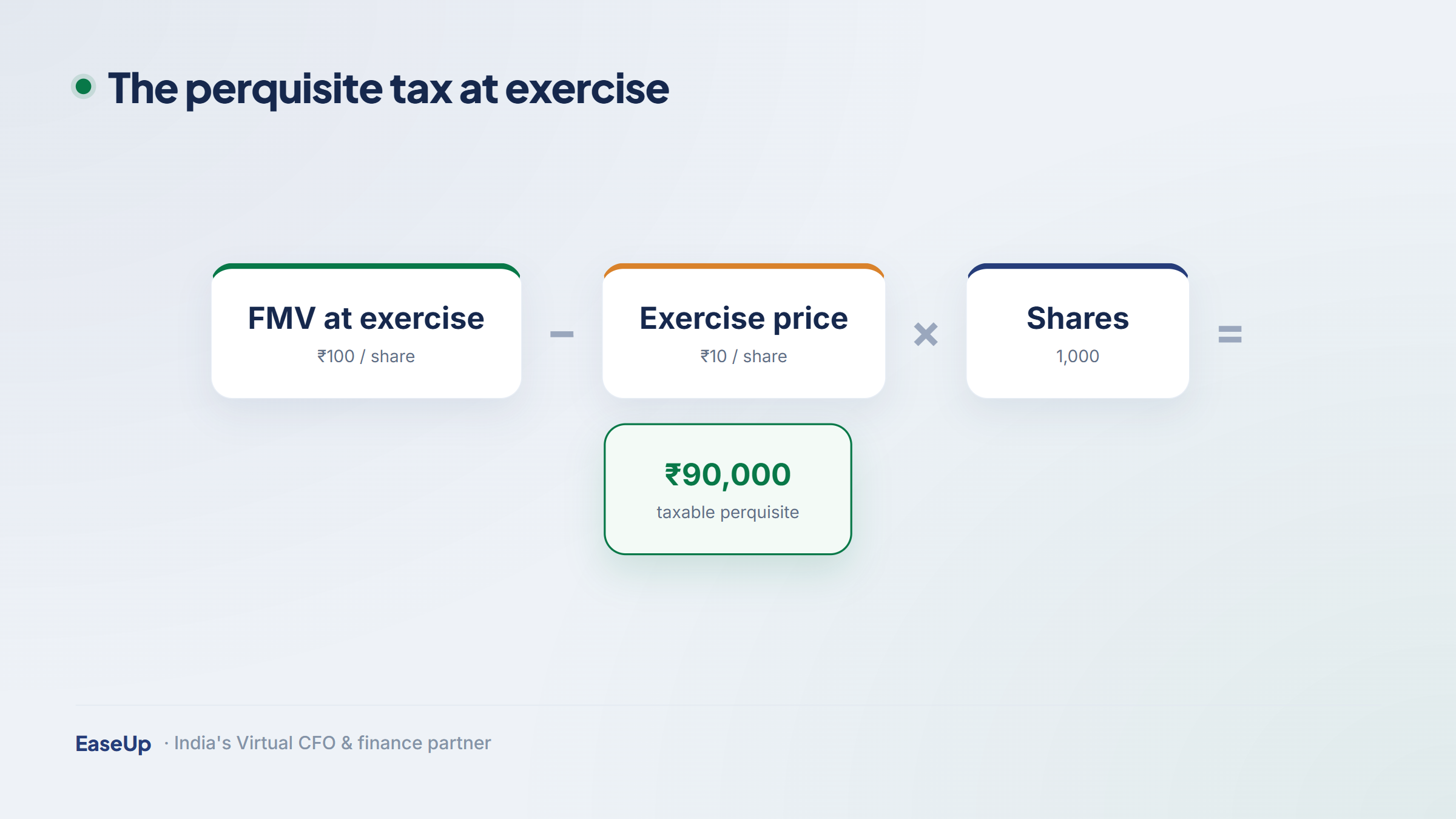
Say an employee holds options for 1,000 shares at an exercise price of ₹10. On the exercise date, the FMV is ₹100. The perquisite is (₹100 − ₹10) × 1,000 = ₹90,000, added to salary and taxed at slab rates.
:info: Who sets the FMV: For unlisted companies, the FMV must be certified by a SEBI-registered Category I merchant banker, on the exercise date or within 180 days before it (Rule 3(8) of the Income Tax Rules). Never self-estimate this number.
When the employee later sells, the gain is the sale price minus the FMV already taxed at exercise. Whether it is short- or long-term depends on how long the shares are held after exercise, which sets the tax rate. Planning the sale timing well can meaningfully change the final tax bill — a good reason to loop in your accounting and compliance team early.
Paying tax at exercise — before selling a single share — has hurt many employees at unlisted startups. To fix this, eligible startups can defer the exercise-stage tax.
Point | Detail |
Who qualifies | DPIIT-recognised startups with a valid IMB certificate under Section 80-IAC |
Deferral window | Up to 48 months from the end of the assessment year of allotment (shares allotted before 1 Apr 2026); up to 60 months from the end of the tax year of allotment |
Tax becomes due at | The earliest of: window expiry, sale of shares, or the employee leaving |
Why it matters | Employees are not taxed on paper gains they cannot yet cash out |
To use this, your startup must be recognised by DPIIT. You can check eligibility and apply on the Startup India portal.
Issuing options is a governed process under Section 62(1)(b) of the Companies Act, 2013 and Rule 12. Skip a step and the grant can be challenged later. Here is the flow:
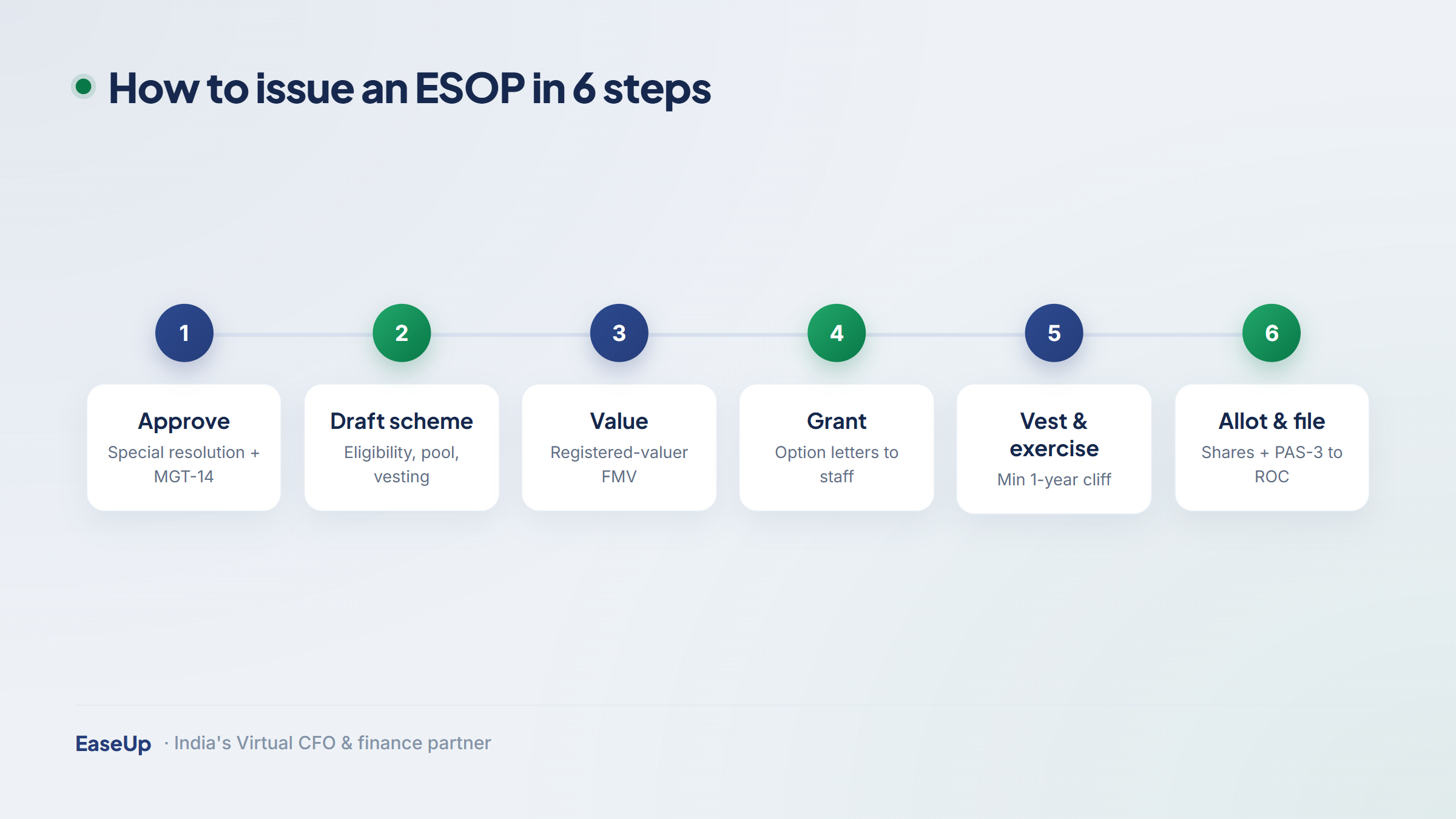
Board & shareholder approval — pass a special resolution under Section 62(1)(b) and file Form MGT-14 with the MCA within 30 days.
Draft the ESOP scheme — define eligibility, pool size, vesting, exercise price and exit terms.
Get a valuation — a registered valuer sets the fair value of shares at grant.
Grant the options — issue grant letters recording the number of options and exercise price.
Vesting & exercise — options vest after a minimum one-year cliff; employees then exercise and pay the exercise price.
Allot & file — allot shares and file Form PAS-3 (Return of Allotment) with the ROC within 30 days.
Every step should be documented. You can access the forms and filing requirements on the Ministry of Corporate Affairs portal.
The ESOP pool is the slice of equity you reserve for the team — usually 8–15% of fully diluted capital for an early-stage Indian startup. Set it too small and you cannot hire; too large and you dilute founders and investors more than needed.
Founder tip: Create the pool before a funding round, not after. Investors expect the pool to come from the pre-money cap table, so sizing it early protects your ownership. A quick business valuation keeps the numbers defensible.
Vesting: options are earned over time, commonly across four years, so people stay to realise the full grant.
Cliff: a minimum period (at least one year under Rule 12) before any options vest. Leave before the cliff and you get nothing.
Exercise window: the period in which vested options can be converted to shares — pay close attention to what happens when an employee resigns.
Promising options informally over email, with no scheme or board approval behind them.
Ignoring the perquisite tax, so employees are shocked by a TDS hit at exercise.
Skipping the merchant-banker valuation and using a made-up FMV.
Sizing the pool after a round, quietly diluting the founders.
No communication — employees who do not understand their options do not value them.
An ESOP touches finance, tax, law and HR at once. If you are designing a pool alongside a fundraise, modelling dilution, or preparing for an audit, expert help avoids expensive mistakes. A virtual CFO brings the cap-table discipline, valuation inputs and board-reporting rigour to get it right the first time.
An ESOP (Employee Stock Option Plan) gives an employee the right to buy company shares at a fixed price after a vesting period. If the company grows, the employee can buy at the old, lower price and benefit from the increase in value — a way to reward talent without paying more in cash salary.
Share-settled ESOPs are taxed twice. First, at exercise, the difference between the fair market value and the exercise price is taxed as a salary perquisite, with TDS deducted by the employer. Second, at sale, any further gain is taxed as capital gains. SARs are taxed only once, as a cash salary payout.
Yes. DPIIT-recognised startups holding a valid IMB certificate under Section 80-IAC can defer the exercise-stage tax by up to 48 months (60 months for shares allotted from 1 April 2026). The deferred tax falls due at the earliest of the window expiry, the sale of shares, or the employee leaving the company.
Most early-stage Indian startups reserve 8–15% of fully diluted equity for their ESOP pool. The right number depends on how many senior hires you plan to attract with equity. Create the pool before a funding round so it comes from the pre-money cap table and protects founder ownership.
Under Rule 12 of the Companies (Share Capital and Debentures) Rules, options cannot vest earlier than one year from the date of grant. This one-year cliff is the legal minimum; most startups spread total vesting over four years to encourage employees to stay.
This guide is for general information only and does not constitute tax, legal or financial advice. ESOP rules and tax provisions change — confirm the current position with a qualified professional before you design or issue a plan.


Your trusted partner for all your Financial needs.


Finance Management
Strategic Services