
TL;DR — the 30-second version
• Ecommerce bookkeeping means recording every sale, fee, tax and return — not just the money that lands in your bank.
• Book gross sales as revenue. The payout from Amazon or Flipkart is gross sales minus commission, TCS, TDS and fees. Never book the payout as revenue.
• GST registration is mandatory for marketplace sellers from day one — there is no turnover threshold.
• FY 2025-26 numbers to know: 0.5% TCS under GST and 0.1% TDS under Section 194O. Both are credits, not costs.
• Reconcile each settlement report monthly, keep business and personal money apart, and use cloud accounting software.
Ecommerce bookkeeping is the steady habit of recording every rupee that moves through your online store. That means sales, marketplace fees, taxes, refunds and inventory — not just the payout that hits your bank account.
Selling online looks simple. A customer orders, the marketplace pays you, money arrives. But behind one payout sits a stack of numbers: gross sale, commission, shipping fee, Tax Collected at Source (TCS), Tax Deducted at Source (TDS), and returns. If you only track the payout, your books are wrong from day one.
Good books are not paperwork for its own sake. They tell you which product makes money, how much tax you owe, and whether you can afford to scale. Many founders treat this as an afterthought and then scramble at filing time. A steady bookkeeping routine fixes that.
 Note: This guide uses FY 2025-26 rates and rules for India. Tax rates change. Always confirm the current rate on the official portal before you file.
A kirana shop has one counter and one cash drawer. An online seller may sell on Amazon, Flipkart, Meesho and their own website at the same time. Each one sends a different report, in a different format, with different fees taken out.
Many platforms, many reports. Three marketplaces mean three settlement files to read and match every month.
Hidden deductions. Commission, closing fee, shipping, advertising and tax are all pulled out before you see a single rupee.
Returns and refunds. A sale can reverse weeks later, so revenue and stock both need correcting.
Cash flow lag. You pay for stock and ads today but get paid 7 to 15 days later.
None of this is hard once you have a system. It is only painful when you wait until the year ends to start.
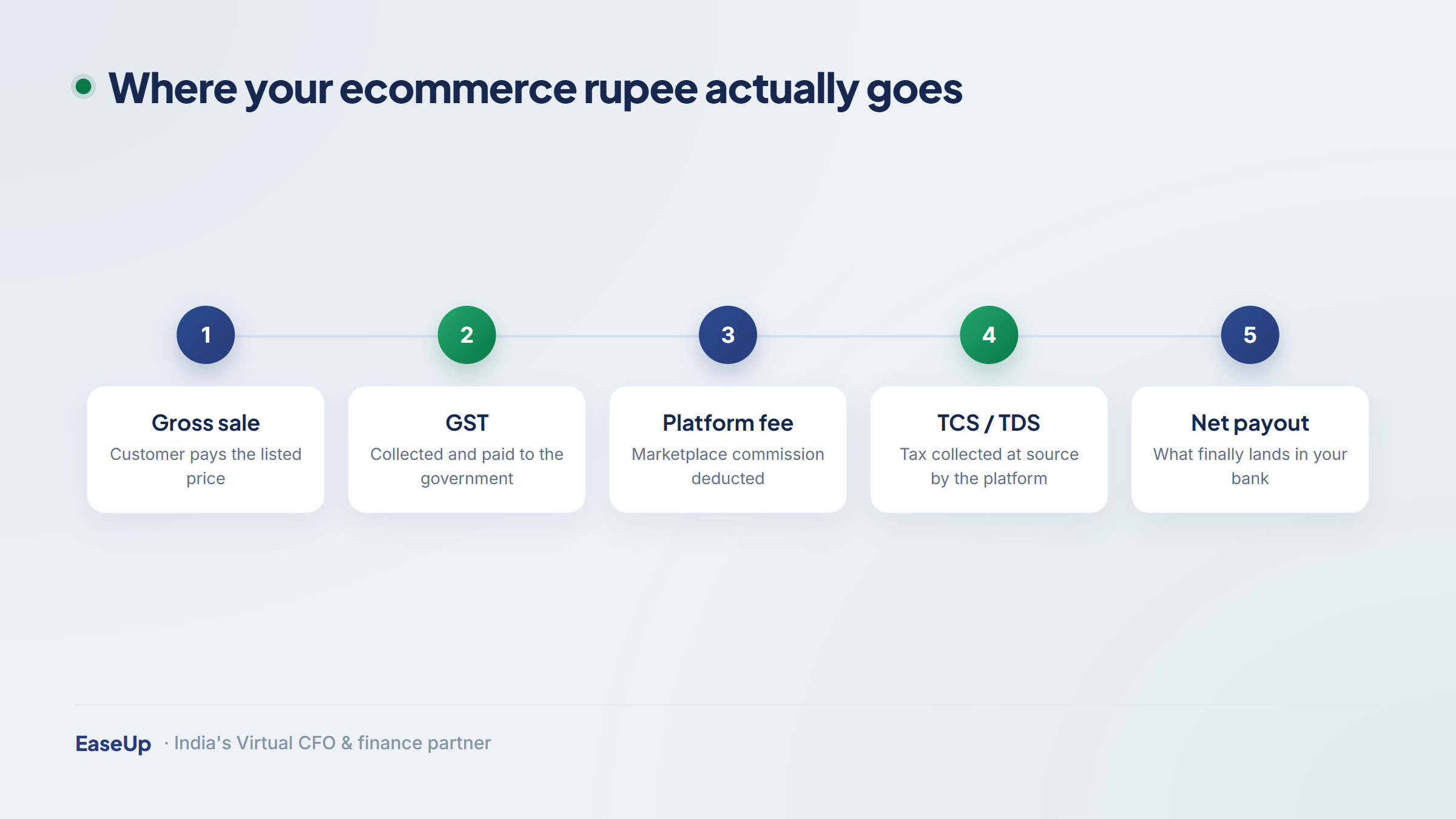
This is the single biggest error online sellers make, so read it twice. Your revenue is the gross sale value (before GST). The settlement is what the marketplace actually pays you after taking its cut. They are not the same number.
If you record only the settlement as revenue, you understate your sales, lose the Input Tax Credit (ITC) on the commission GST, and your profit and loss statement stops telling the truth. Here is how one order really breaks down.
Line item | Amount (Rs) | What it is |
Gross sale (item price) | 1,000 | Your revenue, before GST |
GST collected (18%) | 180 | You hold this for the government |
Marketplace commission | -150 | Platform fee (an expense) |
GST on commission | -27 | Claimable as ITC |
Shipping / closing fee | -60 | Logistics expense |
TCS under GST (0.5%) | -5 | A tax credit, not a cost |
TDS u/s 194O (0.1%) | -1 | A tax credit, not a cost |
Settlement to your bank | 937 | What you receive — NOT your revenue |
 Watch out: In this example, revenue is Rs 1,000 — not the Rs 937 that reached your bank. Book the Rs 1,000 as sales, record each deduction separately, and claim the TCS, TDS and commission GST as credits.
If you sell physical goods through any marketplace, GST registration is mandatory from your first sale. Under Section 24(ix) of the CGST Act, there is no turnover threshold for marketplace sellers, and the composition scheme is not available to you. You can confirm the rules and register on the official GST portal.
TCS under GST. The marketplace collects 0.5% TCS on your net taxable sales (0.25% CGST + 0.25% SGST intra-state, or 0.5% IGST inter-state) and deposits it against your GST number.
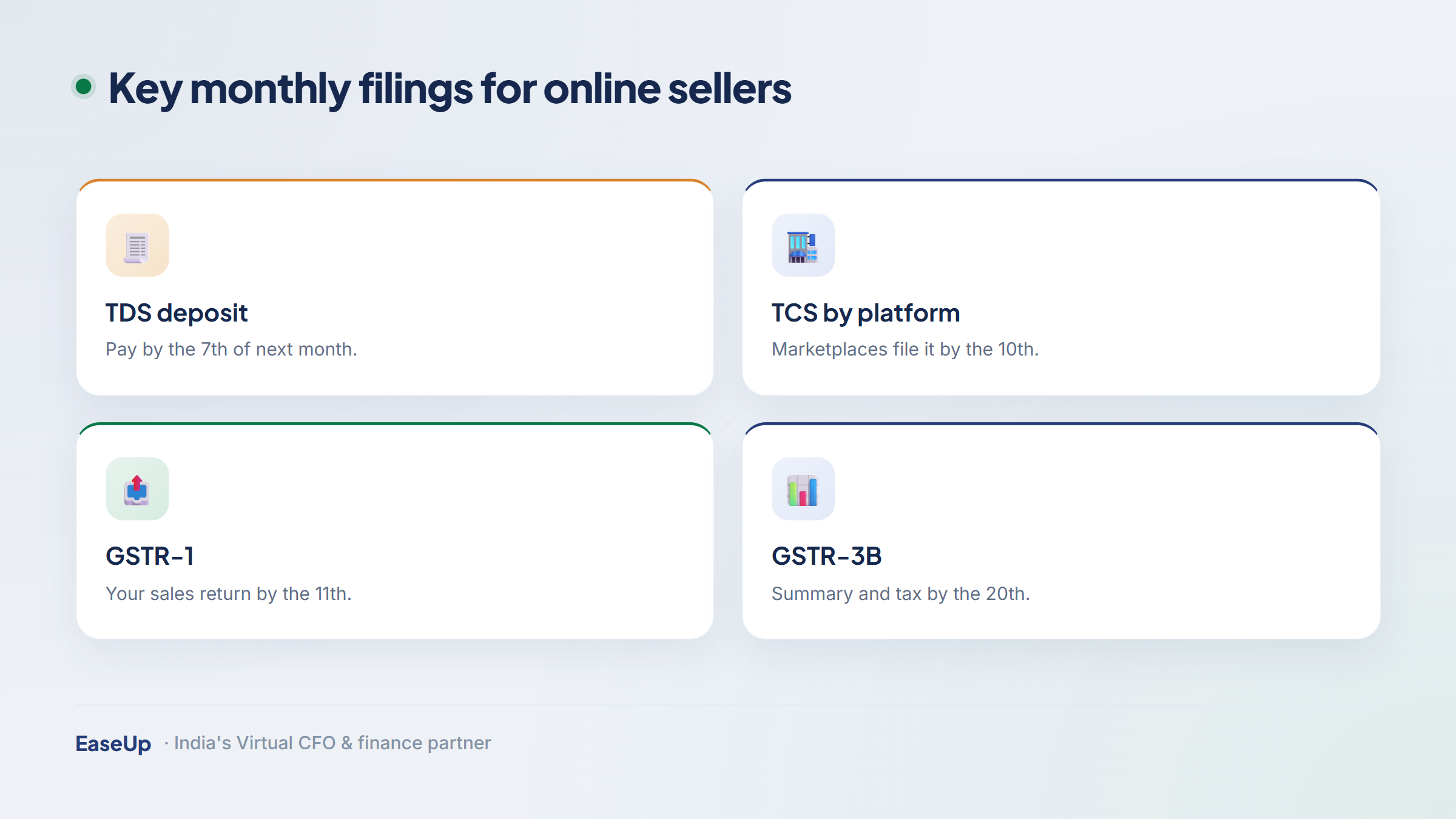
Monthly returns. You file GSTR-1 (sales) and GSTR-3B (summary and payment) every month. File NIL returns even in months with zero sales.
Annual return. GSTR-9 once a year if you cross the turnover limit.
Accept your TCS credit. Check GSTR-2A / the TCS statement and accept the credit so it offsets your GST liability.
Miss a monthly return and late fees of about Rs 20 to Rs 50 per day start adding up. A clean ledger makes filing a ten-minute job instead of a weekend of panic.
Apart from GST, marketplaces also deduct income tax. Under Section 194O of the Income Tax Act, the platform deducts 0.1% TDS on the gross amount of your sales and deposits it against your Permanent Account Number (PAN).
This is not a fee you lose. It is advance income tax. When you file your return, it shows up in Form 26AS and your Annual Information Statement (AIS), and it reduces the tax you finally pay. Record it as a tax credit, never as an expense.
However, Individual and HUF sellers whose gross sales through a platform stay under ₹5 lakh in a financial year are exempt from this TDS altogether, provided their PAN or Aadhaar is on file with the marketplace.
:check_mark_button: Founder tip: Download Form 26AS and your AIS every quarter. If the TDS the platform claims to have deducted does not match what the government shows, you can fix it before filing — not after a notice.
There are two ways to record money. Most small sellers start with cash basis, but accrual gives a truer picture once you have stock and ads in play.
Method | When you record | Best for |
Cash basis | When money actually moves in or out | Very small or just-starting sellers |
Accrual basis | When a sale or expense happens, even if unpaid | Sellers with inventory, credit and ads |
Accrual matters for ecommerce because you buy stock and pay for advertising before the payout arrives. Accrual matches the cost to the sale, so your profit per product is real. If you are unsure which to use, a Virtual CFO can set the right method for your stage.
Cost of Goods Sold (COGS) is what each product cost you — the purchase price plus inbound shipping and packing. Subtract COGS from revenue and you get gross profit. Get this wrong and a "bestseller" can quietly lose money.
Track stock in real time. Link your inventory to your books so stock-outs and overstock do not surprise you.
Pick one valuation method. FIFO (first in, first out) or weighted average — pick one and stay consistent.
Account for returns. When a customer returns an item, reverse the sale and put the stock back if it is resaleable.
Include the hidden costs. Packing material, warehousing and last-mile fees all belong in your true product cost.
Reconciliation simply means matching your records to what really happened. Do it monthly and tax season becomes a non-event. Here is a simple order to follow.
Download every settlement report. Pull files from each marketplace and your payment gateway.
Match payouts to sales. Confirm each payout equals gross sales minus the listed deductions.
Record fees separately. Log commission, shipping, ads and GST on each as their own lines.
Reconcile the bank. Tick off that every payout actually landed in your account.
Check your tax credits. Accept TCS in GST and confirm TDS in Form 26AS.
Review stock. Match physical stock to your books and adjust for returns.
:check_mark_button: Founder tip: Block two hours on the 5th of every month for reconciliation. A recurring calendar slot beats a year-end marathon every single time.
You do not need expensive tools to keep clean books. You need software that connects to your marketplaces, handles GST, and lets you pull a profit and loss statement in one click.
Look for marketplace sync. Auto-import from Amazon, Flipkart and your gateway saves hours of typing.
GST built in. It should generate GSTR-ready reports and track ITC.
Inventory linked to books. Stock and COGS should update together.
Cloud access. You and your accountant see the same numbers from anywhere.
Popular India-friendly options include Zoho Books, TallyPrime and QuickBooks. The right pick depends on your volume and how many channels you sell on.
Online sellers juggle GST and income tax deadlines together. Keep this calendar where you can see it.
Around the 10th. Reconcile settlements and accept TCS credit for last month.
11th of each month. File GSTR-1 (outward sales).
20th of each month. File GSTR-3B and pay net GST.
Quarterly. Pay advance income tax and check Form 26AS / AIS.
Annually. File GSTR-9 (if applicable) and your income tax return.
If your business is a private limited company, you also have Ministry of Corporate Affairs filings such as annual returns and board compliance. A compliance partner can map every due date for you.
Most messy books come from a few repeat mistakes. Spot them early and you save yourself notices, penalties and sleepless nights.
Mixing personal and business money. Open a dedicated business account and card from day one.
Booking the payout as revenue. Always record gross sales, then deductions, separately.
Ignoring NIL returns. Even a zero-sales month needs a filed return.
Forgetting tax credits. Unclaimed TCS, TDS and commission GST is money left on the table.
Doing it once a year. Monthly bookkeeping is faster, cheaper and far more accurate.
In your first months, with one channel and low volume, you can keep books yourself with good software. As you add marketplaces, hire staff or chase funding, the numbers get serious — and so do the penalties for getting them wrong.
That is when founders bring in support. A part-time finance team handles reconciliation, GST and reporting so you can focus on growth. Explore EaseUp’s bookkeeping services or a full Virtual CFO when you are ready to scale with confidence.
Note: You can read the official rules anytime on the Startup India portal and the GST and Income Tax sites linked above before making big calls.
Yes. If you sell physical goods through a marketplace like Amazon, Flipkart or Meesho, GST registration is mandatory from your very first sale under Section 24(ix) of the CGST Act. There is no turnover threshold, and the composition scheme is not available to marketplace sellers. You can register on the official GST portal.
Gross sales is the full price of the item you sold and that is your revenue, recorded before GST. The settlement is what the marketplace actually pays into your bank after deducting commission, shipping, TCS, TDS and fees. Always book gross sales as revenue and record each deduction separately, otherwise your profit and loss statement will be wrong.
Under GST, marketplaces collect TCS at 0.5% of your net taxable sales (split as 0.25% CGST and 0.25% SGST for intra-state, or 0.5% IGST inter-state). Under Section 194O of the Income Tax Act, platforms deduct 0.1% TDS on gross sales. Both are credits you can claim back, not costs. Always confirm the latest rate on the official portal before filing.
The best software is one that syncs with your marketplaces, has GST built in, links inventory to your books and runs in the cloud. Popular India-friendly options include Zoho Books, TallyPrime and QuickBooks. Your right choice depends on sales volume and how many channels you sell on. The key is consistent monthly use, not the brand name.
Monthly, at a minimum. Online sellers have GST returns due every month, so reconciling settlements, recording fees and checking tax credits monthly keeps you compliant and accurate. Doing books only once a year leads to errors, missed credits and a stressful, expensive scramble at tax time. A fixed two-hour slot each month is enough for most small sellers.
This article is for general information only and is not tax, legal or accounting advice. Tax rates and rules change; please verify the current position on official government portals or consult a qualified professional before acting.


Your trusted partner for all your Financial needs.


Finance Management
Strategic Services