TL;DR — Crowdfunding vs VC in one minute
• Crowdfunding raises small amounts from many backers. It validates demand and keeps you in control, but the cheques are small.
• Venture capital brings large, institutional money and a strong network — in exchange for equity, board seats and growth pressure.
• True equity crowdfunding is still legally restricted in India. Platforms like Tyke use CSOPs (Community Stock Option Plans) to work around it.
• Rewards and donation models suit early-stage B2C and D2C brands. VC suits high-scale, 10x-potential tech startups.
• Whichever you pick, clean books and a fundable data room matter more than most founders expect. Sort your finance stack before you pitch.
The choice between crowdfunding and venture capital decides your startup’s speed, control and future. They are not two versions of the same thing — they are different worlds.
Crowdfunding raises small amounts from a large number of people, usually online. Backers might get a product, a thank-you, a fixed return, or a right to future equity. It proves that real customers want what you are building.
Venture capital is institutional money. A VC fund writes a large cheque, takes equity, and expects your business to grow 10x-100x. You gain capital, mentorship and a network — but you also gain a boss in your boardroom. If you are still deciding which path fits, a fundraise preparation review can map your options against your stage.
 Founder tip: Ask why you need money before you ask how much. Validation, working capital and hyper-growth are three different problems — and each points to a different funding route.
India recognises four broad crowdfunding models, each under different rules. Getting the model wrong can put you on the wrong side of company law, so start here.
Model | How it works | Best suited to |
Rewards-based | Backers pre-pay and receive a product or perk in return | D2C launches, creative and product-first brands |
Donation-based | People give money for a cause with no financial return | Social causes, medical and community projects |
Debt-based (P2P) | Individuals lend to you at a fixed interest rate, via RBI-licensed NBFC-P2P platforms | Small business loans and working capital |
Equity-like (CSOP) | Backers get a contractual right to future equity or upside, not shares today | Startups wanting community investors, legally |
Here is the part most founders get wrong: true equity crowdfunding is still not legal in India. Under the Companies Act, a private company cannot offer shares to more than 200 people in a financial year without going through a public issue.
SEBI floated a framework back in its 2014 consultation paper, flagging risks like weak investor protection and money laundering. More than a decade on, that framework has still not been notified. You can read the original proposal on the SEBI consultation paper on crowdfunding.
So how do platforms do it? They use instruments like CSOPs (Community Stock Option Plans) or convertible debentures — contracts that convert into equity later. This sidesteps the immediate "public offer" tag. It is legal, but it is a workaround, not the same as owning shares on day one.
 Watch out: A CSOP is a contractual right, not a share certificate. The regulatory ground is still shifting — Registrars have started treating CSOPs as securities. Read every clause and take legal advice before you accept crowd money against future equity.
The platform you choose depends on your model and audience. Here are eight widely used Indian platforms and where each one fits.
Platform | Primary type | Best for |
Tyke | Equity-like (CSOP) | Startup community fundraising |
Ketto | Donation | Medical and social causes |
Milaap | Donation | Personal and community causes |
Wishberry | Rewards | Creative and D2C projects |
Faircent | Debt (P2P) | Business loans |
LenDenClub | Debt (P2P) | Working capital |
ImpactGuru | Donation | Healthcare fundraising |
Fueladream | Rewards | Product launches |
:info: On fees: Platform fees typically run 0-10% of funds raised, plus payment-gateway charges. Debt (P2P) platforms add interest costs. Always model the net amount you keep, not the headline raise.
VCs back "venture scale" — businesses that can return many times the fund’s money. They invest in stages, and each stage has a different focus and cheque size.
Stage | Typical ticket (India) | What VCs look for |
Pre-seed | ₹50 lakh – ₹2 crore | Founder pedigree and an early prototype |
Seed | ₹2 crore – ₹10 crore | Early traction and product-market fit |
Series A | ₹25 crore – ₹80 crore+ | Unit economics and a proven, scalable model |
Funds like Peak XV, Accel, Blume and Kalaari usually follow a set path: warm intro, first meeting, partner review, due diligence, term sheet, then legal closure. Once you hit diligence, weak documentation slows everything down — which is why founders line up a virtual CFO well before the first partner call.
This is the trade-off that decides most founders. A crowdfunded round and a VC seed round of similar headline size affect your ownership very differently.
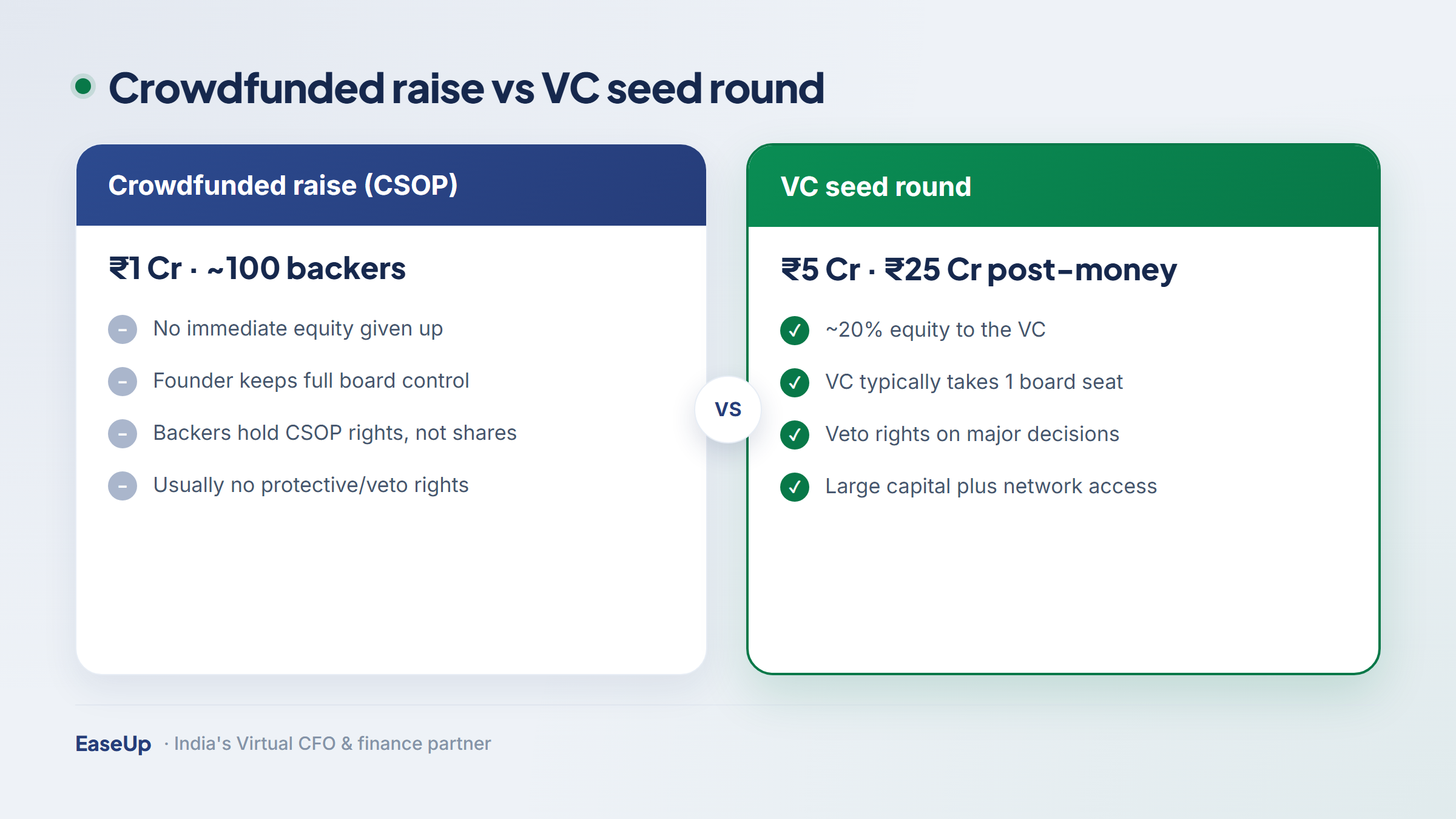
Factor | Crowdfunded raise (CSOP) | VC seed round |
Typical raise | ₹1 crore from ~100 backers | ₹5 crore at ₹25 crore post-money |
Immediate dilution | None — backers hold CSOP rights | ~20% equity to the VC |
Board control | Founder keeps full control | VC usually takes 1 board seat |
Protective rights | Usually none for backers | Veto rights on sale, senior hires, key decisions |
Neither is "better". Crowdfunding protects control; VC buys speed and firepower. To see how each option changes your cap table, a business valuation gives you the real numbers before you sign.
Crowdfunding shines when your product is easy to explain and easy to love. It is a great fit for:
B2C products: build a community before the product even ships.
Social causes: high emotional appeal drives donations.
Vernacular and regional plays: tap a specific language or local audience.
D2C brands: test real demand with pre-orders and rewards.
Crowdfunding struggles when the crowd cannot easily judge your product, or when you need a big cheque fast.
B2B SaaS: hard to sell to "the crowd"; it needs institutional sales.
Deeptech: long R&D cycles and high costs the crowd will not fund.
Large raises: anything above ₹10 crore is nearly impossible via pure crowdfunding in India.
Founder tip: If a stranger cannot understand your product in one sentence, crowdfunding will be an uphill battle. Save the complex, capital-heavy pitches for VCs who can do the technical diligence.
Before you spend months chasing VCs, run your startup through this quick screen. If you cannot pass all four, VC is probably not your path.
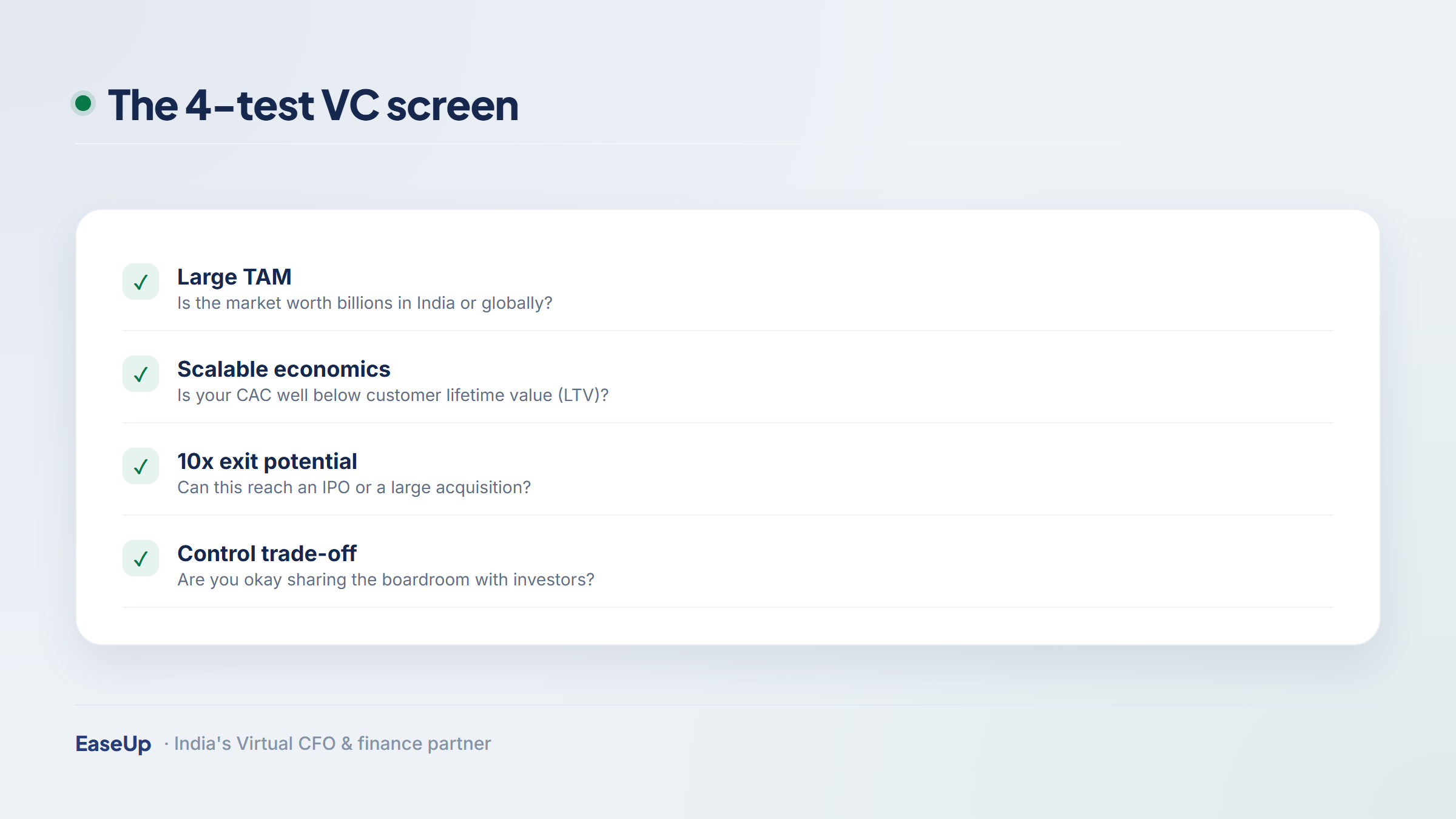
Large TAM: is the market for your product worth billions in India or globally?
Scalable economics: can you acquire customers at a cost (CAC) far below their lifetime value (LTV)?
10x exit potential: can this business reach an IPO or a large acquisition?
Control trade-off: are you comfortable sharing your boardroom with institutional investors?
Razorpay and Zomato passed these tests early and raised aggressively. Zerodha, by contrast, chose to bootstrap — it did not want to trade control for capital it already had. To check whether your startup is even eligible for the government’s startup benefits, see the Startup India portal.
Crowdfunding looks "cheaper" because you keep your equity, but the cost is real: platform fees, fulfilment of rewards, and the time and marketing spend to run a public campaign. A failed campaign is also public.
VC money has no fee, but the price is equity and control. Give up 20% at seed, and every future round dilutes you further. The cheapest capital of all is revenue — which is why many founders bootstrap as long as they can before choosing either route.
Peer-to-peer (P2P) lending is the one crowdfunding model with a clear, dedicated regulator. Platforms like Faircent and LenDenClub must be registered as NBFC-P2P entities and follow RBI’s directions, including lending caps per borrower and lender.
For a founder, P2P is debt, not equity — you keep 100% ownership but you repay with interest on a fixed schedule. It suits predictable working-capital needs, not high-risk bets. The current rules sit in RBI’s master directions on the Reserve Bank of India website.
The crowdfunded win — Wishberry: filmmakers and D2C brands raise ₹20-40 lakh, keep full ownership, and build a loyal base that buys the next product.
The VC win — Razorpay: raised early from Y Combinator and Indian VCs, built a large engineering team, and captured the payments market fast. The dilution was heavy, but the remaining founder stake grew to be worth a fortune.
The bootstrap choice — Zerodha: skipped VC entirely, grew on its own revenue, and kept complete control and ownership.
Match the funding to the goal. Choose crowdfunding to validate demand, build community, or raise under ₹10 crore for a consumer product. Choose VC when you have a huge market, scalable economics and the appetite to grow 10x with a partner in your boardroom.
Whichever you pick, backers and investors both look at the same thing first: can they trust your numbers? Messy books, missing filings and a thin data room kill deals faster than a weak pitch. Before you raise a rupee, get your finance stack in order.
Not in its pure form. Indian company law bars a private company from offering shares to more than 200 people in a financial year without a public issue, and SEBI has never notified a dedicated equity-crowdfunding framework. Platforms work around this using instruments like Community Stock Option Plans (CSOPs) or convertible debentures, which give backers a contractual right to future equity rather than shares today.
Crowdfunding raises small amounts from many backers online and often lets you keep control and validate demand. Venture capital is a large cheque from one institutional fund in exchange for equity, board influence and pressure to grow 10x. Crowdfunding suits early B2C and D2C products; VC suits high-scale, high-potential tech startups.
It depends on the model and product. Rewards and CSOP campaigns commonly raise from a few lakh up to a few crore. Anything above ₹10 crore is very hard to raise through pure crowdfunding in India, which is where venture capital or larger private rounds usually take over.
Not immediately, if you use a CSOP structure — backers hold a contractual right to future equity rather than shares on day one, so you keep board control now. A VC seed round typically takes around 20% equity and a board seat straight away, along with veto rights over major decisions. The dilution profiles are very different.
Usually VC or angel funding. B2B SaaS is hard to explain to a general crowd and relies on institutional sales, long sales cycles and deep product diligence. Investors who understand the space can assess it properly, whereas rewards or donation crowdfunding rarely fits a B2B model.
This guide is for general information only and does not constitute legal, tax or financial advice. Crowdfunding, SEBI and RBI rules change — confirm the current position with a qualified professional before you raise funds or accept any investment.


Your trusted partner for all your Financial needs.


Finance Management
Strategic Services