
In the intricate world of finance, determining the worth of a business is both an art and a science. This process, known as business valuation, is crucial for startups, tech companies, and small to medium businesses aiming to attract investments, plan for future financial events like mergers or acquisitions, and make informed decisions regarding taxation and funding. However, the path to an accurate valuation is fraught with complexities -- particularly in the Indian business environment, where informal economy dynamics, regulatory layering, and limited comparable data make the process uniquely challenging.
In this blog, we will delve into the common challenges in business valuation, explore India-specific hurdles that founders and business owners face, break down how challenges differ by business stage and sector, and explain how EaseUp's IBBI-registered valuers navigate these complexities to deliver clear, defensible valuations.
Understanding the economic value of a company is not just about putting a price tag on it; it is about unlocking its potential for growth, investment, and strategic planning. Business valuation acts as a critical tool for investors and shareholders, offering a snapshot of the company's health and future prospects.
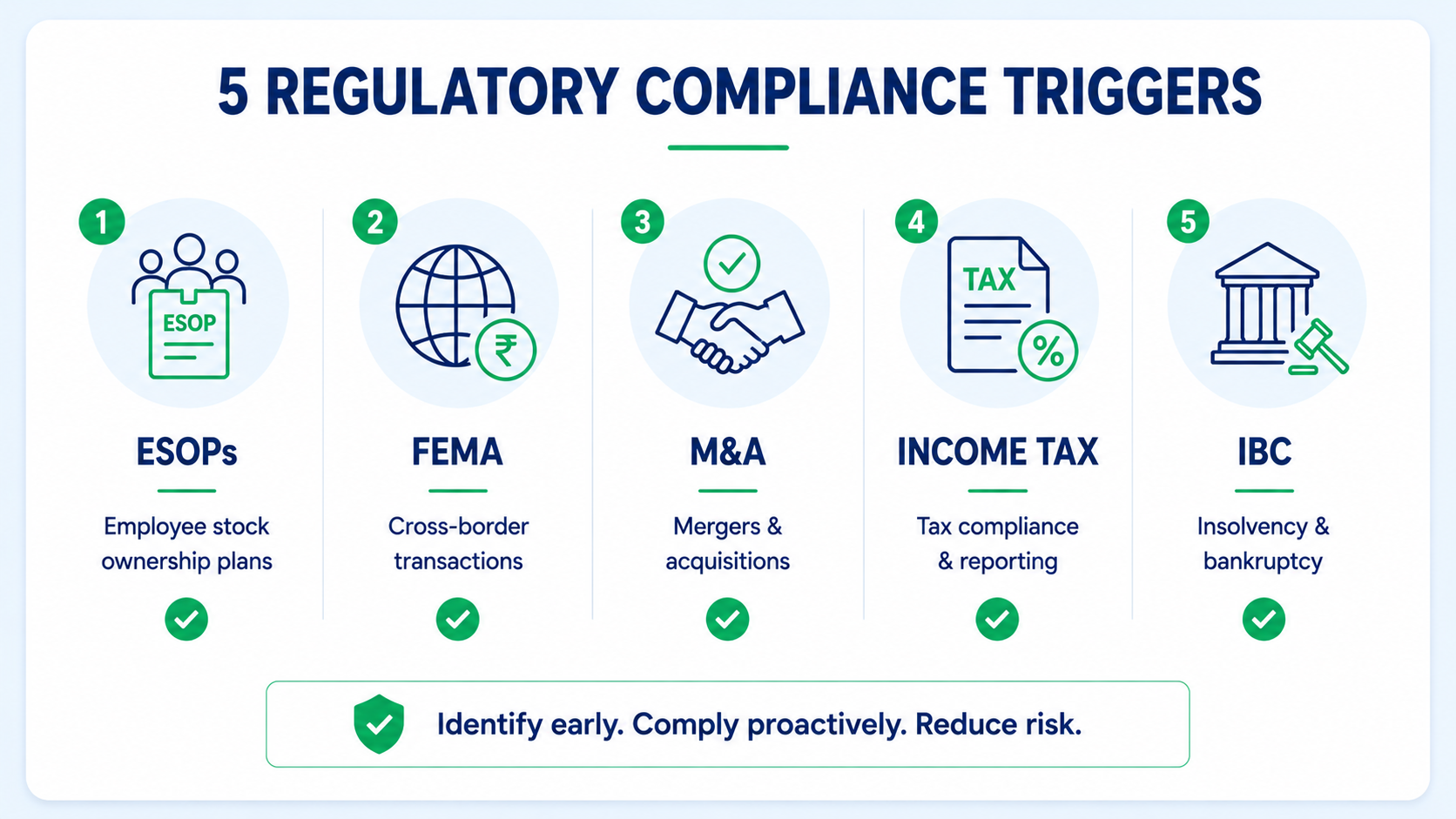
In India, business valuation is required in a wide range of scenarios beyond fundraising:
ESOP issuance and exercise: Section 62(1)(b) of the Companies Act requires a valuation report from a registered valuer for issuing shares at a price other than face value.
Foreign investment compliance: FEMA pricing guidelines mandate valuation for any share issuance or transfer involving foreign investors, using methods prescribed by RBI.
Mergers and acquisitions: NCLT-approved schemes of arrangement under Sections 230-232 of the Companies Act, 2013, require independent valuation.
Tax filings: Section 56(2)(viib) of the Income Tax Act (the "angel tax" provision) requires fair market value determination when shares are issued at a premium to resident investors.
Insolvency proceedings: Under the IBC, IBBI-registered valuers must provide fair value and liquidation value estimates during the CIRP process.
Companies like EaseUp, with their deep expertise in business valuation services, play a pivotal role in this process, especially for sectors that are rapidly evolving such as technology and startups.
One of the most significant challenges in business valuation arises from the unpredictable nature of market conditions. Fluctuations can dramatically affect the perceived value of a company from one moment to the next, making it difficult to pin down a stable valuation. This challenge in business valuation requires a keen understanding of market trends and the ability to forecast potential shifts.
In the Indian context, market volatility is amplified by factors such as rupee fluctuations against the dollar (which directly impact export-oriented and SaaS businesses), changes in FII/FPI investment flows, and sudden policy announcements that can reshape entire sectors overnight. For instance, demonetisation and the GST rollout caused significant short-term disruption to business valuations across the MSME sector.
Today's businesses, particularly in the tech sector, increasingly find their value not in physical assets but in intangible ones like intellectual property, brand reputation, and proprietary technology. These assets are notoriously difficult to quantify, presenting a unique challenge in business valuation. The subjective nature of these valuations can lead to significant disparities in a company's estimated worth.
For Indian businesses, intangible asset valuation becomes more complicated because of limited IP monetisation history. Unlike the US, where patent licensing revenues and IP sale transactions create benchmark data, India's IP marketplace is still maturing. A software company in Bengaluru may hold valuable patents, but the absence of comparable Indian IP transactions forces valuers to rely on international benchmarks -- introducing currency risk and market comparability issues into the valuation.
A company's valuation is heavily influenced by its projected future earnings. However, accurately predicting these figures involves a complex interplay of market trends, competitive positioning, and operational capabilities. This forward-looking aspect introduces a degree of uncertainty and speculation, compounding the challenges in business valuation.
Indian startups face a specific problem here: the Total Addressable Market (TAM) in India often looks massive on paper (1.4 billion population), but the actual Serviceable Obtainable Market (SOM) can be a fraction of that. A fintech targeting UPI-based lending may cite India's 22 billion+ monthly UPI transactions, but converting that into realistic revenue projections requires accounting for competitive intensity (hundreds of fintech players), regulatory caps on lending rates, and the price sensitivity of the Indian consumer.
Different industries face unique risks and opportunities, which can significantly impact valuation. For instance, a startup in the renewable energy sector might face different regulatory and technological hurdles compared to a software company. These industry-specific factors add layers of complexity to the valuation process.
Changing regulations and tax laws can also pose significant challenges in business valuation. A policy shift can suddenly alter a company's financial landscape, affecting its value. Staying updated with these changes and understanding their implications is crucial for an accurate valuation.
Beyond the universal challenges listed above, Indian businesses face a distinct set of hurdles that make valuation particularly complex.
The Discounted Cash Flow (DCF) method works well in isolation, but most valuation exercises also rely on market multiples derived from comparable transactions. In India, the challenge is acute:
Most MSME transactions are private, and deal values are rarely disclosed publicly.
Startup funding data, while increasingly available through platforms like Tracxn and VCCEdge, often lacks the granularity needed -- revenue multiples may be reported, but EBITDA multiples, customer acquisition costs, and churn rates are typically withheld.
Sector-specific multiples for industries like edtech, agritech, or D2C e-commerce in India can differ significantly from global benchmarks due to unit economics differences.
This forces valuers to make more assumptions, which in turn increases the subjectivity of the final number and creates room for disputes.
Navigating transaction pricing and market multiples can be complex. Check out our specialized business valuation packages designed for your current business stage.
A significant portion of Indian businesses, particularly in manufacturing, trading, and services, operate partially in the informal economy. Cash transactions, underreported revenues, and off-the-books expenses are realities that valuers must navigate carefully. While GST implementation has improved formalisation significantly, many businesses transitioning from informal to formal still carry legacy issues in their financial records.
For valuers, this creates a dilemma: the reported financials may not reflect the true earning potential of the business, but basing a valuation on unverifiable cash flows is neither ethical nor defensible. Experienced valuers address this through normalisation adjustments, but the extent of these adjustments often becomes a point of negotiation between buyers and sellers.
India's regulatory framework creates a situation where the same business may need to be valued differently depending on the purpose:
Purpose | Governing Law | Prescribed Method | Who Can Value |
Share issue to foreign investors | FEMA / RBI NDI Rules | DCF (internationally accepted method) | SEBI-registered Category I Merchant Banker, CA. |
Share transfer from resident to non-resident | FEMA / RBI NDI Rules | DCF or NAV (whichever is higher) | SEBI-registered Category I Merchant Banker or CA |
NCLT / IBC proceedings | Insolvency and Bankruptcy Code | Fair value + Liquidation value | IBBI-registered valuer |
ESOP valuation | Companies Act, 2013 | As per registered valuer | IBBI-registered valuer |
This means a company might receive different valuations for different regulatory purposes -- a situation that causes confusion and sometimes triggers scrutiny from tax authorities if the numbers diverge significantly.
Early-stage companies present the most challenging valuation scenarios. With little or no revenue history, the traditional income and market approaches have limited applicability. Key challenges include:
No financial track record: Projections are based almost entirely on assumptions about market size, product-market fit, and execution capability.
Founder dependency: The value often resides in the founding team rather than the business itself, making it difficult to separate personal goodwill from enterprise value.
High mortality rate: Industry data suggests that over 90% of Indian startups fail within the first five years, making any growth projection inherently optimistic.
Convertible instruments: SAFEs, convertible notes, and other instruments common in early-stage funding add complexity to cap table valuation.
Growth-stage businesses have proven their model but face different challenges:
Burn rate vs. growth trade-off: Many Indian growth-stage companies are unprofitable by design, prioritising market capture. Valuing a company burning Rs 3 crore per month while growing at 150% year-over-year requires careful judgment about when profitability will materialise.
Multiple revenue streams: As businesses scale, they often diversify. Valuing a D2C brand that has both online and offline channels, wholesale and retail, and perhaps a subscription model requires segment-level analysis.
Governance gaps: Many growth-stage Indian companies have not yet institutionalised governance. Related-party transactions, promoter salary optimisation, and informal arrangements can distort financial statements.
Even established businesses face valuation challenges:
Succession and key-person risk: Many Indian businesses are family-owned, and the transition from first to second generation introduces uncertainty about future management quality.
Real estate and non-core assets: Indian companies often hold significant real estate that may be undervalued on the books. Separating core business value from asset value requires specialised expertise.
Tax contingencies: Pending tax demands, transfer pricing disputes, and unresolved litigation can create significant (but hard to quantify) liabilities that affect valuation.
Indian SaaS companies face a unique valuation dynamic. Those serving international markets (US/Europe) are typically valued on revenue multiples (6-15x ARR for high-growth companies), while those serving the Indian market often command lower multiples (3-6x ARR) due to lower contract values and longer sales cycles. Key metrics that drive SaaS valuations include:
Net Revenue Retention (NRR) -- above 120% commands premium multiples.
CAC payback period -- under 18 months is considered healthy.
Gross margin -- above 70% is expected for true SaaS businesses.
Rule of 40 (growth rate + profit margin) -- a combined score above 40% indicates strong business health.
Manufacturing valuations in India must account for:
Asset-heavy balance sheets: Plant, machinery, and land often form a significant portion of value, requiring physical verification and depreciation assessment.
Working capital intensity: Indian manufacturers typically have longer receivable cycles (60-90 days) and inventory holding periods, which affect cash flow projections.
Government incentives: PLI schemes, SEZ benefits, and state-level subsidies create temporary earnings boosts that must be normalised.
Environmental compliance: Increasingly stringent pollution control norms can create future capital expenditure obligations that reduce enterprise value.
Service businesses -- consulting firms, law practices, CA firms, staffing companies -- are notoriously difficult to value because their primary asset walks out of the door every evening. In India, additional challenges include:
Revenue concentration risk (top 3-5 clients often account for 50%+ of revenue).
Difficulty distinguishing between personal goodwill (tied to individual partners) and enterprise goodwill.
Non-compete and non-solicitation enforceability issues under Indian law.
The Insolvency and Bankruptcy Board of India (IBBI) established a formal framework for registered valuers under the Companies (Registered Valuers and Valuation) Rules, 2017. IBBI-registered valuers, such as EaseUp's Aditya Chokhra, bring a structured, regulation-compliant approach to valuation:
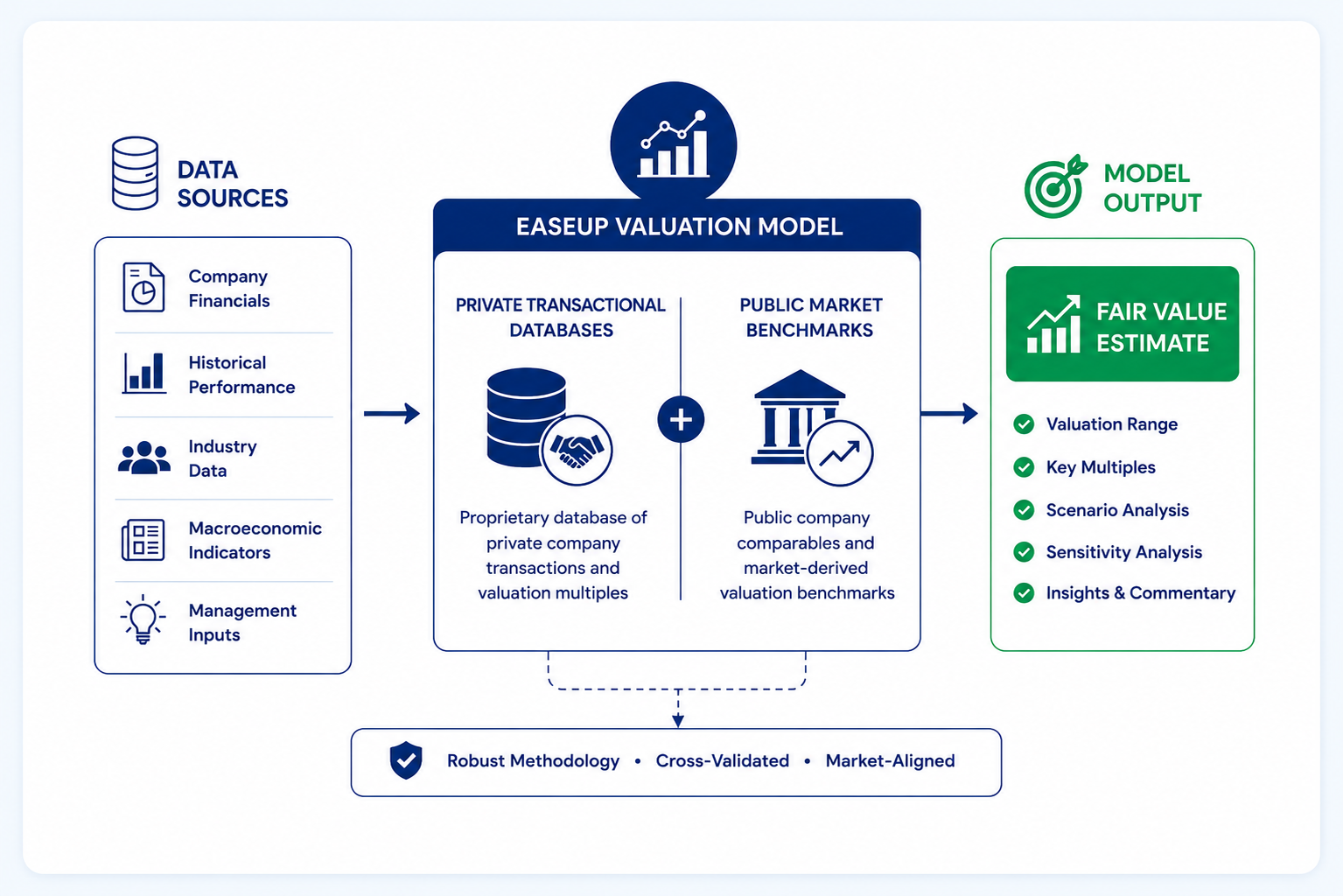
Multiple methodology approach: Rather than relying on a single method, IBBI-registered valuers typically apply two or three methods (DCF, comparable transaction analysis, and asset-based approach) and triangulate the results. This provides a valuation range rather than a single point estimate, which is more defensible.
Documented assumptions: Every assumption -- discount rate, terminal growth rate, revenue projection -- must be documented and justified. This creates an audit trail that stands up to regulatory scrutiny.
Independence requirements: IBBI rules mandate that the valuer must not have a material interest in the company being valued, ensuring objectivity.
Continuing education: Registered valuers must complete specified hours of continuing professional education annually, ensuring they stay current with evolving standards and regulations.
Facing these challenges head-on, EaseUp employs a comprehensive toolkit of strategies and expertise to navigate the complex terrain of business valuation:
To counter market volatility, EaseUp conducts in-depth market analyses, leveraging real-time data and trend forecasting to provide a valuation that reflects the current and future market landscape. This approach helps mitigate the risks associated with market fluctuations.
EaseUp's team is adept at evaluating intangible assets, employing advanced methodologies to assign tangible values to these critical but elusive assets. This expertise ensures that a company's full spectrum of value is captured, from its physical assets to its intellectual property and brand value.
Utilizing sophisticated financial models and predictive analytics, EaseUp offers advanced solutions to the challenge of forecasting future revenues. This data-driven approach provides a more accurate and reliable projection of a company's financial trajectory.
Acknowledging the unique challenges posed by different industries, EaseUp tailors its valuation processes to suit specific sectoral needs. This customized approach ensures that industry-specific risks and opportunities are fully accounted for in the valuation.
In the ever-evolving regulatory environment, staying informed about legal and policy updates is crucial for accurate business valuation. EaseUp's proactive approach ensures that valuations not only reflect the current regulatory framework but also anticipate potential legal shifts. This forward-thinking strategy safeguards businesses against sudden regulatory impacts and ensures that their valuations remain relevant and compliant.
Real-world examples underscore the efficacy of EaseUp's approach. For instance, a tech startup grappling with the valuation of its proprietary software found clarity and confidence in EaseUp's comprehensive valuation report, which detailed not just the software's current market value but also its potential for future revenue generation. Similarly, a small manufacturing business facing market volatility benefited from EaseUp's dynamic valuation model, which adapted to market changes, offering a more stable and reliable valuation.
In another case, an Indian D2C brand preparing for a Series B round needed a valuation that would satisfy both its existing domestic angel investors and the incoming Singapore-based VC fund. EaseUp prepared a dual-purpose valuation report that complied with FEMA pricing guidelines (for the foreign investor), saving the company from having to commission two separate valuation exercises.
The path to a precise and meaning business valuation is fraught with challenges, from market volatility and the valuation of intangible assets to predicting future revenues and navigating industry-specific risks. In the Indian context, these challenges are compounded by regulatory complexity, limited comparable data, informal economy factors, and a rapidly evolving business landscape.
However, with the right expertise and approach, these hurdles can be overcome. EaseUp's specialized business valuation services, backed by IBBI registration and deep experience across sectors, exemplify how domain knowledge, regulatory awareness, and advanced analytical tools can navigate the complexities of valuation, providing Indian businesses with the insights they need to thrive.
Ready to address your specific business valuation challenges and secure a defensible, regulator-approved report? Book a free strategy session with our certified valuation team.
The most common methods are Discounted Cash Flow (DCF), comparable company or transaction multiples, and asset-based or Net Asset Value (NAV) valuation. The right method depends on the company’s stage, sector, profitability, and the purpose of the valuation, such as fundraising, ESOPs, tax compliance, or insolvency.
Startup valuation is more challenging because early-stage companies often have limited financial history, evolving business models, and projections that depend heavily on future assumptions. That makes valuation more sensitive to market size, founder execution, burn rate, unit economics, and investor sentiment.
An IBBI-registered valuer is required in several cases under the Companies Act, 2013 and in insolvency-related matters. Depending on the type of transaction, foreign investment or tax-related valuations may also require reports from other qualified professionals, so the valuation purpose should always be identified before the exercise begins.
Businesses can improve valuation readiness by cleaning up financial statements, strengthening compliance, documenting predictable revenue, reducing customer concentration, clarifying margins, and building realistic forecasts backed by evidence. Strong governance and well-supported assumptions improve buyer and investor confidence.
Sometimes, but not always. Different regulatory purposes can require different methods, assumptions, and sign-off requirements. In some cases, one well-prepared report can address multiple needs, but it should be structured around the exact transaction and compliance requirements from the beginning.


Your trusted partner for all your Financial needs.


Finance Management
Strategic Services