TL;DR — the 30-second version
• Cash accounting books money when it hits your bank. Accrual books it when you earn or owe it.
• In India, registered companies must use accrual (Companies Act, 2013). Proprietors, partnerships and LLPs can pick either.
• Cash is simpler and tracks real money. Accrual gives a true profit picture and is what investors and lenders expect.
• GST does not care which one you use. Your GST liability is based on the invoice date, not the payment date.
• Most growing startups start on cash and switch to accrual before they raise funds or cross Rs 2 crore in turnover.
You closed a big deal in March. The client paid in May. So which month did you actually make that money? Cash vs accrual accounting is just two honest answers to that one question. Pick the wrong one and your profit, your tax, and your funding pitch can all look wrong.
This guide is written for Indian founders and small business owners. Plain English. Rupee examples. And the exact India rules that the foreign blogs skip. By the end you will know which method fits you right now, and when to switch.
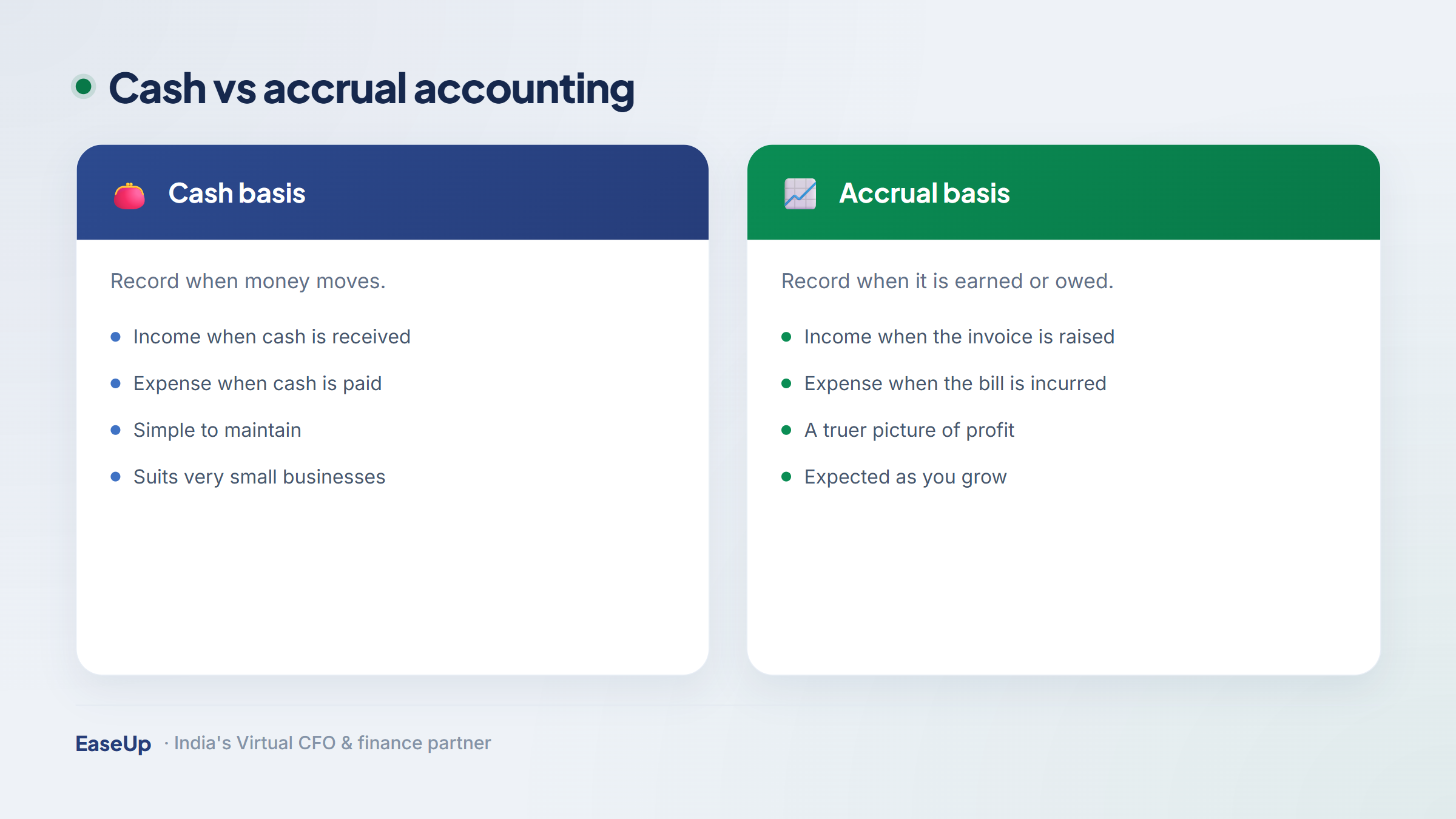
Both methods record the same money. They only differ on timing — the moment you write a sale or a cost into your books.
Cash basis. You record income when cash comes in. You record an expense when cash goes out. No bank movement, no entry.
Accrual basis. You record income when you earn it (you raised the invoice). You record an expense when you owe it (the bill arrived). Payment can come later.
In Indian tax law, accrual is called the mercantile system. You will see that word on forms and in the Income Tax Act, so it is worth remembering.
Here is the same Rs 1,00,000 sale and a Rs 20,000 bill, recorded both ways.
Event | Cash basis | Accrual basis |
You raise a Rs 1,00,000 invoice on 25 March | No entry yet | Income of Rs 1,00,000 booked in March |
Client pays the Rs 1,00,000 on 10 May | Income booked in May | No new income; you reduce receivables |
Vendor bill of Rs 20,000 dated 28 March | No entry yet | Expense of Rs 20,000 booked in March |
You pay the Rs 20,000 vendor on 12 April | Expense booked in April | No new expense; you reduce payables |
Same money. Same year, maybe. But the month-wise profit looks very different. That difference is the whole debate.
Say you run a small design studio. In March you finish two projects worth Rs 5,00,000 in total, but clients pay in April. In March you also get a Rs 1,50,000 rent and salary bill, which you clear in March.
March numbers | Cash basis | Accrual basis |
Income recorded in March | Rs 0 | Rs 5,00,000 |
Expenses recorded in March | Rs 1,50,000 | Rs 1,50,000 |
March profit / (loss) | (Rs 1,50,000) | Rs 3,50,000 |
Under cash, March looks like a loss. Under accrual, March was your best month. Neither is lying — they just answer a different question. Cash answers "how much money did I have?" Accrual answers "how much did I actually earn?"
:check_mark_button: Founder tip: If you ever feel "profitable on paper but broke in the bank", you are likely on accrual. Keep a separate weekly cash-flow sheet so you never get caught short on salary day.
This is where Indian rules matter, and where most global guides go silent. Your business type decides your freedom.
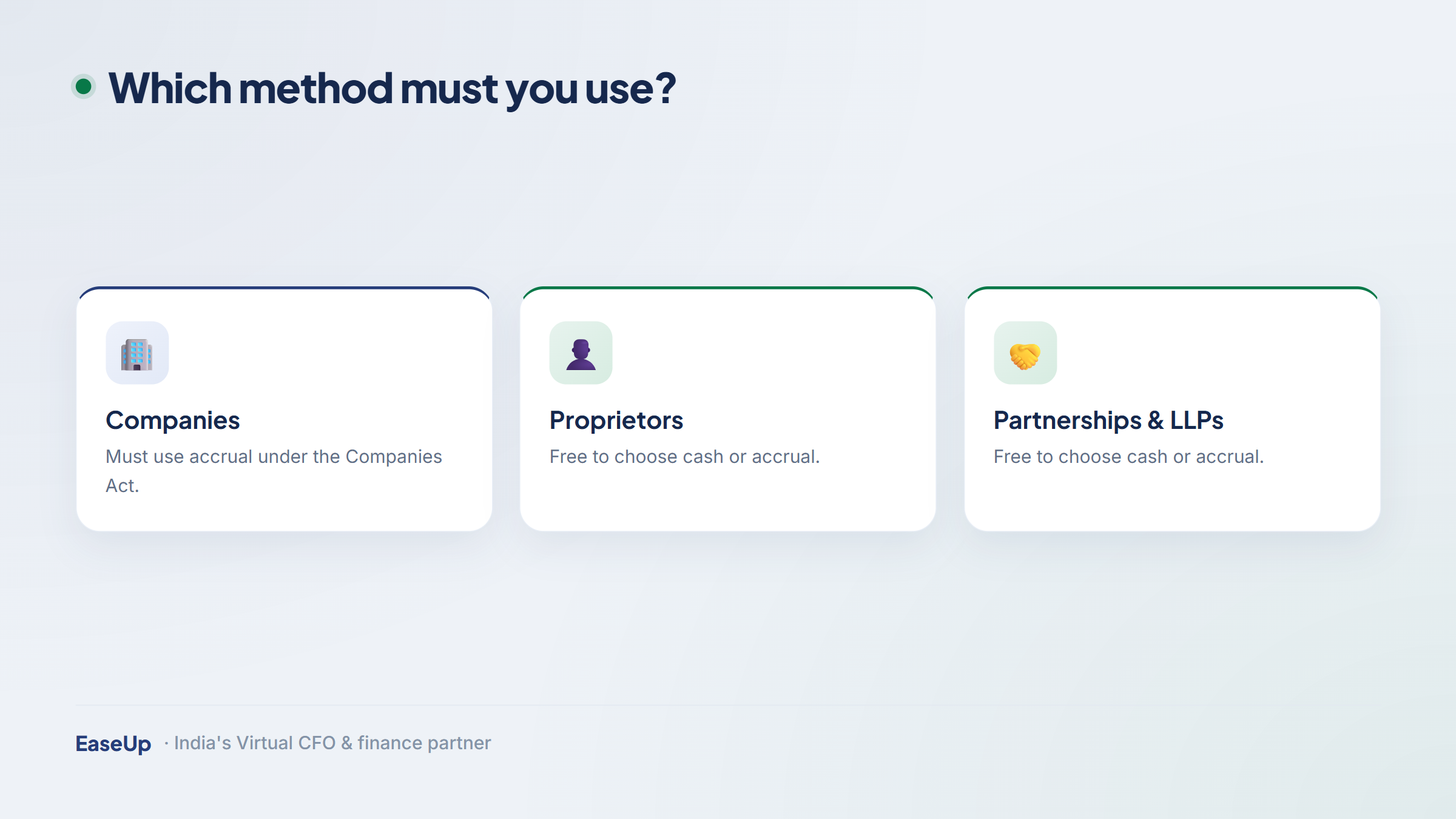
Private limited and other companies. You must keep books on the accrual (mercantile) basis. This is fixed by Section 128 of the Companies Act, 2013 — cash basis is not an option for a registered company.
Proprietorships, partnerships, LLPs, HUFs. You may choose cash or accrual, as long as you follow it consistently year after year.
For income tax, Section 145 of the Income Tax Act, 1961 confirms that business income can be computed on either the cash or mercantile system, "regularly employed" by the taxpayer. You can read the section on the Income Tax Department portal. The Companies Act rule sits with the Ministry of Corporate Affairs.
 Watch out: Even on cash basis, a recognised standards body view (and ICDS for businesses) still expects you to provide depreciation on fixed assets and follow Income Computation and Disclosure Standards. Cash basis does not mean "ignore non-cash items at tax time".
This trips up a lot of founders. Your accounting method does not change your GST. Under GST, the time of supply is set by the invoice — so your output GST is due for the period of the invoice, even if the client has not paid you yet.
So you can be on cash basis in your own books, show "no income yet" because the money has not arrived, and still owe GST on that invoice this month. Plan your working capital for it. The rules live on the official GST portal. Clean books make this painless, which is exactly what good bookkeeping services are for.
Many small Indian businesses use presumptive taxation. Under Section 44AD, eligible businesses up to Rs 2 crore turnover (Rs 3 crore if cash receipts are within 5%) can declare a flat percentage of turnover as profit. Section 44ADA does the same for professionals up to Rs 50 lakh (Rs 75 lakh with the same cash-receipt limit).
If you opt for presumptive tax, you do not maintain detailed cash-or-accrual books for that income at all — you pay on the deemed profit. But the moment you cross those limits, or want a real profit picture, full accrual books become the practical choice.
 Note: Presumptive scheme limits and percentages change with each Budget. Always confirm the current-year figure for FY 2025-26 before you file, or ask your finance partner to.
Simple. If you can read a bank statement, you can do cash books. Less software, less training.
Shows real money. Your books match your bank, so you always know what you can spend.
Tax on receipts. You are taxed on money you have actually received, which can ease early cash flow.
But it hides reality. A month with big unpaid invoices looks like a loss. You cannot see margins, dues, or trends clearly.
And it does not scale. Investors, banks and auditors will not accept cash-basis numbers for serious due diligence.
True profit picture. Income and the costs that earned it land in the same period, so margins are real.
Investor and bank ready. This is the only basis lenders and venture investors trust during diligence.
Shows what you owe and are owed. Receivables and payables sit on your books, so nothing hides.
But it is more work. You track invoices and bills, not just bank entries. You need decent software and discipline.
And profit can hide cash gaps. You can show a profit while the bank is low, because the cash has not arrived yet.
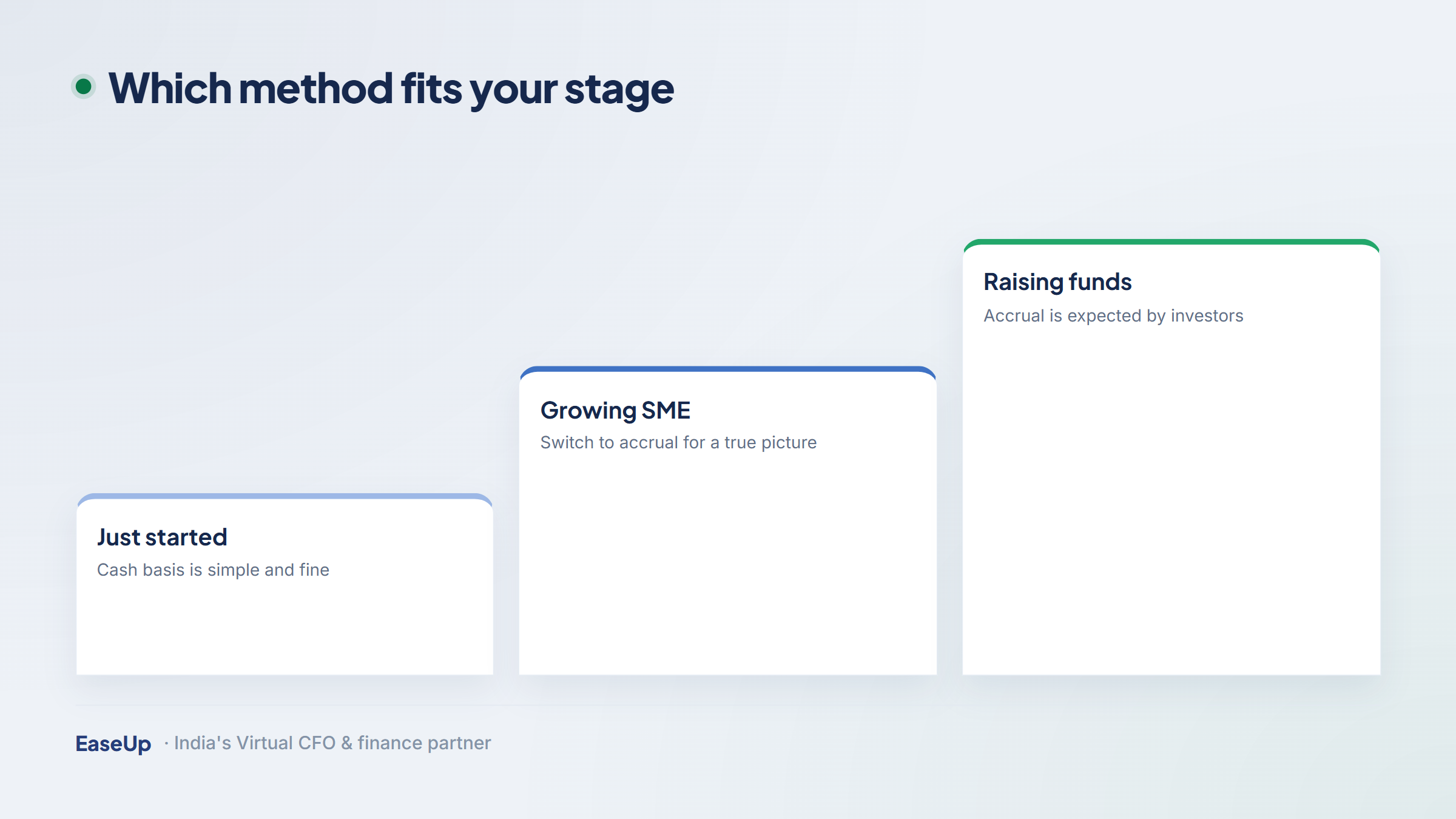
There is no single winner. There is a winner for your stage. Use this quick map.
Your stage | Usually better | Why |
Solo / very early, few invoices | Cash | Simple, cheap, matches your bank |
Growing SME, vendors and credit sales | Accrual | You need real margins and dues tracking |
Planning to raise funds | Accrual | Investors expect accrual financials in diligence |
Registered private limited company | Accrual (required) | Mandatory under the Companies Act, 2013 |
Taking bank loans / large credit | Accrual | Banks assess accrual statements |
If you are unsure where you sit, a short call with a virtual CFO will settle it in minutes.
Switch before you are forced to, not after. These are the clear signals:
You plan to raise funds. Move to accrual at least a year before, so you have clean history to show.
You sell on credit. When unpaid invoices and vendor dues become normal, cash books stop telling the truth.
You incorporate as a company. The day you register a private limited, accrual is mandatory.
You cross presumptive limits. Past Rs 2 crore (or Rs 50 lakh for professionals), proper accrual books become the sane choice.
You take on debt. Banks and NBFCs assess accrual statements before sanctioning loans.
:check_mark_button: Founder tip: Switch at the start of a financial year (1 April), not mid-year. A clean cut-over makes your books, audit and tax filing far easier to reconcile.
A method change is a careful one-time exercise. The basics:
Pick the cut-over date. Ideally the first day of a financial year.
List open items. Capture every unpaid invoice (receivable) and unpaid bill (payable) as on that date.
Pass opening entries. Bring those receivables and payables onto the books so nothing is double-counted or missed.
Update your software. Set the accounting basis to accrual and lock the prior period.
Tell your CA / auditor. Disclose the change so your tax computation stays consistent under Section 145.
This is exactly the kind of clean-up our bookkeeping team handles for founders, so your numbers are audit-ready and investor-ready from day one.
Mixing methods. Cash for sales but accrual for expenses. Pick one and apply it consistently.
Forgetting GST timing. Assuming "no payment, no GST". GST follows the invoice, not the bank.
Switching mid-year. It creates messy, hard-to-audit books. Switch at year start.
Ignoring receivables. On cash basis you can lose track of who owes you. Keep an ageing list anyway.
Doing it solo too long. A short review with a finance expert prevents an expensive clean-up later.
EaseUp is your finance partner built for Indian founders and SMEs. We set up the right accounting basis for your stage, keep your bookkeeping clean and compliant, and give you investor-ready accrual financials when you need them. For deeper planning, our virtual CFO team owns your numbers end to end.
You focus on building. We make sure the books, the tax, and the GST line up — for FY 2025-26 and beyond. Standards and rates are maintained by bodies like the Institute of Chartered Accountants of India.
It depends on your stage. A very early startup with few invoices is fine on cash basis — it is simple and matches your bank. But once you sell on credit, take loans, or plan to raise funds, accrual is better because it shows true profit and is what investors and banks expect. Registered companies must use accrual by law.
No. Under Section 128 of the Companies Act, 2013, every registered company must maintain its books on the accrual (mercantile) basis. Cash basis is only an option for non-corporate entities like proprietorships, partnerships, LLPs and HUFs.
No. GST is based on the time of supply, which is driven by the invoice date — not when you receive payment. So even if you use cash basis and have not been paid, your output GST on that invoice is still due for the relevant period. Plan your working capital for it.
Switch before you are forced to. The common triggers are: planning to raise funds (move about a year ahead), regularly selling on credit, incorporating as a company, crossing presumptive tax limits like Rs 2 crore turnover, or taking on bank debt. The cleanest time to switch is the first day of a financial year, 1 April.
If you opt for presumptive taxation under Section 44AD or 44ADA, you declare a flat percentage of turnover as profit and are not required to maintain detailed regular books for that income. But once you cross the eligibility limits, or want an accurate profit and margin picture, full accrual books become the practical choice.
This article is for general information only and is not tax, accounting or legal advice. Rules, limits and rates change — please confirm the current position for FY 2025-26 with a qualified professional before acting.


Your trusted partner for all your Financial needs.


Finance Management
Strategic Services