
TL;DR — the 30-second version
• Burn rate is the cash your business spends each month. Gross burn = total monthly spend. Net burn = spend minus revenue collected.
• Runway = cash in bank divided by monthly net burn. Rs 60 lakh in bank and Rs 5 lakh net burn = 12 months of runway.
• Indian founders must add hidden cash outflows most ignore: GST paid on vendor bills, TDS, PF + ESI, and advance tax on fixed due dates.
• Reduce burn by fixing payroll bloat, claiming Input Tax Credit, renegotiating tool spend, and tightening collections — not by starving growth.
• Aim for 18–24 months of runway before you raise. Start the raise when 9–12 months are left.
Burn rate is the speed at which your company spends cash. If you put Rs 1 crore in the bank and Rs 5 lakh leaves every month, you are burning Rs 5 lakh a month. Simple.
But the number behind that number is what keeps Indian founders and small business owners awake. Spend too fast and you run out of money before the next round or the next big order. Spend too slow and you choke growth. Burn rate calculation is how you find the safe middle.
This guide is built for India. We use rupee figures, real statutory outflows like GST and TDS, and FY 2025-26 rules. Whether you run a funded startup or a bootstrapped SME, the math is the same. Our virtual CFO team uses these exact steps with founders every week.
:check_mark_button: Founder tip: Burn rate is a cash number, not a profit number. Look at your bank statement, not your profit and loss report. Cash is what runs out — and what kills companies.
There are two burn numbers, and mixing them up causes bad decisions.
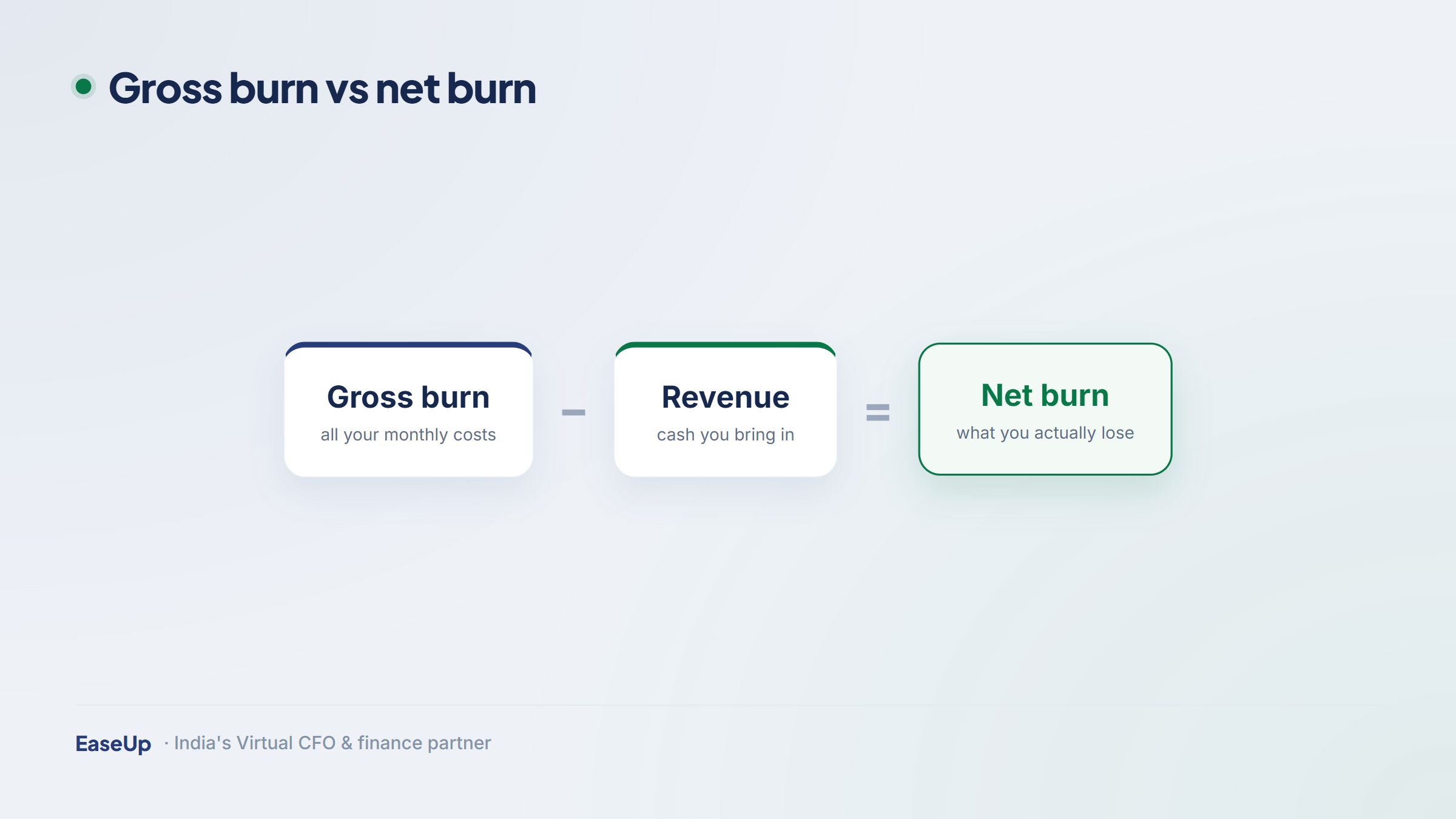
Gross burn. Your total cash spend in a month. Every rupee that leaves the bank: salaries, rent, cloud, ads, GST on bills, professional fees. This shows how heavy your cost base is.
Net burn. Gross burn minus the cash revenue you actually collected that month. This shows how fast your reserves shrink. Runway is built on net burn.
Net burn matters most for survival. Gross burn matters most for control, because that is the part you can cut. A virtual CFO will track both side by side so you never confuse a revenue dip with a cost problem.
Three short formulas run the whole show. Memorise these.
Gross burn = total cash out for the month.
Net burn = gross burn − cash revenue collected.
Runway (months) = cash in bank ÷ monthly net burn.
Use a three-month average, not a single month. One bad month with an annual software renewal or an advance tax payment will spike your burn and scare you for no reason.
 Watch out: Use cash revenue collected, not revenue invoiced. In India, payments often land 30–90 days late. If you count unpaid invoices as revenue, your net burn looks small and your runway looks long — until reality bites.
Here is a real-shaped monthly cost stack for a seed-stage SaaS startup in Bengaluru with 15 people. Copy this table and plug in your own numbers.
Cost head | Monthly amount (Rs) | Notes |
Payroll (net salaries) | 12,50,000 | Take-home for all staff |
PF + ESI (employer share) | 1,70,000 | Included in CTC, on top of take home salary — often missed |
Cloud + infrastructure | 1,80,000 | AWS / GCP usage |
Performance marketing | 3,00,000 | Ads and growth spend |
Office rent | 1,20,000 | Co-working or lease |
SaaS subscriptions | 60,000 | Tools and licences |
Professional fees | 1,00,000 | CA, legal, compliance |
GST paid on vendor bills | 1,80,000 | Recovered later as Input Tax Credit |
Gross burn (total) | 23,60,000 | Add it all up |
Now subtract cash revenue collected. If this startup collected Rs 8 lakh this month, net burn is Rs 23.6 lakh − Rs 8 lakh = Rs 15.6 lakh. That is the number runway is built on.
 Note: PF and ESI are employer costs included in CTC over and above take-home salary. For 25 staff this can add Rs 2–3 lakh a month that CTC-based budgets quietly leave out. Always model it. See the EPFO portal for current rates.
Runway is how many months you can keep going before the bank hits zero. The formula is simple, but the inputs need care.
Find your true cash balance. Start with the bank balance, then subtract money already committed: TDS due, GST payable, PF + ESI, advance tax, and any annual contract about to renew.
Find your average net burn. Use the last three months of net burn and take the average.
Divide. True cash ÷ average net burn = runway in months.
Scenario | Cash in bank (Rs) | Net burn / month (Rs) | Runway (months) |
Lean bootstrapped SME | 40,00,000 | 4,00,000 | 10 |
Seed-stage startup | 1,20,00,000 | 15,60,000 | ~7.7 |
Post-Series A startup | 8,00,00,000 | 50,00,000 | 16 |
Cash-tight, needs action | 25,00,000 | 10,00,000 | 2.5 |
Less than six months of runway is a red flag. Time to either cut burn, raise, or both. Our team builds these projections inside a live financial model so the number updates every month.
Global burn rate guides skip the things that actually drain Indian bank accounts. These hit on fixed due dates, so they must sit in your cash calendar.
GST paid on vendor bills. Real cash out now. You claim it back as Input Tax Credit later, but the lag is 30–60 days. Check it against your GSTR-2B on the GST portal.
TDS. Tax deducted at source must be deposited by the 7th of the next month under the Income Tax Act. TDS deducted in March, however, is due by 30 April, not 7 April. File on the Income Tax e-filing portal.
Advance tax. Due on 15 June, 15 September, 15 December and 15 March. A profitable SME can lose lakhs in one shot if this is not planned.
PF + ESI. Employer contributions due by the 15th of the following month.
ROC and statutory filings. Annual MCA filings and audit fees. See the MCA portal for due dates.
Watch out: Founder salaries. At seed stage many founders pay themselves nothing, so burn looks low. But investors model market-rate founder pay from day one. Excluding it understates real burn by 15–30% and breaks your runway math when you finally start paying yourselves.
What is a normal burn? It depends on your stage and team size. These ranges reflect what funded Indian startups actually spend right now.
Stage | Team size | Gross burn / month (Rs) | Typical runway target |
Pre-seed | 2–5 | 5–12 lakh | 12–18 months |
Seed | 8–20 | 15–40 lakh | 14–18 months |
Pre-Series A | 20–40 | 40–80 lakh | 18–24 months |
Series A | 40–80 | 80 lakh–2 crore | 18–24 months |
SMEs are different. A bootstrapped business should aim to keep net burn below 5–8% of cash reserves each month, and ideally march toward breakeven rather than the next round.
Raising money? Investors look past raw burn to the burn multiple: how many rupees you burn to add one rupee of new annual recurring revenue.
Burn multiple = net burn ÷ net new ARR. Lower is better. Under 1.0 is exceptional. 1.0–1.5 is strong and investable. Above 2.5 needs a clear improvement story. It is the single fastest way for an investor to judge how efficient your growth is.
:check_mark_button: Founder tip: A high burn multiple is not always bad — but it must come with fast growth. Burning Rs 2 to win Rs 1 of new ARR is fine at 100% growth and dangerous at 20%. Always pair the number with your growth rate.
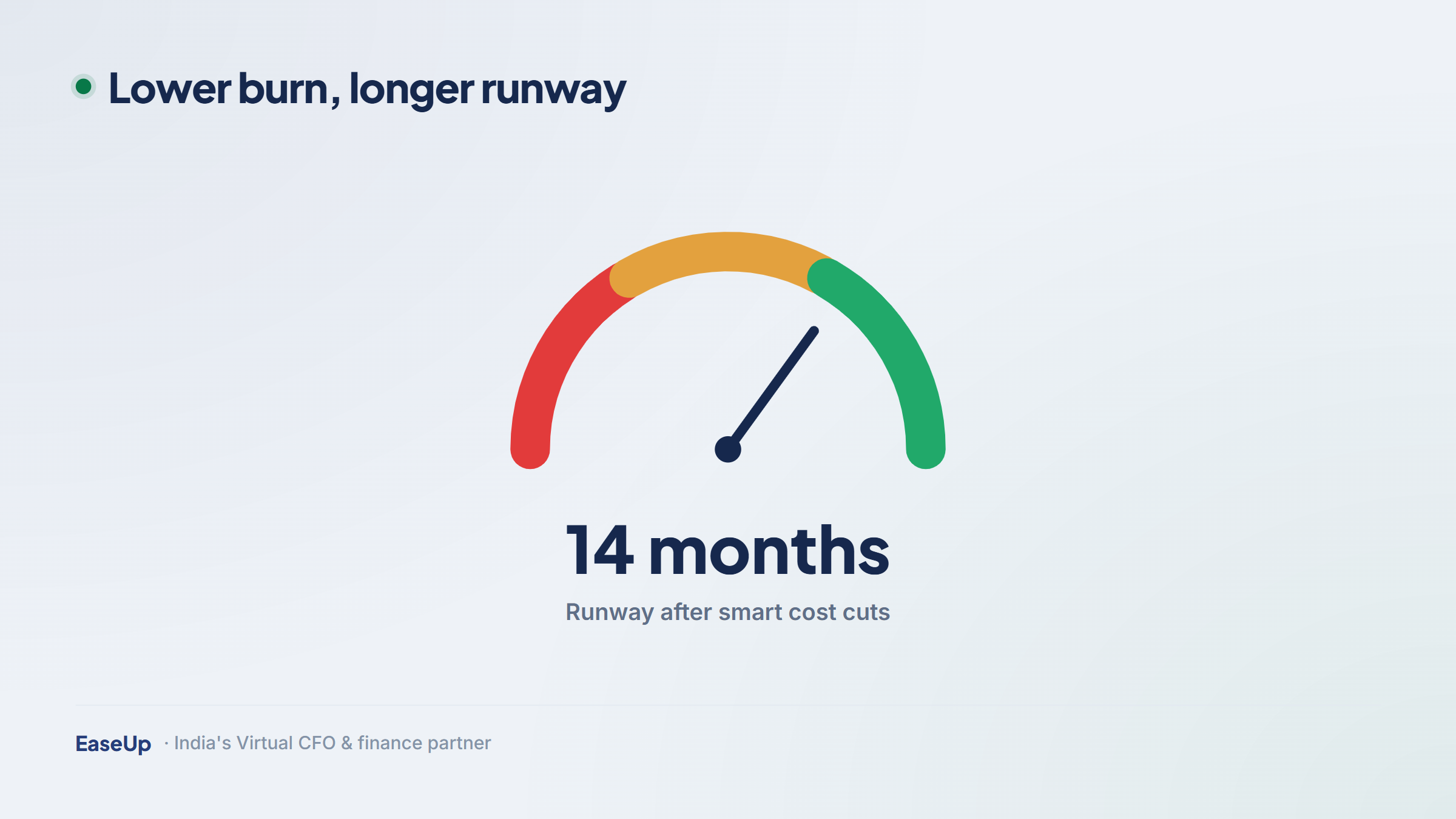
Cutting burn is not about firing people and going dark. It is about removing waste so every rupee buys more runway. Here are the seven levers that move the needle fastest.
Fix payroll bloat first. Payroll is usually 50–70% of burn. Pause non-critical hiring before you touch the team you have.
Claim every rupee of Input Tax Credit. Unclaimed GST credit reaching up to lakhs, sitting on the books is common. Reconcile against GSTR-2B monthly and recover it.
Renegotiate SaaS and cloud. Cancel duplicate tools, move to annual plans, and right-size cloud usage. Easy 10–20% off.
Tighten collections. Faster invoicing and follow-ups shrink net burn directly. Cash collected today is runway tomorrow.
Re-look at marketing efficiency. Kill channels with weak payback. Spend behind what converts.
Use DPIIT and tax benefits. A Startup India DPIIT-recognised startup can claim a three-year income tax holiday under Section 80-IAC, saving real cash.
Defer big one-time spends. Push back office expansions and annual licences when runway is tight.
Want a line-by-line burn audit? A virtual CFO will rank every cost by impact so you cut fat, not muscle. You can also explore our broader finance services to keep the model live.
Counting invoiced revenue instead of collected cash. Your runway looks longer than it is.
Ignoring GST, TDS and advance tax timing. Big lumps hit on fixed dates and blow up a quiet month.
Leaving founder salaries at zero. Understates burn and breaks future planning.
Using one month instead of a three-month average. One renewal spikes the number and triggers panic.
Forgetting PF + ESI on top of CTC. Adds lakhs a month that budgets quietly skip.
Runway tells you which lever to pull. Use this simple rule of thumb.
Over 18 months. Comfortable. Focus on growth and efficiency.
12–18 months. Start preparing. Clean up your numbers and warm up investors.
9–12 months. Begin the raise now. Indian rounds take 3–9 months to close.
Under 6 months. Cut burn hard and raise in parallel. Do not wait.
Investors expect you to close a round with 18–24 months of fresh runway. Starting a raise with under 12 months left puts you in a weak negotiating spot.
Burn rate is not a one-time calculation. It is a monthly discipline. A clean monthly MIS report — bank reconciliation, gross and net burn, runway, and a 12-month cash calendar — turns burn from a scary surprise into a number you control.
Most founders discover a problem two months too late because no one was watching the cash. A monthly close fixes that. Our virtual CFO service delivers this every month so you always know exactly how many months you have left.
There is no single number — it depends on stage and revenue. As a rule, keep monthly net burn below 5–8% of your cash reserves, and make sure your burn buys real growth. A seed-stage startup burning Rs 15–25 lakh a month with strong revenue traction is healthy; the same burn with flat revenue is a warning sign. Always judge burn against growth, not in isolation.
Divide your true cash balance by your average monthly net burn. First subtract committed outflows (TDS, GST, PF, ESI, advance tax) from your bank balance to get true cash. Then take the average net burn of the last three months. For example, Rs 60 lakh true cash ÷ Rs 5 lakh net burn = 12 months of runway.
Gross burn is your total monthly cash spend — every rupee that leaves the bank. Net burn is gross burn minus the cash revenue you actually collected that month. Gross burn shows how heavy your cost base is; net burn shows how fast your reserves shrink. Runway is always calculated on net burn.
Yes, always. Even if founders take little or no salary today, investors model market-rate founder pay from the start, and you will eventually pay yourselves. Leaving founder salaries at zero understates real burn by 15–30% and breaks your runway math the moment salaries begin. Include them at a realistic market rate.
Start with the biggest levers. Pause non-critical hiring (payroll is usually the largest cost), reconcile and claim unclaimed GST Input Tax Credit, cancel duplicate SaaS tools, move to annual plans, and tighten collections so cash comes in faster. Use DPIIT tax benefits if eligible. The goal is to remove waste, not starve growth — a virtual CFO can rank every cost by impact so you cut fat, not muscle.
This article is for general information only and is not tax, legal, or financial advice. Statutory rates and due dates change — verify current rules with the relevant Indian government portal or consult a qualified professional before acting.


Your trusted partner for all your Financial needs.


Finance Management
Strategic Services