
TL;DR — MRR vs ARR in one minute
• MRR is the predictable revenue your SaaS earns each month. ARR is that figure annualised — usually just MRR × 12.
• MRR is your operating metric — it catches month-to-month churn and expansion. ARR is your headline metric for pitch decks and board reviews.
• Exclude one-time setup, implementation and services fees. Only recurring subscription revenue counts.
• The number that really matters is Net New MRR — new plus expansion plus reactivation, minus contraction and churn.
• Indian investors read these metrics like a language. Get the definitions clean before you put a single number in a data room.

Monthly Recurring Revenue (MRR) is the predictable revenue your business earns each month from active subscriptions, normalised to a monthly figure. The key word is predictable. One-time setup fees, implementation charges and professional-services revenue are left out — they do not repeat, so they are not "recurring".
MRR is the pulse of a subscription business. It tells you, month after month, whether your revenue base is growing, flat, or quietly shrinking. If you run monthly reviews or an MIS dashboard, MRR is usually the first line on it.
 Founder tip: Decide your MRR definition once, write it down, and never quietly change it. If you start counting setup fees or GST in MRR halfway through the year, every trend line you show an investor becomes meaningless.
The basic formula is simple:
MRR = Number of active subscribers × Average Revenue Per User (ARPU)
For annual plans, divide the annual contract value by 12 to get the monthly contribution. Say a B2B SaaS company in Pune sells a project-management tool across three tiers:
Plan | Price | Active subscribers | MRR contribution |
Starter | ₹999 / month | 120 | ₹1,19,880 |
Professional | ₹2,499 / month | 85 | ₹2,12,415 |
Enterprise | ₹7,999 / month | 22 | ₹1,75,978 |
Enterprise (annual) | ₹79,990 / year (₹6,666/mo) | 15 | ₹99,990 |
Total | — | 242 | ₹6,08,263 |
This company has an MRR of roughly ₹6.08 lakh and an ARPU of about ₹2,513 per user per month. Notice how the annual Enterprise plan is broken into its monthly equivalent — that keeps every rupee comparable.
ARR is not a different metric so much as a different lens. It is the annualised view of the same recurring revenue. The distinction that matters is when you reach for each one.
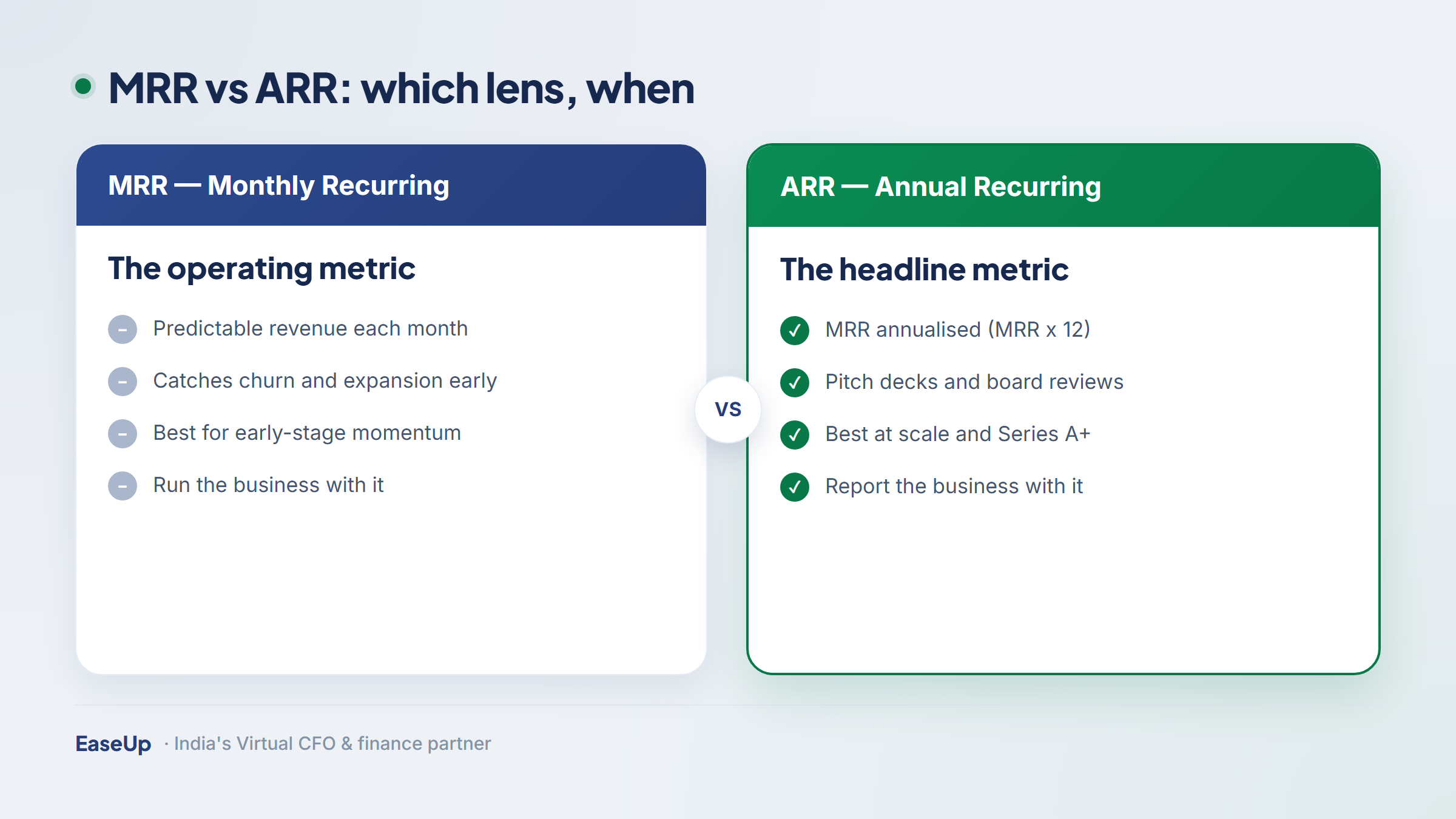
For most early-stage founders, MRR is the more useful day-to-day number because it reflects real momentum, churn impact and expansion trends. ARR becomes more relevant as contracts lengthen and you start reporting to a board. When you plan the accounting and compliance side of revenue recognition, both figures need to reconcile to your books. Recurring revenue is recognised under the Ind AS 115 standard notified by the Ministry of Corporate Affairs.
Tracking total MRR alone is like watching your bank balance without seeing the inflows and outflows. Break MRR into its five components and the story gets far clearer:
New MRR — revenue from first-time customers this month. Acquire 18 new accounts at an average ₹1,800/month and New MRR is ₹32,400.
Expansion MRR — extra revenue from existing customers who upgraded, added seats or bought add-ons. This is the cheapest revenue you can earn — no fresh acquisition cost.
Contraction MRR — revenue lost when existing customers downgrade or drop seats, without cancelling fully.
Churned MRR — revenue lost from customers who cancelled outright. Eight Starter accounts at ₹999 leaving costs you ₹7,992 in Churned MRR.
Reactivation MRR — revenue from previously churned customers who came back and resubscribed.
 Watch out: A month can add plenty of New MRR and still shrink overall if churn and contraction are bigger. Top-line MRR growth hides this. Always read the components together, never the headline alone.
Pull the five components into one figure and you get Net New MRR — the single best measure of whether your revenue engine is actually growing.
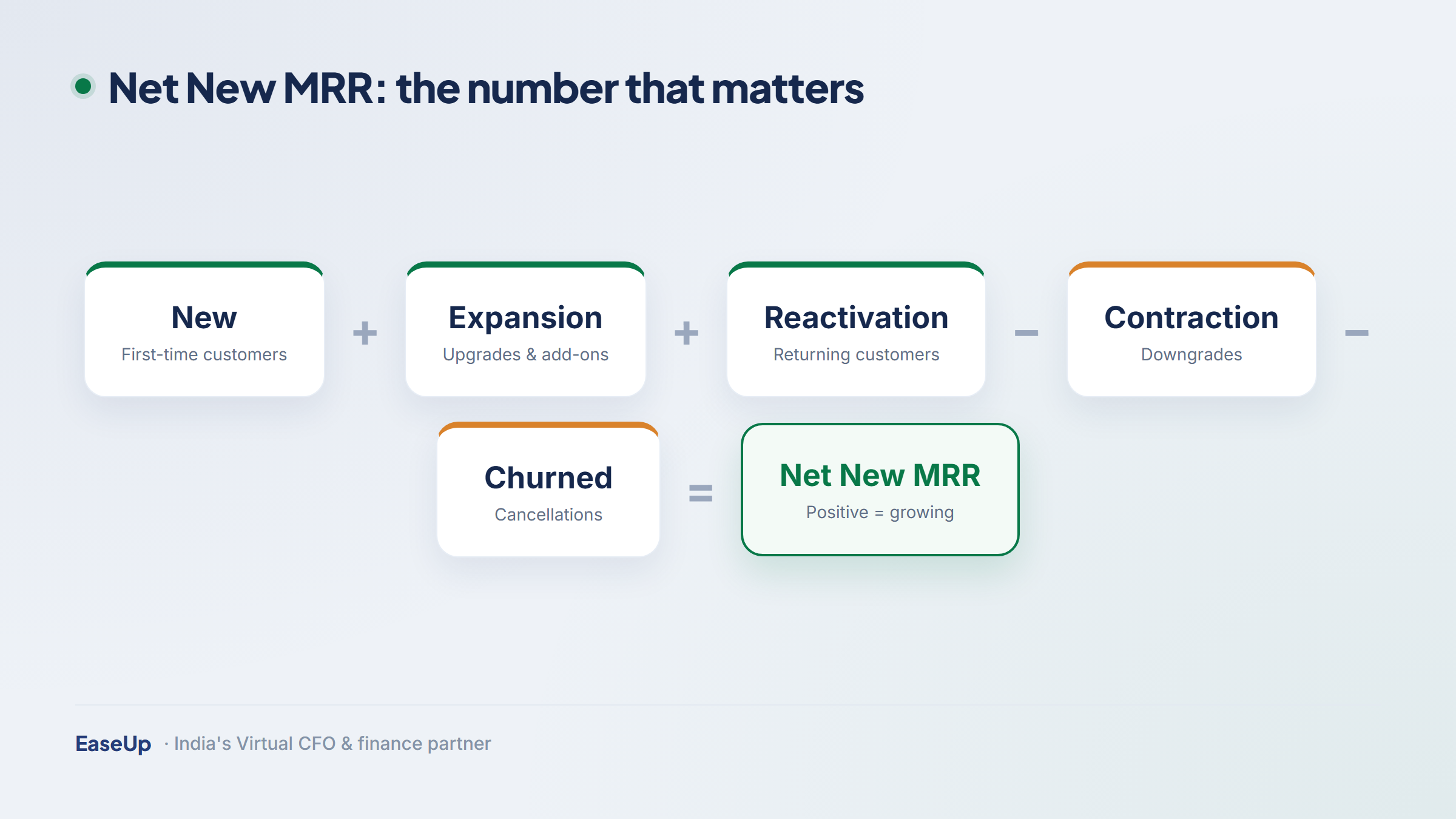
Using the numbers above: ₹32,400 + ₹15,000 + ₹7,497 − ₹7,500 − ₹7,992 = ₹39,405 Net New MRR. A positive figure means you are growing. A negative one means you are losing revenue faster than you are winning it — a red flag no matter how many logos you signed.
For a monthly-subscription business, ARR is simply:
ARR = MRR × 12
For companies built on annual contracts, add up the annual contract value of every active subscription instead. Our Pune example, with ₹6.08 lakh MRR, has an ARR of roughly ₹73 lakh (₹6,08,263 × 12).
ARR decomposes just like MRR — Beginning ARR, New ARR, Expansion ARR, Contraction ARR and Churned ARR roll up to your Ending ARR for the period. It is the same logic, one zoom level out.
:info: A note on foreign revenue: Many Indian SaaS firms bill overseas customers in dollars. Those receipts are exports of software services and sit under FEMA rules — including SOFTEX filing. The Reserve Bank of India governs how that revenue is realised and repatriated, so keep MRR (business view) and booked revenue (FEMA view) reconciled.
Situation | Reach for MRR | Reach for ARR |
Early stage (under ₹50 lakh ARR) | Primary metric for month-to-month growth | Less meaningful — annual trends not yet set |
Series A (₹50 lakh–₹5 cr ARR) | MRR growth chart in the data room | Lead with ARR in the pitch-deck headline |
Growth stage (₹5 cr+ ARR) | Sales targets and operational reviews | Board decks, investor updates, benchmarking |
Monthly billing model | Primary metric | Derived (MRR × 12) |
Annual contract model | Derived (ARR ÷ 12) | Primary metric |
Seasonal business | Captures monthly swings better | Can mask seasonal dips over a year |
The pattern is consistent: use MRR to run the business and ARR to report it. A good virtual CFO will keep both in one dashboard so operating reality and the investor headline never drift apart.
India's SaaS ecosystem has matured fast, from horizontal platforms like Zoho and Freshworks to a wave of vertical SaaS products. As the money has professionalised, so has the scrutiny. Investors now expect clean, component-level MRR and ARR before they write a term sheet.
If your startup is DPIIT-recognised, these metrics also sit alongside the eligibility and reporting you already maintain on the Startup India portal. Clean revenue metrics are not a fundraising nicety — they are the foundation of a data-driven business. They must also square with the subscription income you report on the Income Tax Department portal.
Benchmarks vary widely, so treat these as directional rather than gospel. They give you a feel for what "healthy" looks like as you scale:
Metric | Early growth | Scaling | Growth stage |
MRR growth (MoM) | 10–20% | 5–10% | 3–7% |
ARR growth (YoY) | 3x–5x | 2x–3x | ~50–100% |
Monthly gross churn | 3–5% | 1–3% | under 1.5% |
Net Revenue Retention | 80–100% | 100–120% | 110–140% |
Net Revenue Retention above 100% is the signal investors love — it means your existing customers alone are growing your revenue, even before you add a single new logo. Enterprise-heavy books tend to run higher NRR than self-serve SMB books.
Net Revenue Retention (NRR): expansion minus churn and contraction, on your existing base. The clearest read on product stickiness.
Gross churn: the share of revenue you lose each month. Watch it monthly, not annually — small leaks compound fast.
ARPU: average revenue per user. Rising ARPU usually means you are selling upmarket or expanding accounts well.
CAC payback: how many months of MRR it takes to recover the cost of winning a customer.
Counting one-time fees as recurring revenue, which inflates MRR and collapses the moment those fees stop.
Reporting gross MRR growth while ignoring churn and contraction underneath it.
Confusing bookings with MRR — a signed annual contract is not recognised revenue on day one.
Changing the MRR definition mid-year, so every historical trend becomes unreliable.
Leading a seed pitch with ARR when MRR momentum tells a stronger, more honest story.
MRR and ARR look simple until you stitch them to revenue recognition, foreign receipts, deferred revenue and a board pack that has to reconcile with your audited books. That is where founders slip. A virtual CFO builds the metric definitions, the MRR waterfall and the investor-ready reporting so your numbers survive due diligence the first time.
MRR (Monthly Recurring Revenue) is the predictable subscription revenue your business earns each month. ARR (Annual Recurring Revenue) is that figure annualised, usually MRR multiplied by 12. MRR is the better day-to-day operating metric because it catches churn and expansion quickly, while ARR is the headline number used in pitch decks and board reports.
The basic formula is MRR = number of active subscribers × average revenue per user (ARPU). For annual plans, divide the annual contract value by 12 to get the monthly contribution, then add it in. Exclude one-time setup fees, implementation charges and professional-services revenue, because they are not recurring.
Net New MRR = New MRR + Expansion MRR + Reactivation MRR − Contraction MRR − Churned MRR. It is the single best measure of whether your revenue base is actually growing in a given month. A positive figure means growth; a negative figure means you are losing revenue faster than you are adding it.
Early-stage startups should lead with MRR, because month-to-month movement in churn and expansion is where the real signal lives before annual trends have formed. ARR becomes the headline metric later, around Series A and beyond, when you report to a board and pitch investors on annualised scale.
Net Revenue Retention (NRR) above 100% is considered strong, because it means your existing customers grow your revenue even before new sales. Early-growth companies often sit in the 80–100% range, scaling companies around 100–120%, and mature growth-stage companies frequently reach 110–140%. Enterprise-heavy books usually run higher NRR than self-serve SMB books.
This guide is for general information only and does not constitute financial, tax or accounting advice. Metric definitions and revenue-recognition rules vary by business model — confirm the right treatment with a qualified professional before you report to investors.


Your trusted partner for all your Financial needs.


Finance Management
Strategic Services