TL;DR — Angel funding in one minute
• An angel investor is a high-net-worth individual who backs your startup with personal money, usually at the earliest stage — before the big VCs arrive.
• In 2026, Indian angel rounds typically run ₹1 crore to ₹5 crore for 10–15% equity. Beyond cash, angels bring credibility, a network and speed.
• Big news: angel tax (Section 56(2)(viib)) is abolished for shares issued from 1 April 2025 — no more valuation-premium tax on your raise.
• Angels score you on six pillars: team, traction, unit economics, market size, moat and exit path. Weak bookkeeping kills most deals at due diligence.
• Budget 16 weeks end to end. Get your books, cap table and pitch deck clean before you send the first email.
Angel investment is the first formal cheque you raise to move from a working prototype to real market traction. An angel investor is a high-net-worth individual who invests their own wealth into early-stage startups — long before a venture capital fund would look at you.
The goal is simple: raise enough to survive the risky early years and reach the point where larger VCs are ready to lead your Series A. In the 2026 Indian market, a typical angel round is ₹1 crore to ₹5 crore in exchange for roughly 10–15% equity.
If your numbers still need cleanup before you pitch, sort your fundraise preparations first. A messy start slows everything that follows.
 Founder tip: Angels back people first, numbers second. Before you obsess over your deck, get one warm intro from a founder they already trust. A cold pitch and a warm intro are not in the same league.
In 2026, angels are your first believers. The money is useful, but the real value is what comes attached to it. A good angel gives you three things cash alone cannot buy.
Credibility: a respected angel on your cap table is a strong "buy" signal to every VC who looks at you next.
Strategic network: warm access to senior corporate leaders, customers and experienced exit-founders.
Speed: angel rounds close far faster than institutional VC rounds — often in weeks, not months.
Angel activity in India has picked up again after two cautious years, with syndicates backing hundreds of deals. The bar is higher, but the money is there for founders who show up prepared.
For over a decade, angel tax under Section 56(2)(viib) was the most feared line in the Income Tax Act. If you raised money above your "fair market value", the premium could be taxed at around 31%. It scared away investors and buried founders in valuation paperwork.
That is now history. The Finance Act 2024 abolished angel tax for shares issued from 1 April 2025. For any raise from that date, the provision does not apply — regardless of investor type, DPIIT status or the valuation you agree on.
:info: What this means for you: You can now raise at the valuation the market gives you, without a special merchant-banker certificate just to avoid angel tax. Read the government position on the Income Tax Department’s angel tax exemption page. Raises before 1 April 2025 may still face legacy demands.
Before writing a cheque, the 2026 Indian angel runs a structured scorecard. Be ready to defend all six pillars during your pitch — they are the questions behind every "yes" and every "no".
Pillar | What the angel asks | What strong looks like |
Founder–market fit | Does the team have deep domain expertise? | A technical co-founder in-house, real scars in the space |
Traction | Is revenue actually growing? | ~10% month-on-month growth with returning customers |
Unit economics | Do the numbers work per customer? | LTV greater than 3x CAC, healthy gross margins |
Market size (TAM) | Can this get big enough? | A path toward ₹1,000 crore in revenue |
The moat | What stops a giant from copying you? | Unique data, IP or a loyal community |
Exit path | Who buys this in 5–7 years? | A realistic acquirer or IPO roadmap (NSE/BSE) |
Two ratios decide whether your growth is real or just expensive. Angels will ask for both, so know them cold.
LTV > 3x CAC: the lifetime value of a customer should be at least three times what it costs to acquire them. Below that, you are buying growth you cannot afford.
Gross margins: healthy margins prove the business can scale profitably, not just grow revenue while burning cash.
If retention is weak — customers who do not come back — even fast top-line growth will not convince a sharp angel. Fix the leaky bucket before you raise.
 Watch out: Vanity metrics fool no one. Downloads, sign-ups and "GMV" without paying, returning customers are red flags, not proof. Lead with revenue, retention and margins — the numbers an angel can bank on.
Instead of chasing individual investors one by one, target organised syndicates and networks. They aggregate cheques, run due diligence and move as a group. Here are well-known Indian networks and their typical cheque sizes.
Network / platform | Typical cheque | Known for |
Indian Angel Network (IAN) | ₹1 Cr – ₹5 Cr | Sector agnostic |
Inflection Point Ventures | ₹2 Cr – ₹10 Cr | High-scale tech |
AngelList India | ₹50L – ₹3 Cr | SaaS & fintech |
Mumbai Angels | ₹1 Cr – ₹4 Cr | Early-stage tech |
LetsVenture | ₹50L – ₹2 Cr | D2C & consumer |
Venture Catalysts | ₹2 Cr – ₹5 Cr | Tier 2/3 startups |
Chennai Angels | ₹1 Cr – ₹4 Cr | Agri & supply chain |
Hyderabad Angels | ₹1 Cr – ₹3 Cr | Pharma & IT |
Cheque sizes shift with the market, so treat these as a guide, not a promise. Many founders also register on the Startup India portal to access DPIIT recognition and investor connect programmes.
In 2026, your pitch deck should be 12 slides at most. Every slide earns its place. Use this order to keep the angel engaged from the problem to the ask.
Problem — the specific, massive pain point in the Indian market today.
Solution — your product; show what it does, not just the vision.
Market size — the ₹ crore opportunity in your specific niche.
Business model — how you make money and what your margins are.
Traction — six months of growth charts showing revenue or users.
Team — founder pedigree, past startups and execution history.
The ask — the exact amount (e.g. ₹3 Cr) and precisely how you will spend it.
The remaining slides cover competition, financials and the roadmap. Keep the story tight — a confused angel is a "no".
Raising money is a full-time commitment. In the 2026 Indian ecosystem, budget about four months end to end and run it in four phases.
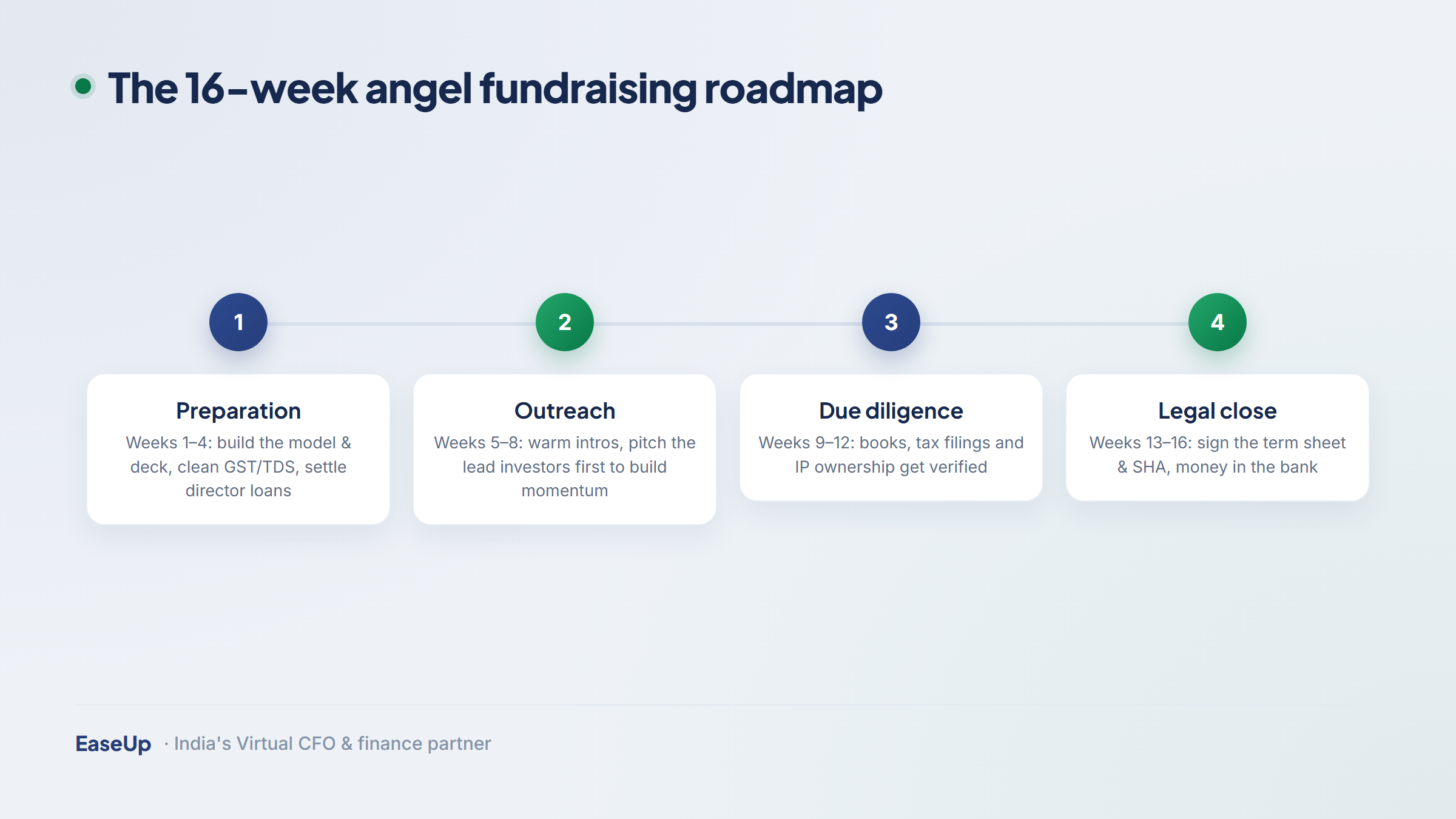
Weeks 1–4, preparation: build your financial model and deck, clean up GST/TDS filings and settle any director loans.
Weeks 5–8, outreach & pitching: get warm intros from founders and community leaders, and pitch the lead investors first to build momentum.
Weeks 9–12, due diligence: investors verify your bank statements, tax filings and IP ownership. Most Indian deals stall here on poor bookkeeping.
Weeks 13–16, legal closing: sign the term sheet and Shareholders’ Agreement (SHA), then — money in the bank.
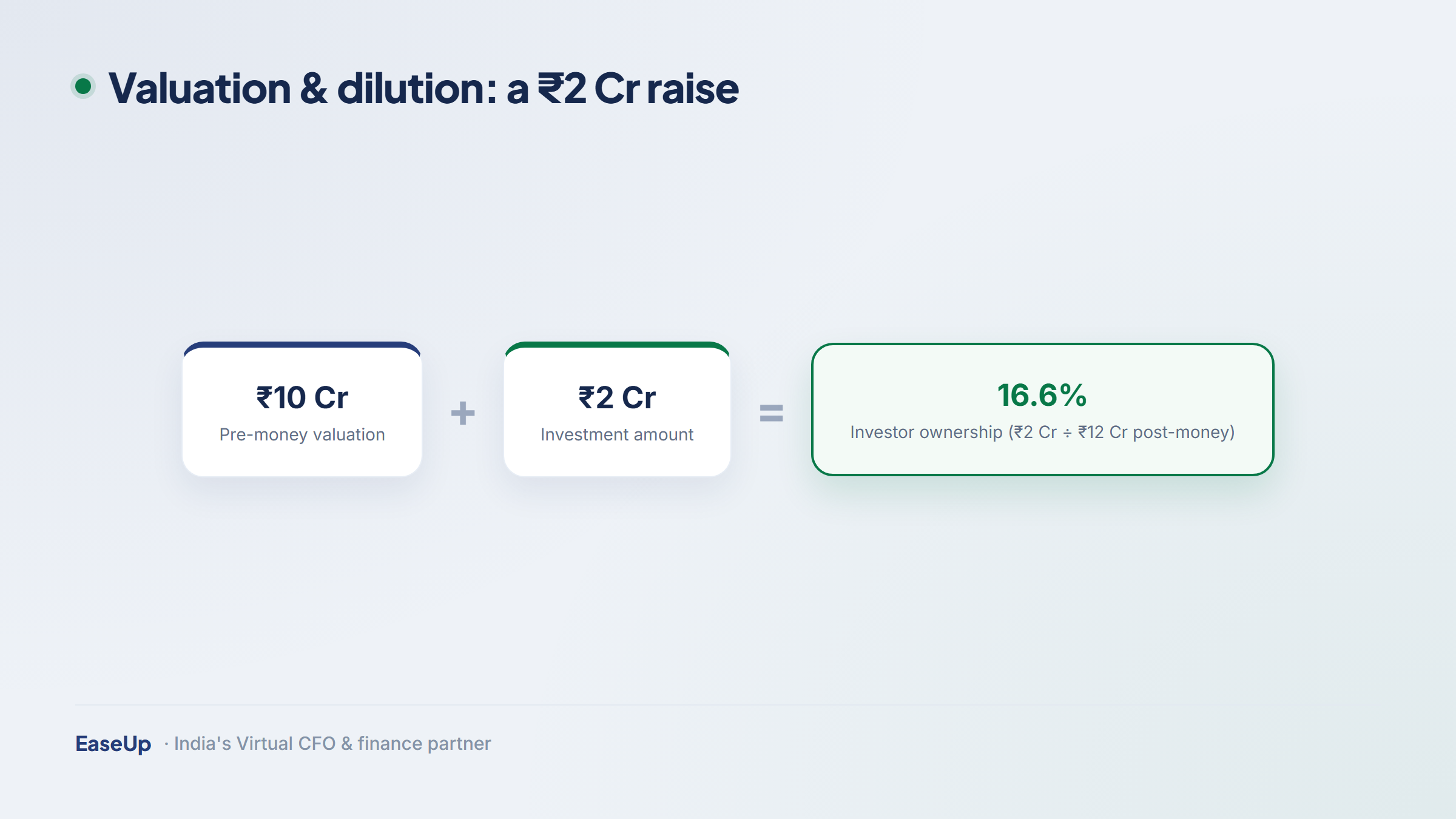
Indian angels still expect reasonable valuation logic. Overvalue yourself early and you set up a painful down round later. A defensible number keeps the round moving. Here is the math on a simple ₹2 crore raise.
Metric | Value |
Pre-money valuation | ₹10 crore |
Investment amount | ₹2 crore |
Post-money valuation | ₹12 crore |
Investor ownership | 16.6% (₹2 Cr ÷ ₹12 Cr) |
Founder tip: A valuation is only "good" if you can grow 3x before your next round. Do not set the bar so high that you cannot clear it. A formal business valuation gives you a number you can actually defend in the room.
When the cheque is ready, you sign a term sheet followed by the Shareholders’ Agreement (SHA). Three terms matter most — understand them before you sign.
Liquidation preference (1x non-participating): if you sell the company, the investor gets their original money back first, before the remaining proceeds are split.
Anti-dilution: protects the investor if your next round is at a lower valuation than this one.
Founder vesting: you "earn" your own shares over four years. Quit early and you forfeit the unvested portion.
In 2026, Indian angels are hyper-focused on compliance. These four issues routinely destroy deals during due diligence — and every one of them is avoidable.
Red flag | Why it kills the deal |
Statutory defaults | Unpaid GST or TDS for more than three months signals a company out of control |
Director loans | Personal loans taken by founders from company accounts spook every investor |
Messy cap table | "Dead" equity holders who add no value make the round hard to structure |
No IP assignment | The company does not legally own its own product code or brand |
You can confirm your filing status and company records on the Ministry of Corporate Affairs portal. Clean records here are the cheapest insurance you can buy before a raise.
Deal momentum dies when a founder says "let me check with my CA and get back to you". By the time answers arrive, the angel has cooled. A virtual CFO sits in the room with you — answering diligence questions live, defending the valuation and keeping the data room tidy.
From clean books to a defensible cap table to a crisp financial model, the right finance partner turns a shaky raise into a confident one. That is exactly where EaseUp helps founders close.
Angel investment is early-stage funding from a high-net-worth individual who invests their own money into your startup, usually before venture capital funds get involved. In 2026, Indian angel rounds typically range from ₹1 crore to ₹5 crore for around 10–15% equity, and often bring credibility and a strong network alongside the cash.
Most Indian angel rounds involve roughly 10–15% equity dilution. The exact figure depends on how much you raise and your valuation. For example, a ₹2 crore raise at a ₹10 crore pre-money valuation gives the investor about 16.6% of the company, because ₹2 crore divided by the ₹12 crore post-money valuation equals 16.6%.
No. Angel tax under Section 56(2)(viib) has been abolished for shares issued from 1 April 2025 under the Finance Act 2024. This means startups can raise at a market-agreed valuation without the old premium tax, regardless of DPIIT status. Fund raises made before 1 April 2025 may still face legacy assessments for those years.
Budget around 16 weeks, or four months, in the 2026 Indian ecosystem. That covers roughly four weeks of preparation, four weeks of outreach and pitching, four weeks of due diligence, and four weeks of legal closing. Deals most often stall during due diligence because of poor bookkeeping, so clean financials speed everything up.
Indian angels assess six pillars: founder–market fit, revenue traction (around 10% month-on-month growth is a strong signal), unit economics such as LTV greater than 3x CAC, a large market, a defensible moat, and a realistic exit path. During due diligence they also check compliance, so unpaid GST or TDS, director loans and a messy cap table are common deal-breakers.
This guide is for general information only and does not constitute tax, legal or financial advice. Fundraising terms, valuations and tax rules change — confirm the current position with a qualified professional before you raise or sign anything.


Your trusted partner for all your Financial needs.


Finance Management
Strategic Services