



As the year draws to a close, many businesses get caught up in holiday momentum and sales pushes. However, the most successful companies treat the end of the year as a strategic "audit point." Completing a structured year-end financial checklist is not just about tax compliance; it is about reviewing performance, identifying operational leaks, and setting a robust roadmap for the year ahead.
Closing your fiscal year effectively requires moving beyond basic bookkeeping.
The Goal: Shift from "closing the books" to "starting the next chapter" with total control.
The Core Tasks: Reconcile every account, finalize tax liabilities, audit your inventory, and re-forecast your budget using actuals from the current year.
The Strategic Edge: Use this time to identify why your margins fluctuated and align your leadership team on the financial goals for 2026.
The Verdict: If you are still relying on manual spreadsheets to handle this, you are missing out on automation and real-time insights that could fuel your next stage of growth.
Use this structured roadmap to ensure your business enters the new year with clarity and confidence.
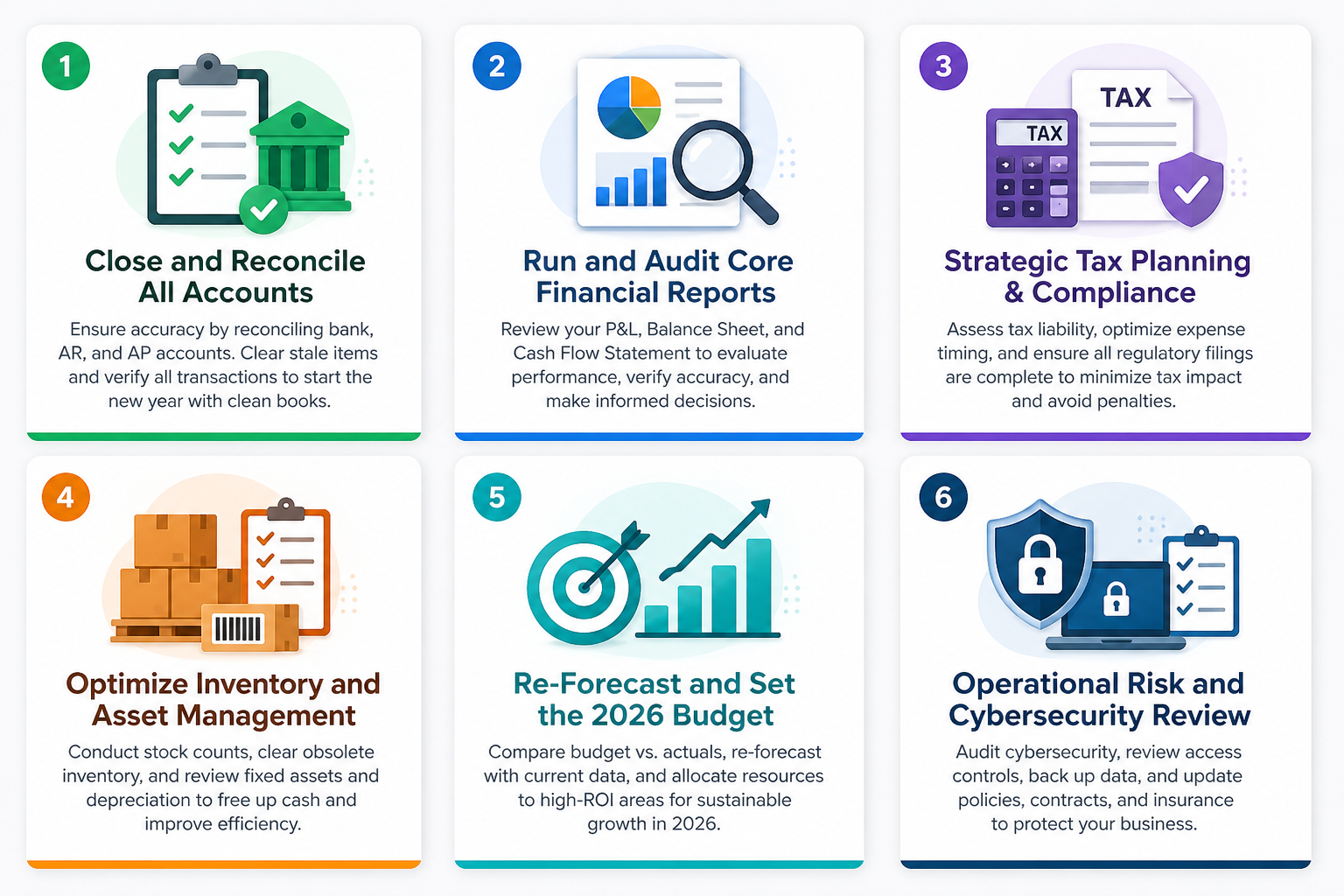
Accuracy is the foundation of all financial strategy. Before you can plan for the future, you must ensure your past is perfectly recorded.
Bank & Credit Reconciliation: Match all entries to your statements. Identify and clear stale-dated cheques or duplicate transactions.
Accounts Receivable (AR) Cleanup: Identify invoices outstanding for 60+ days. Decide whether to pursue collection, offer a settlement, or write off as bad debt.
Accounts Payable (AP) Verification: Ensure all vendor invoices are received, approved, and accounted for. This prevents "hidden" liabilities from appearing in January.
Your financial statements are the "scorecard" of your business performance.
Income Statement (P&L): Assess profitability trends. Where did margins shrink, and where did you outperform?
Balance Sheet: Verify that your assets, liabilities, and equity are accurately stated.
Cash Flow Statement: Analyze your cash movement. Did your outflows match your growth strategy, or were there unexpected drains?
Do not wait for January to start your tax preparations.
Tax Liability Assessment: Work with your financial advisor to estimate your tax bill.
Expense Timing: Consider if accelerating necessary equipment purchases (to claim depreciation) or delaying certain invoices could optimize your tax position for the year.
Regulatory Filings: Confirm that all GST, payroll, and corporate tax filings are complete and that you have the documentation ready for any potential audit.
Inventory is essentially "cash sitting on a shelf."
Physical Count: Perform a physical stock count and reconcile it against your digital inventory management system.
Obsolete Stock Liquidation: Identify slow-moving items and clear them out to free up cash and storage space.
Asset Depreciation: Review your fixed assets (machinery, tech, vehicles) and update your depreciation schedules.
The budget you set last year may no longer be relevant.
Budget vs. Actuals: Compare your original projections against actual performance to find variances.
Strategic Reforecasting: Use your current year’s data to build a more accurate, growth-oriented budget for the next year.
Resource Allocation: Ensure your budget directs resources to the departments or products that provide the highest ROI.
Financial health is linked to operational security.
Cybersecurity Audit: Financial systems are high-value targets during the holiday season. Review access controls, update permissions, and confirm data backup integrity.
Policy Updates: Ensure employee handbooks, vendor contracts, and insurance coverages are up to date.
Feature | DIY / Internal Bookkeeping | EaseUp vCFO Advisory |
Data Cleanup | Reactive & Error-prone | Proactive & Automated |
Tax Strategy | Minimal / Filing-focused | Proactive Optimization |
Forecasting | Based on "Gut Feeling" | Data-driven Predictive Modeling |
Strategy | Focused on "Closing Books" | Focused on "Scaling Growth" |
Q: Why is year-end planning different from monthly accounting?
A: Monthly accounting is for operational maintenance. Year-end planning is for structural review—it’s when you evaluate if your business model, tax structure, and growth strategy are still working for you.
Q: What is the most common mistake businesses make at year-end?
A: Ignoring Accounts Receivable until the new year. If you don't chase outstanding invoices in December, you start January with a cash flow deficit.
Q: Can a Virtual CFO help with tax planning?
A: Yes. A vCFO doesn't just manage the books; they look at your financial data to suggest tax-efficient strategies like asset depreciation, expense timing, and deduction maximization.
Q: When should I start the year-end process?
A: You should start your year-end "pre-flight" check in early Q4 (October/November). Don't wait until December 31st to begin reconciling your accounts.
Year-end financial planning is your ultimate opportunity to turn raw data into a strategic competitive advantage. By methodically reconciling your records, optimizing your tax position, and re-forecasting for growth, you do more than just close the books—you build a resilient foundation for the year ahead.
Ready to start the new year with clarity?
[Click here to schedule a Financial Maturity Audit with an EaseUp expert.]
Year-end close is not just compliance work; it is a chance to spot margin leaks, cash flow risks, and planning gaps before the new year begins.
Start by reconciling bank, receivables, payables, inventory, and fixed assets so your reports reflect reality.
Review your profit, balance sheet, and cash flow together so you can make better tax, budgeting, and growth decisions.
Use actual year-end performance to reset budgets, improve resource allocation, and enter the next year with clearer financial priorities.
A structured year-end review gives leadership a stronger basis for forecasting, compliance readiness, and strategic decision-making.


Your trusted partner for all your Financial needs.


Finance Management
Strategic Services